

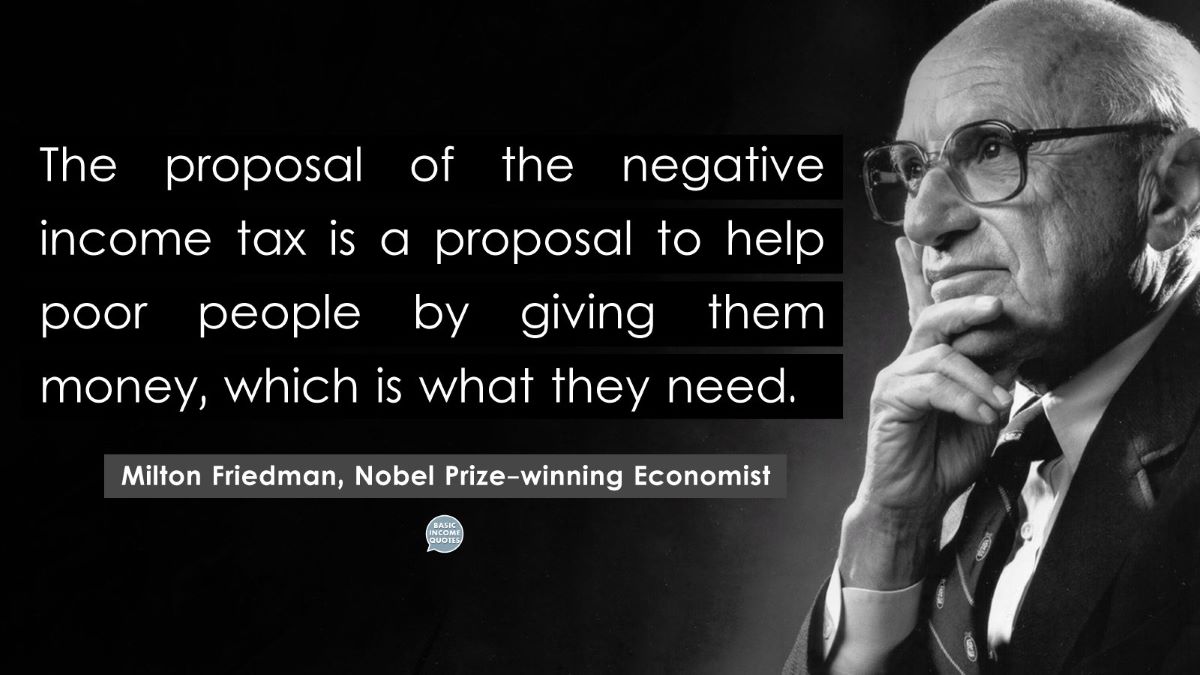
Negative Income Tax is an alternative to the Universal Basic Income, and reverses the direction in which tax is paid for incomes below a certain level.
It provides that wage earners above a certain level of income pay tax, while those below that level receive support from the government.
As a grossly over-simplified example, the first $100 of income per week could be taxed at -50%, meaning the government would pay you an extra $50 on top of your wage if you earned the full $100.
The next $100 at could be taxed at -30%, meaning you would receive $80 from the government if you earned the full $200. The next $100 could be taxed at -10% which would mean you would get $90 if you earned the full $300.
After that, as an example, income over $300 would attract zero tax, income over $400 15% tax, income over $500 25% tax and so on.
Tax rates on higher income earners over a certain amount would need to be higher to offset the negative tax rates, but these earners would have that offset in part by the negative rates on the first $300 of their earnings.
Of course, these are fantasy figures, and are used purely to illustrate how the system would work. I will leave it to the economists to work out the tax rates and income levels for each rate.
The greatest benefit of such a tax system is that it would provide an incentive for low income earners to work, which in turn improves the nation’s economy.
It also addresses the wage gap, in that high income earners would be taxed more, with the money going to low income earners.
Centrelink benefits would remain available for zero income earners, and the current income tests would still apply.
Using the fantasy figures above, this would mean that somebody on Jobseeker earning $100 a week would lose $12.50 from their payment under Centrelink’s rules, but would receive a $50 payment from the tax office. Obviously, this provides a greater incentive to work.
The idea of negative income tax was first proposed in the early 1940s by Juliet Rhys-Williams, while she was working the Beveridge Report in the United Kingdom.
It was popularised by Nobel Prize winning economist Milton Friedman in the 1960s, and counted President Richard Nixon as one if it’s greatest supporters.
A limited version was introduced in the US in 1975, and a survey in 1995 found that 78% of American economists were in favour of it being introduced on a larger scale.
A negative income tax would be much cheaper to implement than a universal basic income, and studies in the US found it would only amount to an increase in spending of about 1.5% of GDP.
The closest we have come to introducing it in Australia was the tax credits (franking credits) introduced by the LNP government in 2015, but this only benefits shareholders and the very wealthy.
In the current Australian political climate, it is unlikely that such a system would be introduced, for the same reason it wasn’t introduced on a larger scale in America. It would mean higher taxes for the wealthy, and they are the ones that donate to political parties.
If only we had a government that was as interested in low income earners as they are in high income donors.
Craig Hill is a Brisbane-based Social Justice Campaigner, Writer, Teacher and Business Consultant. He has campaigned for social justice in Australia, promoted human rights in China and worked with the homeless in Honolulu. He holds a Graduate Certificate in Business, a Graduate Certificate in Education and a degree in Management. He is also the General Manager of The Australian Business and Leadership School.
If you liked this article, please click “Subscribe To My Blog” in the sidebar to receive an email each time a new article is published.
Visit the Australian Book and Language Studio
Discover more from Craig Hill
Subscribe to get the latest posts sent to your email.
 Craig Hill
It is a wrong policy and only encourage the companies’ leaders to rely on the government to compensate workers for under paid work. Pay people a decent wage is what needs to be done. Stop tax unfair concession! Handing out money is a humiliating act unless the person is in real need due to special circumstances such as a disability, sickness or retirement.