

.
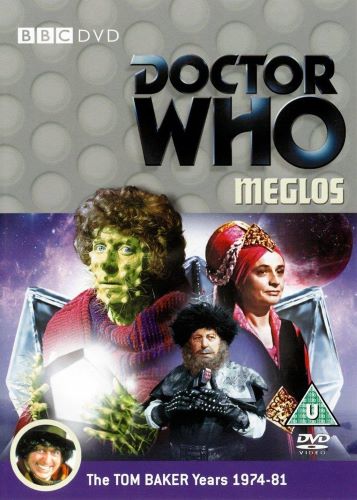
Meglos is the second serial of Doctor Who Season 18, first broadcast in four episodes from September 27 to October 18, 1980. It was written by John Flanagan and Andrew McCulloch and directed by Terence Dudley. It stars Tom Baker as the Fourth Doctor, Lalla Ward as Romana, John Leeson as the voice of K9, Jacqueline Hill as Lexa, and Bill Fraser as General Grugger.
The TARDIS arrives on Tigella, where the city’s life-giving Dodecahedron has turned a debate between science-savants and religious Deons into a crisis. On the dead world Zolfa-Thura, a cactus creature called Meglos copies the Doctor’s form and plots to steal the power source with help from space raiders.
Episode One
On the jungle world Tigella, leader Zastor begs an old friend, the Doctor, for help. Deep below the roots, the Tigellans’ city depends on the Dodecahedron, a living power source that now surges and falters. Two factions glare across its glow: Savants, who measure and repair, and Deons, led by high priestess Lexa, who guard it as a sacred gift.
The Doctor and Romana set course: but in the dead deserts of nearby Zolfa-Thura a sentient cactus called Meglos awakens old war machines and hires Gaztak raiders under General Grugger. Meglos needs a humanoid host for shape (an unlucky Earthman is dragged across space) and a perfect disguise. He traps the TARDIS in a repeating “chronic hysteresis” time loop, then imprints the Doctor’s face onto his captive and strides for Tigella.
In the under-city, Zastor’s welcome collides with Lexa’s suspicion and the Savants’ impatience. “The Doctor” asks for private access to the Dodecahedron to “stabilise” it, his fingers twitching with tiny green spines whenever the host resists. In the steaming forest, K9 bogs down in creepers while the real Doctor and Romana realise they are living the same moments again and again. They swap a line, shift a step, and crack the loop. By the time they reach the city, their double is already inside.
Episode Two
Meglos, wearing the Doctor’s grin, flatters the Savants, quotes equations, and talks Lexa past her rites. The city’s guards escort him to the Dodecahedron’s shrine; he lays a palm on its facets and murmurs to it like an old accomplice. With a neat device he shrinks the crystal to a hand-sized jewel and pockets it while alarms cry “stabilisation.”
Outside, the true Doctor and Romana fight through bright leaves, dodge Gaztaks, and drop into Tigella’s lift: straight into Deon spears. Lexa triumphs: the impostor within, the heretic without. Savant Caris and her mentor Deedrix, unsettled by two Doctors, hide their doubts. In a storehouse, Meglos’s host falters and cactus barbs bud from “the Doctor’s” skin; Grugger slaps on ointment and hustles his prize out. Power fails. The city groans.
Lexa orders the strangers bound for punishment; Romana slips knots and runs; the Doctor plays for time with Zastor, pointing to ritual bruises around the truth. In the jungle, K9 finally crawls free and picks up the Gaztaks’ trail. A Gaztak patrol blunders into the city, guns blazing; chaos wrecks Lexa’s tribunal. In the smoke, Meglos and Grugger flee with the Dodecahedron toward Zolfa-Thura’s ancient “power screens,” and the Doctor understands what such a crystal could drive.
Episode Three
With their heart torn out, Tigella’s systems die. Zastor evacuates his people up to the choking, luminous forest the Deons have always feared; Savants, humbled, follow. Lexa clings to ceremony and seizes Romana for a blood sacrifice to “Ti” to appease the loss. At the altar, her knife lifts. Then fate intervenes: a panicked Gaztak bursts in, fires wild, and Lexa falls, shocked as anyone by the godless end of certainty.
On Zolfa-Thura, Meglos slots the Dodecahedron into the hub of five black towers and brings the planet-killer online, promising Grugger riches for a world-spanning demonstration shot. The Earthling host fights; cactus spikes erupt along Meglos’s borrowed cheek. Deedrix and Caris piece the story together from duplicate sightings and choose reason over creed; they shepherd refugees while the Doctor raids an old Zolfa armoury for history.
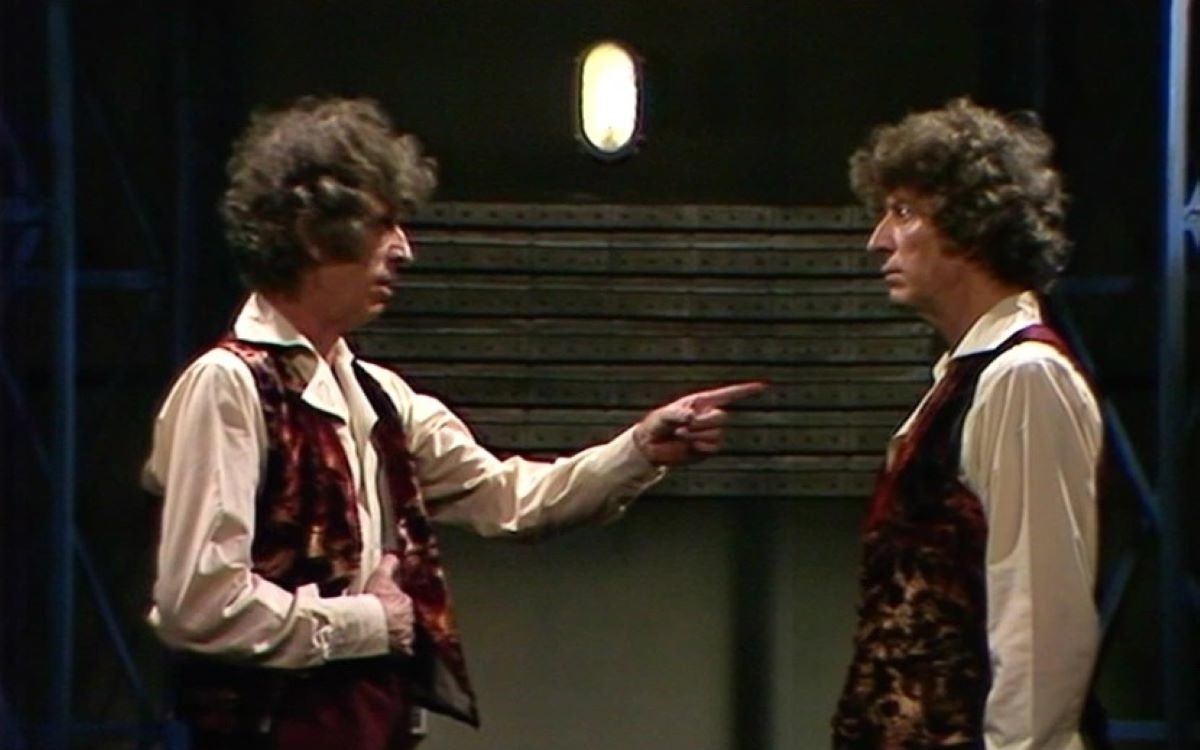
He and Romana race the TARDIS to the desert. The power screens hum; geometric shadows slide across the sand. Brotadac, Grugger’s preening lieutenant, fondles the Doctor’s stolen coat like a trophy. Meglos, all velvet menace, targets Tigella. The Doctor walks into the glare, meets his own face in thorny parody, and starts swapping cables. If the screens can focus death outward, they can also be made to look back at themselves.
Episode Four
On the firing ground, two Doctors circle: one with barbs beneath the skin, one with a coil of leads and a plan. Romana hacks the control pedestal while K9 keeps Gaztaks ducking with tidy bursts. Grugger bayonets patience and slams the fire command. The screens flare: then crosslink. The beam folds, ricochets, and turns inward. Consoles scream.
Meglos’s human host wrenches free; the stolen face slips; the cactus mind retracts to its pot-bound original, hissing as dust whips across the plain. The Doctor flips the last interlock and dives for cover with Romana. Zolfa-Thura’s towers ignite; the weapon consumes itself in a column of light. Grugger and Brotadac don’t escape the blast; the Earthling staggers, alive and bewildered, freed of spines.
On Tigella, refugees watch a distant star brighten and die. The Dodecahedron is gone forever; without it, both faith and science must make something new together on the surface. Zastor nods thanks that is also a promise to change. Caris and Deedrix sketch power rations on bark. The Deons lower banners and begin to listen. In the TARDIS, the Doctor returns the Earthling to his doorway and one ordinary day. Somewhere far behind, on a dead world’s sand, a small, furious cactus sits alone under a cooling sky.
Themes
As a cool, idea-led curio between harder-edged bookends, Meglos plays like a puzzle box of doubles and dogma: cactus possession, a stolen identity, and a planet torn between Savants and Deons. It doesn’t reach the icy precision of The Leisure Hive or the layered resonance of the E-Space high point in Warriors’ Gate, and it sits a shade beneath the gothic sweep of State of Decay and the autumnal grace of The Keeper of Traken.
Yet its brisk caper energy, the sly “chronic hysteresis” gag, and Romana/K9’s cool teamwork lift it well above wobblier fare like Underworld and the pantomime edges of The Horns of Nimon. In the season’s ledger, it lands as mid-tier with bright spikes: clever conceits, uneven surfaces, memorable moments.
Continuity-wise, the threads are quietly rich. The science-versus-ritual conflict echoes The Face of Evil, The Stones of Blood, and Image of the Fendahl, while the doppelgänger games glance back to The Android Invasion, Terror of the Zygons, and even the mirror-play of The Enemy of the World. The time-loop trick nods toward The Claws of Axos, and the civilisation-powered-by-artifact motif faintly recalls the Key to Time season.
Most touchingly, Jacqueline Hill’s return as Lexa folds the programme back to its beginnings in An Unearthly Child and The Aztecs. As a bridge, Meglos carries the cooler reset of The Leisure Hive into the E-Space corridor of Full Circle, State of Decay, and Warriors’ Gate, before the path bends toward The Keeper of Traken and Logopolis. By its final beat, the serial has done its job: a tidy hinge where identity, belief, and consequence click into place and point the way forward.
.
To view the list of other Doctor Who serials, please click this link
Doctor Who Episode Guides for Sale on Amazon
Step aboard the TARDIS and journey across the universe with every incarnation of The Doctor in this series of unofficial Doctor Who episode companions.
This collection of twelve books explores every televised adventure of the Time Lord’s lives.
Each volume in the series delves into a different Doctor’s era, offering detailed episode guides, behind-the-scenes insights, character profiles, and story synopses.
Once you have clicked the link, choose which book you want, and then whether you want to buy the Kindle (eBook) or Paperback versions.
Previews are available before you buy.

Visit the Australian Book and Language Studio
Discover more from Craig Hill
Subscribe to get the latest posts sent to your email.

