

.
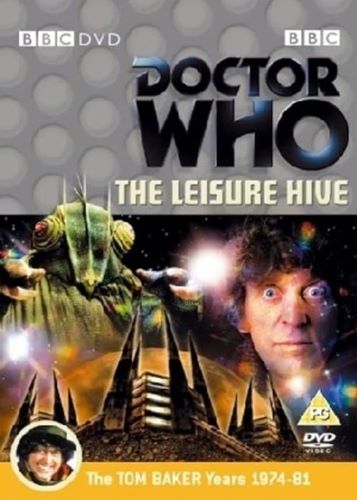
The Leisure Hive is the first serial of Doctor Who Season 18. It was broadcast in four episodes from August 30 to September 20, 1980. It was written by David Fisher and directed by Lovett Bickford. It stars Tom Baker as the Fourth Doctor, Lalla Ward as Romana, John Leeson as the voice of K9, Adrienne Corri as Mena, and David Haig as Pangol.
The TARDIS arrives on the planet Argolis at a tourist complex built after a bitter war with the Foamasi, where a tachyonic generator promises bold science but hides danger. A business deal turns to sabotage, the Doctor is aged to a frail old man, and Pangol dreams of raising a new army from the machine. As secrets, disguises, and rival plans collide, the Doctor and Romana expose the plot, prevent disaster, and help the Argolins find a peaceful future for their hive.
Episode One
Brighton in off-season is all windbreaks and sulks. K9 chases a ball into the sea, sparks, and dies with a polite fizz. The Doctor shrugs on a new holiday and steers the TARDIS to the Leisure Hive on Argolis: part theme park, part memorial, built by a people rendered sterile after a short, ruinous war with the Foamasi.
Chairwoman Mena keeps the books balanced and the peace brittle; her son Pangol seethes for lost glory. An Earth financier, Brock, pushes a hard bargain while his silent aide Klout hovers like a knife. Human physicist Hardin demonstrates a “tachyon recreation” experiment that promises to reverse age itself. His test looks flawless: because he fakes it to keep his grant alive. Romana spots the flaws, offers help, and the machine begins to work for real.
Meanwhile Stimson, a nervous clerk, pokes where he shouldn’t and glimpses Brock and Klout unzip their human skins. There is something scaled underneath; he dies for it in a corridor that suddenly isn’t empty. The Doctor, sniffing at the Hive’s main generator, volunteers for a diagnostic run to prove the system safe. He steps into the chamber as Pangol prowls the gallery and Mena weakens. The field surges. Limbs fly on the scan, a grotesque stroboscope. Romana screams: and the Doctor is torn apart.
Episode Two
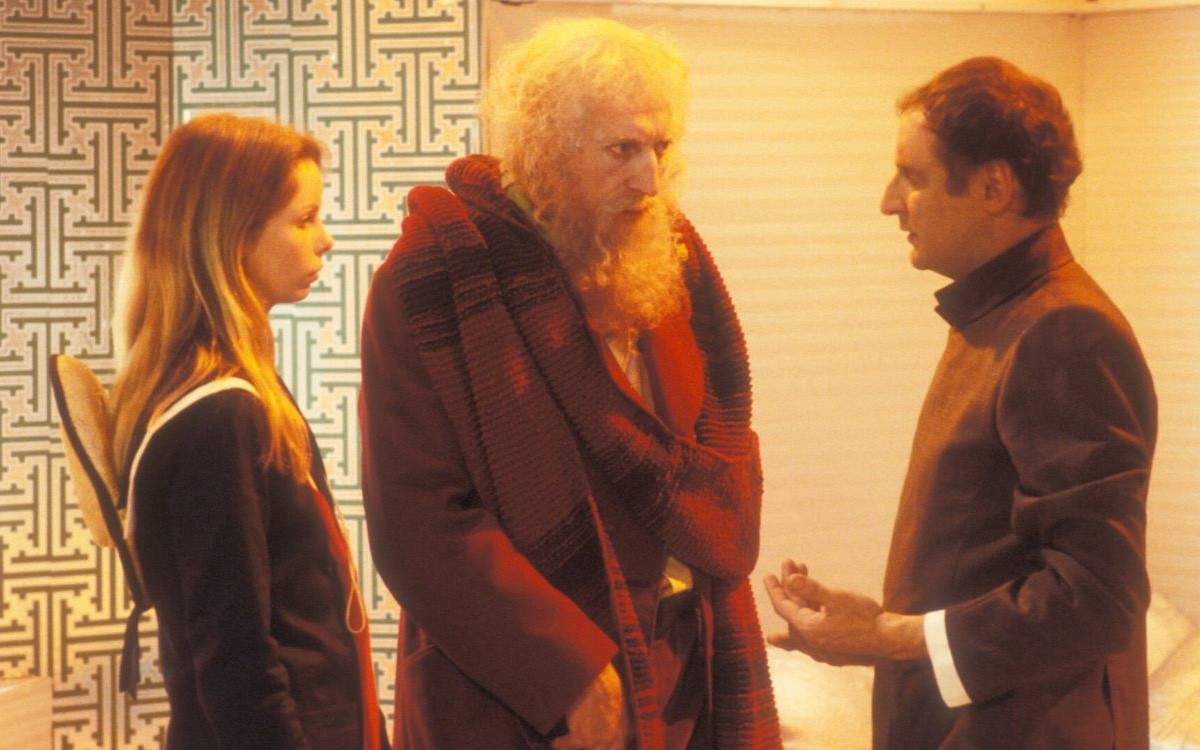
The image resolves into a different horror: the chamber spits the Doctor out whole but shockingly ancient: hair white, hands trembling, eyes still bright. Hardin, shamed, admits the fakery; with Romana’s equations he can now do the thing for real, if they dare.
Mena’s life monitor ticks down. Brock presses for a sale of the Hive while “accidents” mount; Stimson’s disappearance is papered over. Pangol dons a ceremonial helm and talks of armies, of rebuilding Argolis by force with the very machine that reversed the Doctor: what if it can also duplicate? Security tapes show Stimson pursued by a shape that isn’t in the log. Romana recalibrates the tachyon lattice; a small trial restores a flower from dust. Hope flares. The Doctor lopes on, wry inside a wrecked body, and asks for a full reversal: later.
First, he needs proof of what hides behind Brock’s grin. Klout shadows corridors where doors open a heartbeat too early, as if warned. In the demonstration hall, Pangol hijacks the microphones and whips guests into a patriotic mood. Hardin’s next test misfires under a subtle sabotage; a technician vanishes. The old Doctor leans on a rail, murmurs that predators love a crowded place, and watches Brock’s reflection move a fraction before Brock does. In the generator room, someone sets the dials for war.
Episode Three
A Foamasi ship answers a distress code no one at the Hive admits to sending. Armoured, blunt-fingered investigators stride out and smell crime; when they corner Brock and Klout, human faces peel like gloves to reveal West Lodge smugglers: criminals of their species, not diplomats. Panic ripples through the Hive.
Pangol seizes the moment, declares the Leisure era finished, and orders the tachyon recreation generator for “military application.” He is the only Argolin born since the war (the last, the loudest) and he means to copy himself by the thousand. Mena sways with fever; Hardin’s hands shake over the controls; Romana slams in a stabiliser and the Doctor, still elderly, smiles approval through aching joints. The Foamasi expose forged contracts and a staged bankruptcy meant to force Argolis into sale. West Lodge claws for escape; the Doctor herds them with wit and K9 with laser economy.
Pangol locks the main hall and bans evacuation. He preps the machine with his own pattern seed, watching his youthful face in the mirror of the chamber door with a fanatic’s tenderness. In a quiet aside, Mena tells the Doctor a truth he’d guessed: Pangol was born from the generator, not a womb. The Doctor’s eyes flick to the seed matrix. If Pangol is a product of the machine, then perhaps the machine can unmake his plan.
Episode Four
Tachyon relays hum like bees as Pangol throws the master lever. The Doctor, limping, has already switched pattern leads; the first ranks that march from the chamber are the Doctor: copies in scarf and floppy hat, jaunty as toy soldiers. Pangol’s triumph curdles to fury. He resets, screams for his army; the Doctor slips inside the loop and forces the field through one last inversion.
On the balcony, Foamasi officers clap West Lodge in cuffs; the fake Brock’s dealings dissolve in confiscated ledgers. Hardin steadies Mena on the dais as the Doctor, gaunt and grinning, steps back into the chamber at Romana’s nod. The lattice sings. Age runs backward along his bones; he spills out young again, hair dark, energy back. Pangol, caught in the reflected field, reels and tumbles into the generator’s heart. When the glow fades, a child cries.
Romana lifts a newborn, all golden ridges and tiny fists. Mena gathers him, eyes wet; the last son becomes the first of a gentler future. Foamasi investigators stand down; trade reopens without blackmail. The Leisure Hive, no longer a carnival over a grave, becomes a house of therapy and science. K9 is fished from a drying room, still sulking about seawater. The Doctor tips Mena a bow, tucks the broken contract into Brock’s empty briefcase, and takes Romana back to Brighton for a proper holiday.
Themes
As a crisp reset for a new season, The Leisure Hive trades the Adams-era jauntiness for cool precision: harder science, stranger ethics, and a Doctor played with chilly wit. It doesn’t reach the urbane clockwork of City of Death or the jewelled perfection of The Robots of Death, and it’s a shade under the mythic voltage of Pyramids of Mars.
However, it’s markedly stronger and more purposeful than lighter neighbours like The Creature from the Pit and The Horns of Nimon. In the era’s ledger it lands upper-mid-tier: elegant, assured, and quietly audacious, announcing that the programme is steering into sterner waters without losing its spark.
Continuity-wise, the seams are tidy and telling. Coming off the wandering afterglow of The Armageddon Factor and the Parisian sparkle of City of Death, this opener re-keys the Doctor–Romana–K9 dynamic and sets a cooler vector for the season: from Argolis to Meglos, then into the E-Space corridor of Full Circle, State of Decay, and Warriors’ Gate, before the reckoning of The Keeper of Traken and the mathematical brinkmanship of Logopolis.
Its obsessions (aging, duplication, and time twisted by technology) look back to chamber nightmares like The Ark in Space and forward to the entropy meditations that will define the year. By its final fade, The Leisure Hive has done more than start a season; it has reset the compass, pointing the programme toward a colder, cleaner, and intriguingly perilous horizon.
.
To view the list of other Doctor Who serials, please click this link
Doctor Who Episode Guides for Sale on Amazon
Step aboard the TARDIS and journey across the universe with every incarnation of The Doctor in this series of unofficial Doctor Who episode companions.
This collection of twelve books explores every televised adventure of the Time Lord’s lives.
Each volume in the series delves into a different Doctor’s era, offering detailed episode guides, behind-the-scenes insights, character profiles, and story synopses.
Once you have clicked the link, choose which book you want, and then whether you want to buy the Kindle (eBook) or Paperback versions.
Previews are available before you buy.

Visit the Australian Book and Language Studio
Discover more from Craig Hill
Subscribe to get the latest posts sent to your email.
 Craig Hill