

.
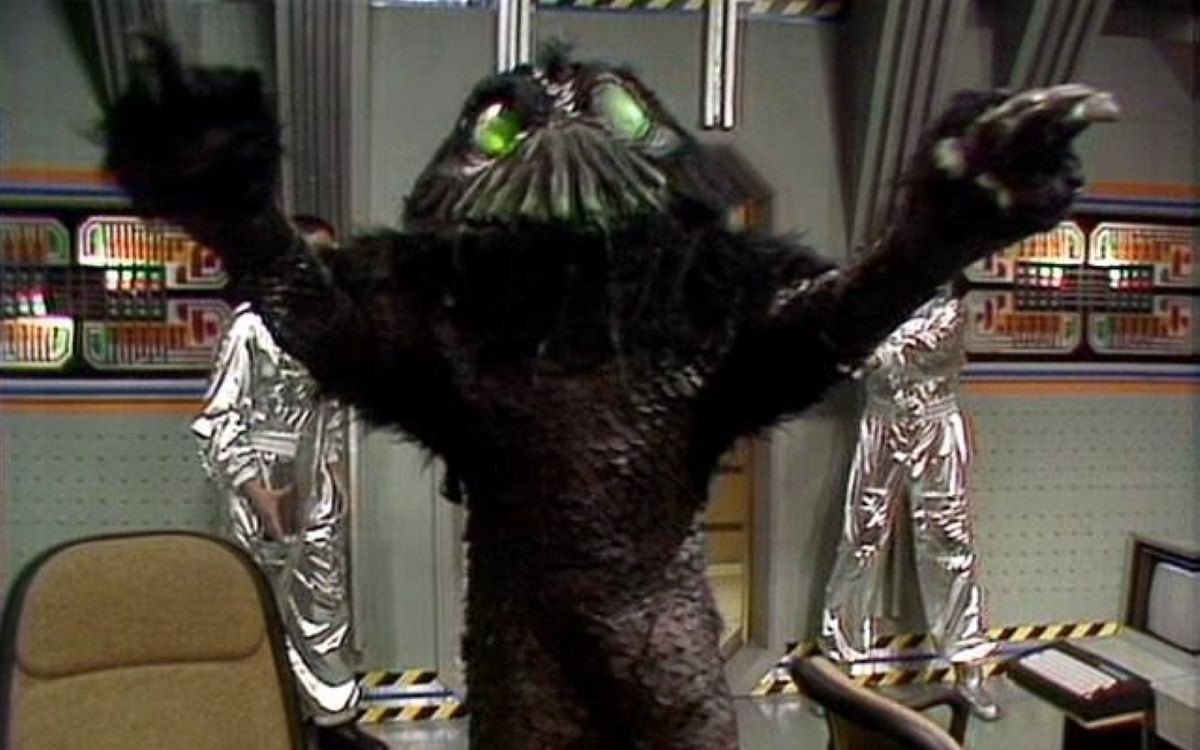
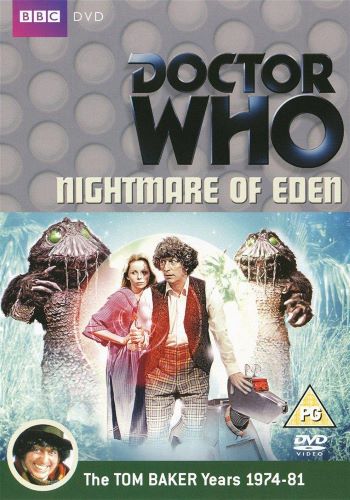
Nightmare of Eden is the fourth serial of Doctor Who Season 17, originally broadcast in four episodes from Nightmare of Eden: 24 November to 15 December 1979. It was written by Bob Baker and directed by Alan Bromly. It stars Tom Baker as the Fourth Doctor, Lalla Ward as Romana, David Brierley as the voice of K9, Lewis Fiander as Professor Tryst, David Daker as Captain Rigg, and Jennifer Lonsdale as Della.
The Doctor and Romana arrive on the starliner Empress just after it fuses with another ship in hyperspace, causing strange distortions and fear among the passengers. Tryst’s CET machine (full of recorded environments, including the world Eden) hides a dangerous secret, while clawed Mandrels prowl the corridors and the lethal drug vraxoin appears. With calm logic and quick action, the Doctor, Romana, and K9 uncover a smuggling scheme, separate the ships, and return the creatures to their proper habitat, turning
Episode One
Two starliners (luxury Empress and the freighter Hecate) try to pass in hyperspace and partially fuse. Bulkheads bloom into each other, doors open onto the wrong ship, and panic ripples through lounges full of tourists. The Doctor, Romana, and K9 answer the mayday and start teasing the tangled dimensions apart.
Captain Rigg blusters while a jumpy first officer sneaks off to “check the navigation” and instead snorts a pinch of glittering powder. Interstellar Customs (Fisk and Costa) arrive hunting a narcotic called vraxoin. Meanwhile Professor Tryst unveils his pride and joy: the CET (Continuous Event Transmuter), a projection cabinet that “stores” entire ecosystems as living images inside crystals. One habitat, labelled EDEN, pulses with jungle light and shadow.
Romana calls the device unethical; Tryst breezily calls it conservation. In the confused corridors, something claws a crewman; he staggers away with blackened wounds and dies. K9 traces a distorting field linking the fused ships to Tryst’s cabinet. The Doctor suspects more than an accident brought the Empress into collision. A private shuttle from the Hecate docks, its pilot, Dymond, speaking very fast about “assistance.” In the lounge a waiter tops up Rigg’s drink; moments later the captain smiles a little too calmly, and the Doctor smells a trap sweet as flowers.
Episode Two
The Doctor steps into the CET’s Eden projection, a humid thicket that feels too real to be a mere picture. Something massive rustles; a clawed silhouette slides between trees. He finds a name carved in a rock (STOTT), evidence of a “dead” surveyor. Outside, Romana works with engineers to detune the interlock between ships; every adjustment makes the corridors ripple.
Customs men sniff around Tryst and Dymond; both are terribly helpful. Rigg grows mellow, then erratic, eyes glittering from the vraxoin slipped into his drink. A crewman addicted to the powder collapses in machinery, and alarms shriek. In the Eden jungle, mandrels (hulking, furred beasts with lamp-glow eyes) close on the Doctor, then recoil as if pushed back by an invisible tide. He tumbles out of the projection with a torn sleeve just as the Empress lurches and the image spills: a mandrel steps through into the corridor, roaring.
Tryst fumbles controls, claiming the cabinet was damaged in the crash. Dymond presses for a quick separation and departure. The Doctor examines residue from a mandrel’s wound; the smell jolts him. He cannot place it: yet. In a shuttle locker, Romana finds odd couplings that don’t belong to passenger craft at all, and K9 quietly records a jamming frequency that keeps spiking whenever the ships try to unfuse.
Episode Three
Mandrels rampage through the passenger decks, smashing glass and sending gamblers screaming; force screens fail and corridor lights strobe. The Doctor herds civilians behind sealed doors and studies a fried mandrel hair under a field lens as a security team discharges high-voltage weapons nearby. The dead creature decays to a glittering dust.
The scent makes sense at last: vraxoin. The monsters are the source: burn or shock them and they break down into the drug. Tryst’s conservation suddenly smells like commerce. In a maintenance bay, a bandaged man steps from the shadows: Stott, alive, an undercover agent tracking a smuggling ring. He points squarely at Tryst and Dymond. The crash, he says, wasn’t an accident; a jamming beam forced the Empress off course while the smugglers hid shipments inside the CET “zoos.” Romana and K9 triangulate the beam’s origin to Dymond’s shuttle.
Rigg, sweating and euphoric, waves off evacuation orders and wanders toward the casino, where a mandrel knocks him sprawling; he does not get up again. Customs try a raid; Dymond’s men stun them and wheel the CET toward the loading bay. The Doctor rigs a low-frequency lure to draw the mandrels back into the Eden projection and buys a little breathing space. Somewhere in the fused architecture, couplings thrum: the thieves are about to make off with a whole jungle.
Episode Four
With separation finally possible, Dymond powers his shuttle, CET bolted inside, and blasts free: smugglers and evidence gone in one lift-off. The Doctor jury-rigs a remote link through the Empress’s battered systems and orders K9 to “talk” to the CET. Tryst, cornered by Customs and trembling with self-pity, calls it a noble act gone wrong; the Doctor calls it murder with footnotes.
On radar, the shuttle slews for deep space. The Doctor floods the CET with a counter-frequency; Eden flickers, the cabinet hums: and the shuttle shimmers, caught. In the viewport, Dymond and Tryst stare as their cockpit dissolves around them and locks into a crystalline vista: they are “archived,” miniaturised inside the very exhibit they used for smuggling. Customs recover the cabinet with a winch and, following the Doctor’s instructions, restore the other captured habitats to their home worlds.
The last mandrels, lured by K9’s tone, pad back into Eden; the Doctor snaps the switch and the images fall still. The Empress and Hecate ease apart; bruised passengers cheer. Fisk and Costa nod thanks and prepare a neat, legal arrest. In the quiet after alarms, Romana slots the tracer beside the Eden crystal and shakes her head at the ways greed rewrites science. The Doctor pockets a sticky playing chip, grins at K9, and steers the TARDIS for somewhere without casinos: or claws.
Themes
As a collision of pulp sci-fi and sharp social commentary, Nightmare of Eden is clever, scrappy, and more pointed than its reputation suggests. The CET machine’s “worlds in a box,” the drug racket’s grim logic, and Tom Baker/Romana’s brisk teamwork give it teeth, even when production seams show. It can’t touch the urbane clockwork of City of Death or the jewelled precision of The Robots of Death, and it’s a shade less elegant than The Androids of Tara or The Stones of Blood.
Yet it’s stronger and more cohesive than the baggier stretches of The Horns of Nimon and more focused than The Creature from the Pit. In the era’s ledger, it lands mid-tier with flashes of upper-tier invention: conceptually rich, tonally Adams-lite, occasionally undone by Mandrel fluff.
Continuity threads bind it neatly to the programme’s long memory and near future. The CET machine’s miniature ecosystems echo the showman’s cabinet of Carnival of Monsters, while the parasite-and-possession lineage runs back through The Ark in Space and forward to darker drug tragedies in The Caves of Androzani.
Economies turned predatory recall the corporate bite of The Sun Makers, and the Randomiser era begun after The Armageddon Factor still frames the team’s wanderings from Destiny of the Daleks and City of Death to the season’s coda in The Horns of Nimon. By the final shutdown, Nightmare of Eden has done more than trap monsters in a frame: it has fused a cautionary fable to a romp, closing one of the era’s strangest, sharpest detours with wry conviction.
.
To view the list of other Doctor Who serials, please click this link
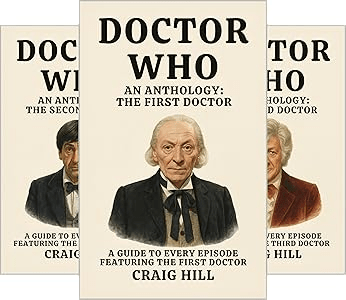
Doctor Who Episode Guides for Sale on Amazon
Step aboard the TARDIS and journey across the universe with every incarnation of The Doctor in this series of unofficial Doctor Who episode companions.
This collection of twelve books explores every televised adventure of the Time Lord’s lives.
Each volume in the series delves into a different Doctor’s era, offering detailed episode guides, behind-the-scenes insights, character profiles, and story synopses.
Once you have clicked the link, choose which book you want, and then whether you want to buy the Kindle (eBook) or Paperback versions.
Previews are available before you buy.
Visit the Australian Book and Language Studio
Discover more from Craig Hill
Subscribe to get the latest posts sent to your email.
 Craig Hill