

.
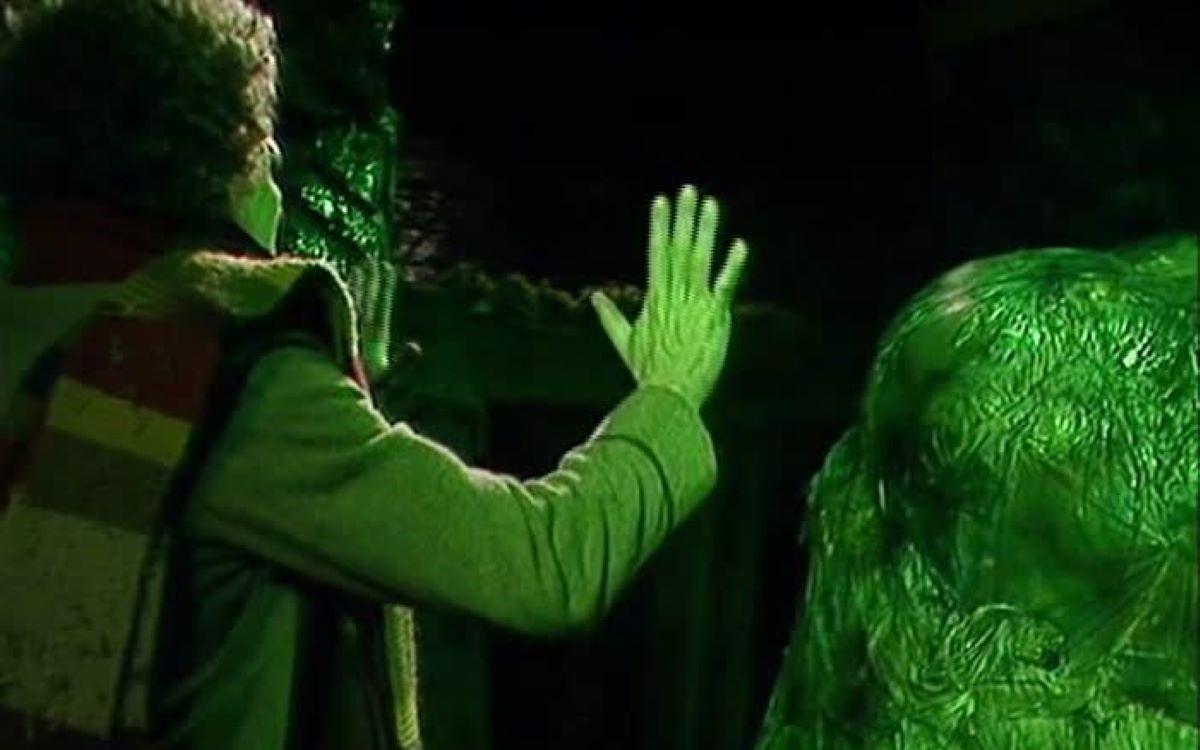
The Creature from the Pit is the third serial of Doctor Who Season 17. It was broadcast in four episodes from October 27 to November 17, 1979. It was written by David Fisher and directed by Christopher Barry. It stars Tom Baker as the Fourth Doctor, Lalla Ward as Romana, David Brierley as the voice of K9, Myra Frances as Lady Adrasta, and Geoffrey Bayldon as Organon.
The TARDIS lands on Chloris, a lush world short of metal and ruled by Adrasta, who keeps power through fear of a deep pit and the “monster” within. The Doctor and Romana discover the creature is Erato, an alien ambassador trapped to protect Adrasta’s monopoly, and that a trade offer has been twisted into a threat. With quick wit, courage, and help from K9, the Doctor exposes the truth, ends a cruel rule, and turns a fearsome pit into a path toward peace and fair exchange.
Episode One
The TARDIS drops into a steamy jungle on Chloris, a world bursting with plants and starving for metal. Vines twitch; wolfweeds (rolling, strangling tumbleweeds) try to smother Romana until K9 scorches them off. The Huntsman and his men arrive with nets and lead the travellers to Lady Adrasta, the iron ruler who hoards every scrap of metal and feeds her enemies to “the Creature” in a sheer-walled pit.
Adrasta’s elegant lieutenant Karela weighs every word and watches every pocket. The Doctor’s jokes earn him a sentence; he is marched to the pit at the edge of a ruined palace while a chanting crowd edges close to see another sacrifice. Far away in the reeds, a ragged band of metal-thieves celebrates a haul: a smooth, heavy “egg” they have dragged from the jungle, too perfect to be natural and too dense to cut.
Romana is seized by the bandits and bargains with bright impatience. Below ground, the Doctor falls into darkness, lands in bones and damp, and hears something vast sigh in the black. A tentacle as thick as a tree root slides over stone and pauses as if listening. A voice answers from deeper shadow: Organon, court astrologer once, prisoner now, who says kindly, “You’ll get used to it.”
Episode Two
By lamplight among skulls, Organon tells the story: Adrasta keeps power by owning metal and feeding fear. The Creature’s tentacles, testing not killing, nudge the Doctor toward a tunnel rather than the drop; he files that away: this isn’t a mindless beast. Up top, the bandits bicker over the egg, dreaming of a throne bought in ingots.
Karela tracks them with quiet relish; Adrasta wants the prize back before anyone understands it. Romana parries the bandits’ threats with knowledge and a little help from K9, who arrives with neat beams and an opinionated bark. Guards clash with thieves in the jungle; wolfweeds roll like living nets. In the pit the Doctor improvises a rope from tatters, hauls Organon toward a chink of daylight, and glimpses a sheen of metal webbed into the Creature’s lair: filament drawn like wire.
Back in Adrasta’s court, the Doctor confronts her with a simple truth about scarcity turned into law; she smiles and orders him returned to the edge. The “egg” is dragged into the palace and cracks under a probe to reveal not treasure but machinery: a translator sphere and delicate circuits. The Doctor’s face lights. “Not a monster,” he says softly, “an ambassador.” A shadow falls across the door. Karela’s voice: “Seal the chamber.”
Episode Three
The Doctor powers the sphere with pilfered cells and coaxes sound from it. The pit roars; the tentacles weave; a voice blooms at last: measured, mournful, intelligent. The Creature names itself Erato of Tythonus, a methane-breather who came to bargain: Chloris’s endless chlorophyll for Tythonian metal.
Adrasta imprisoned him to keep her monopoly, dumped victims to feed rumours, and ordered the translator buried. The hall splits: Huntsman shocked, Karela expressionless, Adrasta furious at daylight poured on her rule. She tries to stab the Doctor and is seized by Erato’s living cable, crushed in a single, terrible second. Karela rallies the guards; the bandits bolt with the sphere and are boxed in by wolfweeds. Romana and K9 drag the translator back to the pit mouth; Erato, weakened but clear, adds a final warning: his people, believing their envoy murdered, have set a neutron star on a collision course with Chloris.
The Doctor stares upward, already hearing the sums. They have hours. He needs Erato’s wire-drawing talent and the refinery’s generators, and he needs everyone (Huntsman, thieves, freed labourers) to stop being enemies long enough to build a sky-sized tool. Karela watches the shifting loyalties and quietly chooses survival. Organon, dusting his robes, volunteers to shout orders.
Episode Four
Chloris holds its breath as the plan takes shape. Erato extrudes gleaming filament in shimmering skeins; the Doctor and Romana rig it to the refinery pylons, K9 juggling stress calculations and timing. The “web” becomes a tether; the TARDIS will carry its far end into space and snag the oncoming star just enough to slingshot it clear.
The Huntsman drives crews with crisp calls; bandits labour for once without skimming; Karela tries a last-minute grab for power and is bundled off by wolfweeds that answer a whistle. In orbit, the TARDIS streaks toward a livid point that swallows starlight. The tether hums; the console shudders; the Doctor grins through clenched teeth as forces try to peel the ship apart. On the marsh below, Erato sings a counter-tone and takes the strain.
The star twitches, slides on a new vector, and races into deep night. Chloris lives. In the calm that follows, the Doctor draws up a trade pact on the back of Organon’s horoscopes: metal for chlorophyll, with neither monopoly nor sacrifice. Erato bows and sinks into the pit that is no longer a prison but a port. The Huntsman smiles at a future with tools. K9 declares the wolfweeds “efficient.” The TARDIS fades between green leaves and new promises.
Themes
As a jungle-bound fairy tale of diplomacy and scarcity, The Creature from the Pit is amiable, uneven, and slyer than its reputation suggests. David Fisher’s story, filtered through Adams-era levity, gives us Adrasta’s cartel, Organon’s patter, and a “monster” that is really an envoy. It never approaches the urbane clockwork of City of Death, the jewelled precision of The Robots of Death, or the moral thunder of Genesis of the Daleks, and it sits below the elegant bite of The Stones of Blood and The Androids of Tara.
Yet it’s warmer and more coherent than the baggier stretches of The Horns of Nimon and less wayward than The Power of Kroll. In the season’s ledger, it lands mid-to-lower-mid tier: a patchy romp brightened by Tom Baker and Romana’s poise, K9’s dry asides, and a central idea with real heart.
It also links the programme’s past and future with tidy seams. The Randomiser fitted at the end of The Armageddon Factor and carried through Destiny of the Daleks and City of Death tosses the TARDIS onto Chloris; from there, its “monster as envoy” turn converses with earlier diplomatic parables like The Curse of Peladon and the misunderstood-terror beats of The Silurians.
Its economics (monopoly, scarcity, and the price of fear) echo The Sun Makers and foreshadow the narcotics morality play of Nightmare of Eden, while the lighter, theatrical tone points toward the operatic camp of The Horns of Nimon. By its closing accord, The Creature from the Pit has done its quiet work: it turns a joke about a monster into a fable about trade, trust, and the kind of peace this era keeps trying to make.

.
To view the list of other Doctor Who serials, please click this link
Doctor Who Episode Guides for Sale on Amazon
Step aboard the TARDIS and journey across the universe with every incarnation of The Doctor in this series of unofficial Doctor Who episode companions.
This collection of twelve books explores every televised adventure of the Time Lord’s lives.
Each volume in the series delves into a different Doctor’s era, offering detailed episode guides, behind-the-scenes insights, character profiles, and story synopses.
Once you have clicked the link, choose which book you want, and then whether you want to buy the Kindle (eBook) or Paperback versions.
Previews are available before you buy.

Visit the Australian Book and Language Studio
Discover more from Craig Hill
Subscribe to get the latest posts sent to your email.

