


.
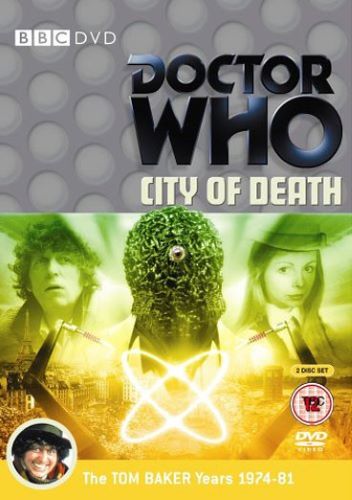
City of Death is the second serial of Doctor Who Season 17. It was first broadcast in four episodes from September 29 to October 20, 1979. It was written by David Agnew and directed by Michael Hayes. The script was officially credited to David Agnew, a pseudonym for Douglas Adams (script editor), Graham Williams (producer), and David Fisher, who contributed the original story. It stars Tom Baker as the Fourth Doctor, Lalla Ward as Romana, Julian Glover as Count Scarlioni/Scaroth, Catherine Schell as Countess Scarlioni, and Tom Chadbon as Duggan.
The Doctor and Romana visit Paris and notice strange time slips that lead them to a suave count, a clever countess, and a plan to steal the Mona Lisa to fund dangerous experiments. In hidden labs and the Louvre’s quiet halls, they uncover copies of the painting, a fractured alien lifeform scattered through history, and a scheme to change the past at the moment life began on Earth.
With Duggan’s blunt help and quick wits of their own, the Doctor and Romana chase clues from cafés to catacombs and finally to prehistoric Earth to stop the disaster. It is a bright, witty adventure that mixes art, science, and humour, showing the Fourth Doctor in playful form. This is frequently ranked amongst the best Doctor Who stories of all time.
Episode One
Paris sparkles, the Doctor and Romana stroll, and time itself hiccups: watches jump, a street scene stutters. Chasing the disturbance leads them to the Louvre and the Mona Lisa, where a stocky man with a clenched jaw (Duggan, a private detective) is tailing suave Count Scarlioni and his elegant wife.
The Doctor sniffs a whiff of temporal machinery behind the museum’s alarms; moments later, a bungled attempt on the painting proves someone is testing security rather than stealing. Invited to Scarlioni’s palatial townhouse, they meet Dr. Kerensky, a nervy physicist refining an experiment that “borrows” moments from time to grow a chicken from embryo to bones and back again. The Doctor applauds the brilliance and damns the purpose; this isn’t a scholarship grant, it’s a war chest.
The Countess, smiling behind a weaponised bracelet, tries to pry Romana’s technical secrets from her. Duggan barges in, fists first; everyone is ejected, bruised and intrigued. That night, the time jitters peak. Romana traces a pulse to Scarlioni’s basement, where a false wall hides nothing: yet the tracer hums. In the gallery, security cameras catch a flicker like a superimposed image: a man’s face, scaled and green, staring from behind Scarlioni’s urbane mask. The Doctor says the name like a memory: Jagaroth.
Episode Two
Back at the mansion, Kerensky demonstrates his field properly: hours cascade through a steak in seconds; the Doctor pleads with him to stop playing with history’s wiring for a patron whose smile doesn’t reach his eyes. Duggan, scouring Paris for angles, discovers multiple secret buyers lined up for “impossible” art.
In Scarlioni’s cellar, the Doctor finds the solid secret behind the false wall: six canvases, all Mona Lisas, all primed and ready. He deduces a breathtaking con: sell several “originals” at once, each authenticated because they truly are painted by Leonardo. How? The Count’s time tech. Romana follows the tracer through the basement apparatus and is hurled into Florence, 1505, where Captain Tancredi (Scarlioni minus the wig and plus a rapier) has Leonardo painting extra Monas under duress.
The Doctor is dragged through after her, imprisoned in the studio, and responds with mischief: while Tancredi preens, he scrawls mirror-written warnings under the primer on each blank canvas: proof hidden beneath paint for any future X-ray. In 1979, the Countess tests the Doctor’s claims by prying a brick loose; the empty niche has quietly become a treasure vault again. Tancredi lays out the wider truth: at the dawn of life, a Jagaroth ship exploded; its commander’s mind splintered across history: and each fragment has been working toward this day.
Episode Three
The Doctor escapes Florence with a flourish and a felt-tip, tumbles back into Paris, and lays it out for Romana and Duggan: Scarlioni/Tancredi/Scaroth is one being, sixteen splinters guiding human progress to rebuild a time engine. The Mona Lisa scam funds the last components. Kerensky, pushed too far, ramps up his field; the Doctor lunges for the switch and fails. Time folds around the physicist, and he ages into dust inside his own machine.
Scarlioni barely glances at the death; the experiment served its purpose. He opens a panel to a hidden study where the wall sketches become star charts and an alien control bank hums. The Countess, rattled by a scribbled notebook that mentions “400 million years,” tries to blackmail her husband and learns what he is; his bracelet flares, and she is ash on the carpet. The heist proceeds:
Duggan’s fists and the Doctor’s underpainting trick tangle the sale, but Scarlioni doesn’t need money now: he needs power. He orders the Mona Lisas abandoned and activates the full generator. In his face, for a heartbeat, the scales ripple again; the urbane mask peels back to a raw, insectile will. If he returns to the moment of the Jagaroth ship’s accident and prevents the explosion, he says, he will save his race: and rewrite life on Earth.
Episode Four
Scarlioni steps through time. The Doctor, Romana, and Duggan dive after him and land on a slime-green shore, 400 million years before Paris: a single Jagaroth spacecraft half-buried in muck, its crew desperate, its commander Scaroth about to order a dangerous takeoff.
The Doctor pleads and then explains the terrible paradox: that explosion seeded amino acids across the young Earth; history. Every painting, every café table, depends on this disaster. In 1979, Scarlioni’s empty lab overruns; his equipment begins to feed back. The Countess’s body cools on the carpet. Back in prehistory, Duggan does what Duggan does best: he throws a punch that knocks Scaroth away from the controls for a second. That second is enough; the ship overloads and erupts into the event that starts everything. The trio stumble back into Paris as the time engine tears itself apart.
In the ruins of the townhouse, a half-transformed Scaroth staggers in wearing Scarlioni’s burned suit; his own henchmen, terrified, set him alight. The Police Nationale arrive to find seven suspicious “originals,” a murdered Countess, and three very odd witnesses who smile and leave at once. On the steps of the Louvre, the Doctor and Romana trade thoughts on accidents, art, and eggs. Paris gleams. History holds. Somewhere, a detective orders another croissant and decides to believe none of it.
Themes
As an urbane heist threaded through temporal physics, City of Death is the show at its most buoyant and precise: Paris sunlight, art scams, and a plot that clicks like a safe. Set against the era’s giants, it sits comfortably on the top shelf beside Pyramids of Mars and The Robots of Death, a whisker under the moral thunder of Genesis of the Daleks, and far above wobblier neighbours like The Creature from the Pit and The Horns of Nimon.
Tom Baker and Romana glide through Douglas Adams’ clockwork with effortless charm, and the result feels definitive: witty, romantic, and exquisitely made. If Destiny of the Daleks reopened old wounds, City of Death heals them with style: proof that cleverness, not just spectacle, can carry the day.
Continuity-wise, the stitches are neat and sly. The Randomiser fitted at the end of The Armageddon Factor flings the TARDIS here from Destiny of the Daleks, and the Doctor–Romana–K9 rhythm crystallises before the season tilts toward The Creature from the Pit, Nightmare of Eden, and The Horns of Nimon.
Its “ancient alien steers human history” concept converses with The Daemons and Pyramids of Mars, while its urbane, time-tangled caper prefigures the unmade Cambridge wit of Shada and later modern puzzles such as The Girl in the Fireplace and The Pandorica Opens. By the final brushstroke, City of Death has done more than multiply Mona Lisas: it crowns the programme’s lightest, brightest streak before the colder reset of The Leisure Hive, leaving the series flush with confidence and possibility.
.
To view the list of other Doctor Who serials, please click this link
Doctor Who Episode Guides for Sale on Amazon
Step aboard the TARDIS and journey across the universe with every incarnation of The Doctor in this series of unofficial Doctor Who episode companions.
This collection of twelve books explores every televised adventure of the Time Lord’s lives.
Each volume in the series delves into a different Doctor’s era, offering detailed episode guides, behind-the-scenes insights, character profiles, and story synopses.
Once you have clicked the link, choose which book you want, and then whether you want to buy the Kindle (eBook) or Paperback versions.
Previews are available before you buy.

Visit the Australian Book and Language Studio
Discover more from Craig Hill
Subscribe to get the latest posts sent to your email.

