

.
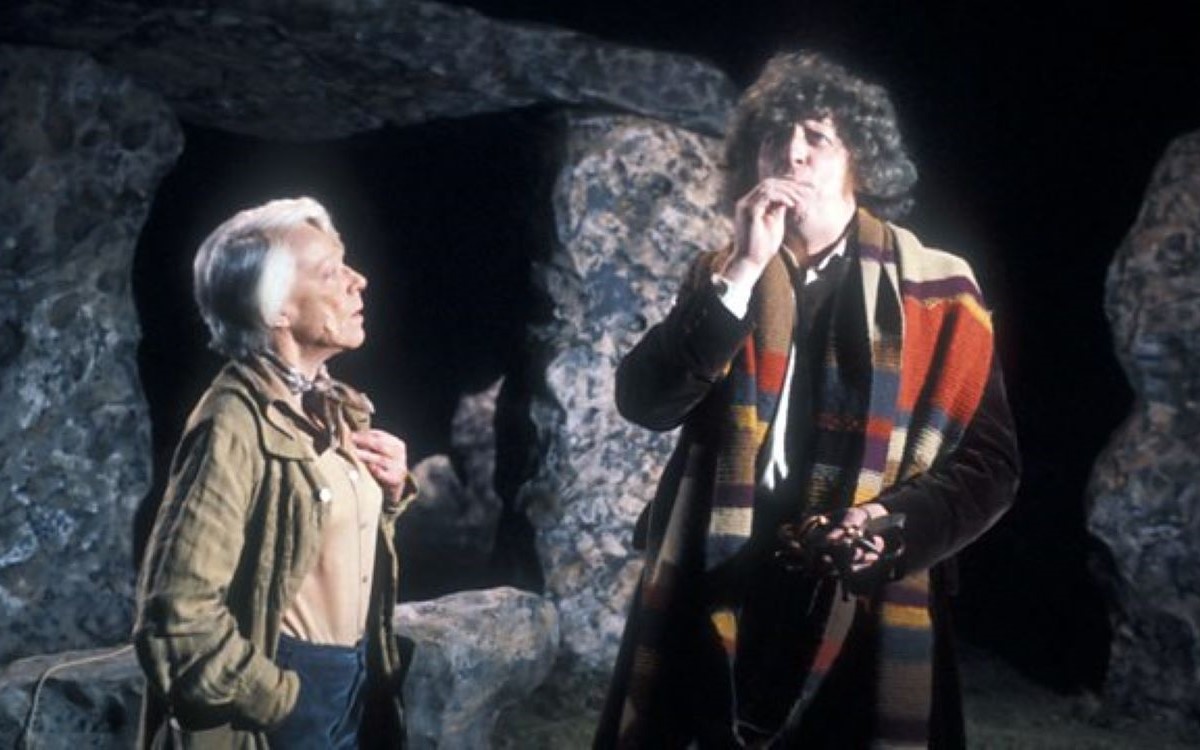
The Stones of Blood is the third serial of Doctor Who Season 16 and part of the overarching Key to Time story arc. It was broadcast in four episodes from October 28 to November 18, 1978. It was written by David Fisher and directed by Darrol Blake. It stars Tom Baker as the Fourth Doctor, Mary Tamm as Romana, John Leeson as the voice of K9, Beatrice Lehmann as Professor Amelia Rumford, and Susan Engel as Vivien Fay.
The Doctor and Romana search for the third segment of the Key to Time in the English countryside, where an ancient stone circle hides strange power and local legends turn deadly. Moving “stones,” a secretive cult, and a lonely manor lead them to the truth: the Ogri are living stone creatures, and their mistress has links to alien justice machines called the Megara.
Episode One
The tracer leads the Doctor, Romana, and K9 to stormy English moorland and a Bronze Age stone circle called the Nine Travellers. Professor Amelia Rumford, a game, sharp-eyed archaeologist, welcomes the curiosity; her patron, the gracious Vivien Fay, funds the dig.
Villagers whisper about the Cailleach, an old goddess, and a modern druid, de Vries, stages torchlit rites in her name. After sunset a hiker is found grey and bloodless, as if the life has been siphoned out of him. The Doctor feels latent charge in the monoliths and catches grainy silicon dust under his nails: these “stones” are not quite stone. K9’s scans spike whenever the circle hums.
De Vries invites the Doctor to his manor and speaks of sacrifices; the Doctor’s smile turns thin when he spots fresh scrape marks round the altar. On the moor, Romana hears the Doctor call her name and sees him beckon from a cliff path: then, with a pleasant smile, he shoves her into space. Air rushes; rock flashes past. In the circle, one of the Travellers has moved a fraction, leaving a gouged scar in the turf. The wind carries a low, hungry throb. In the dark, something ancient and heavy stirs itself and begins to feed.
Episode Two
Romana lives (caught on a ledge, hauled up by K9’s cable) while the Doctor survives de Vries’s rite only because the ritual’s “gods” arrive in person. Two of the megaliths glide up the manor drive and press close; there’s a fizz, a scream, and de Vries and his acolyte crumple into husks. The Doctor dubs the creatures Ogri: silicon-based life forms that drink blood for trace elements.
Amelia, practical even while appalled, helps measure fresh “footprints” in the turf. Vivien smiles and retreats behind philanthropy. The circle’s small “marker stones” prove stranger still: they radiate a precise phase signature as if anchoring a bridge to somewhere unseen. At the dig hut, an iron filing cabinet is pierced as if by a giant corkscrew; the Ogri are testing boundaries and tools.
The Doctor pieces it together: someone here is commanding off-world predators and using the circle as a transmitter. When the markers fire, the Traveller shapes lean inward and the air thickens like glass. Romana glimpses a not-quite-there structure flicker in the rain, poised half a second out of step with reality. K9 reports a hyperspace locus centred on the circle. Amelia fetches her coat. The Doctor grins, tucks the tracer into his pocket, and steps into the humming stones.
Episode Three
A pulse of white light whips Romana away; she wakes inside a sterile corridor where Vivien Fay (no longer gracious) strides in a dark, faceted gown. She calls herself Cessair of Diplos, thief and exile, mistress of the Ogri, and she locks Romana in a cell for bait. On the moor, the Doctor and Amelia triangulate the marker stones and snap a jury-rigged jump, landing aboard the same hidden craft “parked” in hyperspace over the circle.
There, behind seals and warning glyphs, the Doctor finds two floating orbs: the Megara, Justice Machines from Diplos, trapped for centuries en route to try a notorious criminal. He probes the lock; the seals break; the Megara wake: and immediately put him on trial for tampering. Back on the moor, an Ogri thunders through hedges; K9’s laser bites, scorching glassy wounds that ooze molten grit. Amelia, unflappable, chalks new measurements and declares the things “beasts with very bad table manners.”
In the ship’s gallery the Megara convene court, prosecuting and judging in one breath while Cessair smirks behind a force wall, her identity masked by a shield pendant. The Doctor pleads due process and buys time, steering the law toward its real quarry. The sentence for breaking their seals is disintegration. He needs one more objection: fast.
Episode Four
The Megara prepare to disperse the Doctor molecule by molecule; he cites their own statutes and demands medical assessment before execution. Bound by law, the orbs scan, and the beam glances across Cessair when she barges in to gloat. Her shield flickers. The Megara detect the truth: she is the criminal they were sent to judge: the thief of the Great Seal of Diplos, guilty of murder by Ogri and centuries of evasion.
Judgment is instantaneous. They commute the Doctor’s sentence and turn Cessair into stone, a living statue bound to the moor she haunted. The “shield pendant” around her neck clicks in the tracer’s hand and flows into light: the third segment of the Key to Time. On the ship, the Megara reclaim jurisdiction and depart to resume their long journey; with their power withdrawn, the hyperspace bridge collapses and the hidden craft fades.
K9 herds the surviving Ogri back toward their standing circle; without commands, they fall still as boulders. Dawn leaks over wet heather. Amelia Rumford, brisk and delighted, vows to publish a paper that will scandalise half the faculty. The Doctor and Romana slot the new segment beside the others in the TARDIS console. The moor quiets; the stones look ordinary again: until the wind remembers their names.
Themes
As a gleeful blend of folk horror and courtroom farce, The Stones of Blood shows the Key to Time run at its most confident: standing stones that drink light, druidic rites with a technological pulse, and a mid-serial left turn that lands with style. Measured against its neighbours, it feels tighter and more assured than The Pirate Planet, darker and more textured than The Ribos Operation, and only a shade below the crystalline finesse of The Androids of Tara.
In the wider era it doesn’t quite reach the mythic voltage of Pyramids of Mars, but its elegance and nerve place it high on the shelf: above wobblier outings like The Power of Kroll and the baggier stretches of The Armageddon Factor. It’s classic Who in the key of candle and silicon, witty without blinking.
Continuity threads are woven with the programme’s long memory. The tale’s “science in ritual robes” converses with The Daemons, Planet of Evil, and Image of the Fendahl, while its cool, legalistic detour with the Megara anticipates the jurisprudence to come in The Trial of a Time Lord. Within the season arc, it advances the White Guardian’s commission from The Ribos Operation, steadies the Doctor–Romana–K9 rhythm for The Androids of Tara, and keeps the quest’s moral edges visible as the path bends toward The Power of Kroll and the reckoning of The Armageddon Factor.
By its final transmutation, The Stones of Blood has done more than solve a mystery: it has proved the show can lace folklore to circuitry and make both feel inevitable.

.
To view the list of other Doctor Who serials, please click this link
Doctor Who Episode Guides for Sale on Amazon
Step aboard the TARDIS and journey across the universe with every incarnation of The Doctor in this series of unofficial Doctor Who episode companions.
This collection of twelve books explores every televised adventure of the Time Lord’s lives.
Each volume in the series delves into a different Doctor’s era, offering detailed episode guides, behind-the-scenes insights, character profiles, and story synopses.
Once you have clicked the link, choose which book you want, and then whether you want to buy the Kindle (eBook) or Paperback versions.
Previews are available before you buy.

Visit the Australian Book and Language Studio
Discover more from Craig Hill
Subscribe to get the latest posts sent to your email.
 Craig Hill