

.
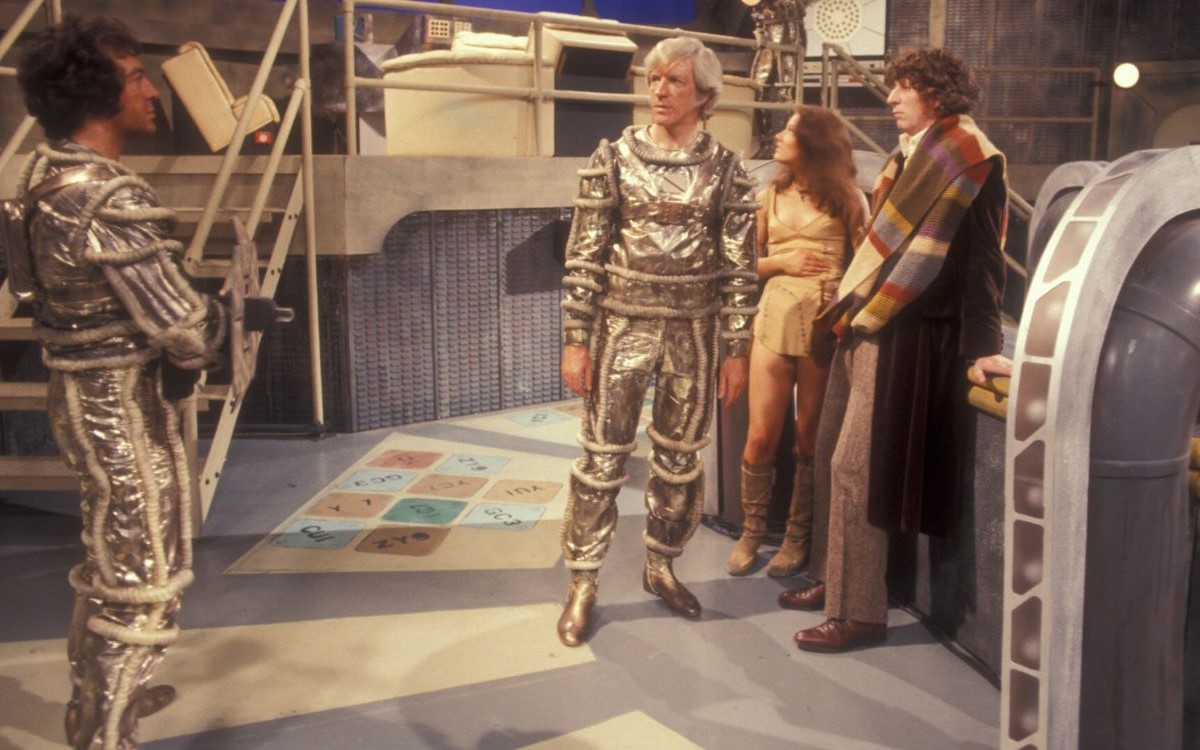
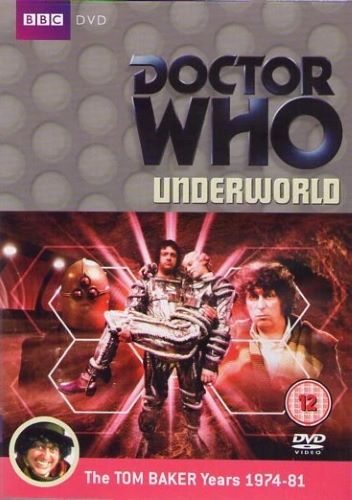
Underworld is the fifth serial of Doctor Who Season 15, originally broadcast in four episodes from 7 to 28 January 1978. It was written by Bob Baker and Dave Martin and directed by Norman Stewart. It stars Tom Baker as the Fourth Doctor, Louise Jameson as Leela, John Leeson as the voice of K9, and James Maxwell as Jackson.
The TARDIS materialises aboard a Minyan ship on a centuries-long quest to recover its lost race banks, leading the Doctor and Leela into a newborn asteroid where an ancient vessel, the P7E, lies at the core. There they find enslaved workers ruled by the Seers and the Oracle, and a “quest is the quest” creed that hides hard truths.
Episode 1
The TARDIS drifts into a storm of rocks around a newborn planet and is nearly pulverised before a sleek ship ploughs a path and hauls them clear. Aboard are Minyans (Jackson, Herrick, Orfe, and Tala) veterans of a quest that has lasted a hundred millennia. Long ago the Time Lords “helped” their people with advanced technology; the Minyans then tore their world apart and fled, vowing to find the sister ship P7E that carried their race banks.
“The quest is the quest,” Jackson says, like prayer and exhaustion at once. Sensors finally pick up the P7E’s beacon from inside the forming planet; accretion has buried it under miles of rock. The Doctor offers to thread a path into the core using the Minyans’ matter-penetrating drive while Leela keeps a practical eye on the trigger-happy Herrick.
They punch into liquid stone and cavernous voids, dodging collapses and sheets of dust that glow like stars. The R1C takes a battering; Tala stabilises spin while Orfe coaxes failing systems to hold. At last a tunnel opens onto a vast hollow lit by reflections, a cathedral inside a world. Somewhere in the rock-heart, the P7E is still alive: and not alone. The ship trembles as a directed beam probes them back.
Episode 2
The R1C sets down in the caverns and the travellers go on foot. The tunnels are carved by tools, not geology: evidence of centuries of labour. A frightened young miner called Idas stumbles into them, babbling about “trogs,” guards, and the Citadel. He leads them to a cave settlement where starving people chip at walls for ore that disappears by conveyor into a forbidden core.
The Citadel looms above, ruled by an unseen “Oracle” that speaks through masked Seers and squads of armoured guards. When Herrick blusters toward open revolt, the party is captured and marched through airlocks into bright, sterile corridors. The Doctor recognises deck-plates and bulkheads behind the cosmetic stone: the Citadel is the P7E, inverted and entombed, its computer enthroned as a god. The Oracle questions Jackson with silky menace, already aware he seeks the race banks.
Leela slips her bonds, frees Idas, and scouts ventilation shafts; the Seers glide after her with precise inhuman patience. In the ore works the Doctor sees how the system feeds itself: rock crushed, energy harvested, obedience enforced by fear and memory loss. He whispers the truth to Idas: your ancestors were the crew. The boy clenches his fists. Above them, the Oracle orders a “correction” and the guards ready the gas.
Episode 3
Chaos breaks the routine. Leela knifes a guard and drags workers into side tunnels, turning retreat into an uprising with simple, stubborn courage. The Doctor wriggles into service ducts, reading ancient Minyan script on plates half swallowed by rock. He reaches an old command gallery and finds the Seers conferring with the Oracle over two small, shielded cylinders: the race banks at last, or something very like them.
When he eavesdrops, the truth chills him: the Oracle has fabricated identical containers packed with fission charges. It will trade its bombs for the genuine banks and incinerate the R1C the moment it leaves, trapping the “god” in safety while the questors die. Jackson’s team fights toward the exchange point, Herrick taking wounds he treats like inconveniences. The miners, led by Idas, jam conveyors and smash surveillance eyes.
Leela is seized and dragged toward a furnace mouth; she spits defiance and kicks free long enough for the Doctor to swing a crane and snatch her back. In a quiet corner he shows Jackson the swap he plans: a neat switch of cylinders under the Seers’ blinking gaze. The Oracle glows with self-satisfaction, certain of victory. Deep timbers groan. The buried ship begins to wake like a beast turning in its sleep.
Episode 4
The exchange is made in the Citadel’s heart: Seers glide in with their “race banks,” Jackson presents the real ones, and the Doctor fumbles, distracts, and swaps. The Oracle purrs and dismisses them to their doom. Alarms follow as guards discover the miners’ revolt; Leela and Idas stampede a work gang through blast doors just before they slam.
The Doctor sprints for the R1C with Jackson, sliding down a scree of powdered rock as tremors rattle the cavern. On the bridge, Orfe locks the cylinders into secure racks and plots a burn to escape the planet’s grip. Behind, the Seers hurry their gift to the Oracle; they open the cases with reverence. Heat blooms. Light hardens. In the hush before detonation the Oracle realises it has been outplayed. The Citadel erupts; tunnels collapse; the P7E dies at the heart of the world it created.
The R1C roars up the launch shaft amid falling fire. Herrick crows. Jackson, thin-voiced, whispers that the quest is fulfilled at last. Idas leads survivors toward caverns that open to the surface, free to make their own myths. In orbit, Jackson thanks the Doctor as the race banks hum like seeds in spring. The travellers watch the newborn planet shed dust and flame, then step back into the TARDIS, already listening for the next call.
Themes
As an ambitious experiment draped in blue-screen caves and mythic echoes, Underworld aims high and lands unevenly. The Jason-and-the-Argonauts spine gives the quest shape, Tom Baker and Leela keep the pulse steady, and K9 adds cool precision; yet the CSO-heavy staging and repetitive chase beats blunt the impact.
In the era’s ledger it sits below the jewelled precision of The Robots of Death, the operatic confidence of The Talons of Weng-Chiang, and the feral bite of The Seeds of Doom, and a notch under the sharp satire of The Sun Makers. Still, its thematic reach (civilisations remade by gods in lab coats) lifts it above mere filler: a lower-mid-tier story with ideas bigger than its scaffolding.
Continuity-wise, it threads the programme’s long memory with purpose. The Minyans’ catastrophe, born of Time Lord “gifts,” refracts the cautionary ethos codified around The Deadly Assassin and anticipates the Gallifreyan reckoning of The Invasion of Time. Its “science wearing myth” idiom converses with earlier and adjacent tales (The Face of Evil, Pyramids of Mars, and Image of the Fendahl) and its classical reworking points forward to later riffs like The Horns of Nimon, while glancing back to The Myth Makers.
Coming off The Sun Makers, it serves as a thematic waystation: from satire to saga, from boardrooms to underworlds, before the TARDIS steps through Gallifrey’s doors once more. By its final “Quest is the quest,” the serial has done its quiet job:closing a loop of meddling and myth so the era can turn a sharper page.
.
To view the list of other Doctor Who serials, please click this link
Doctor Who Episode Guides for Sale on Amazon
Step aboard the TARDIS and journey across the universe with every incarnation of The Doctor in this series of unofficial Doctor Who episode companions.
This collection of twelve books explores every televised adventure of the Time Lord’s lives.
Each volume in the series delves into a different Doctor’s era, offering detailed episode guides, behind-the-scenes insights, character profiles, and story synopses.
Once you have clicked the link, choose which book you want, and then whether you want to buy the Kindle (eBook) or Paperback versions.
Previews are available before you buy.

Visit the Australian Book and Language Studio
Discover more from Craig Hill
Subscribe to get the latest posts sent to your email.
 Craig Hill