

.
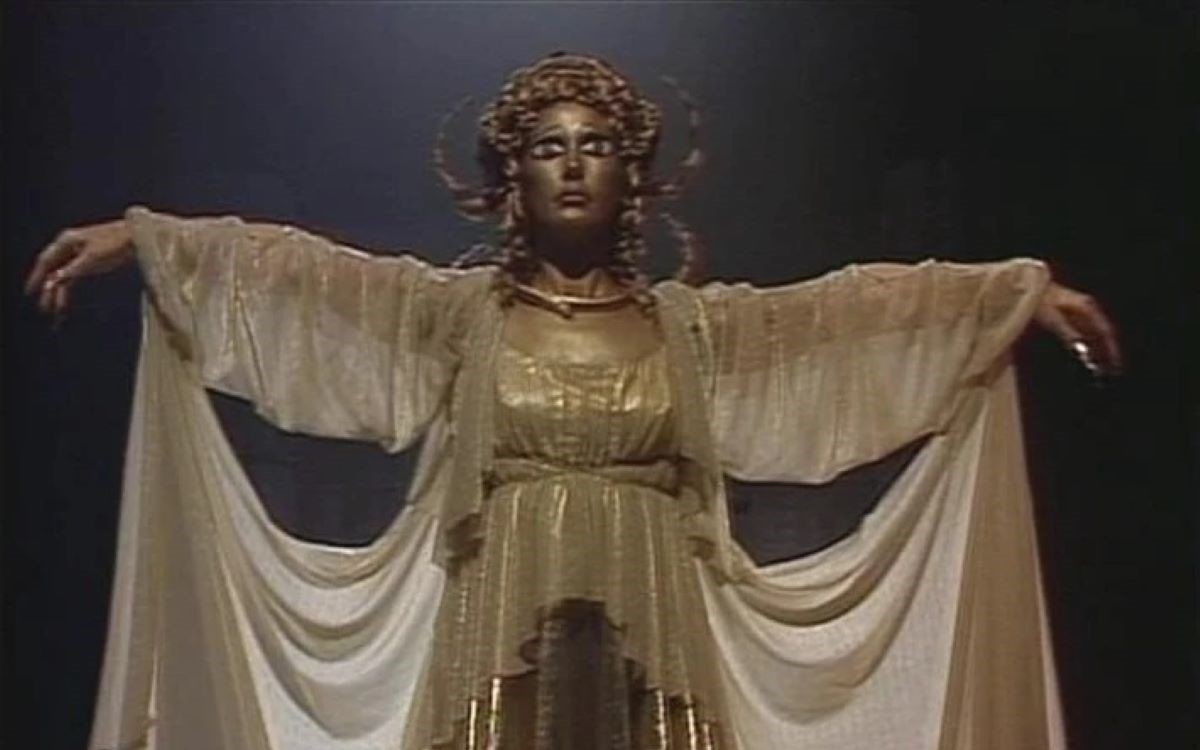
Image of the Fendahl is the third serial of Doctor Who Season 15, originally broadcast in four episodes from 29 October to 19 November 1977. It was written by Chris Boucher and directed by George Spenton-Foster. It stars Tom Baker as the Fourth Doctor, Louise Jameson as Leela, Wanda Ventham (mother of Benedict Cumberbatch) as Thea Ransome, Denis Lill as Dr. Fendelman, and Scott Fredericks as Max Stael.
The Doctor and Leela arrive at a country estate where scientists studying an impossibly ancient human skull have stirred an old evil called the Fendahl. Strange deaths, secret rites, and the skull’s influence spread through the nearby village as Thea begins to change into something terrifying. The Doctor follows clues from lab to cottage and realises the Fendahl once destroyed a world and now seeks rebirth on Earth.
Episode 1
An old priory has become a research lab where Professor Fendelman studies a thirteen-million-year-old human-like skull dug up in Africa: impossibly early for humanity. The Doctor and Leela land nearby after feeling a wrench in time and find local “wise woman” Ma Tyler reeling from visions of a pentagram and a “hungry presence.”
Inside the priory, Thea Ransome, a kind but weary scientist, is drawn to the skull whenever Fendelman powers his prototype time scanner. Adam Colby snipes about bad science; a security man patrols with nerves frayed. When the scanner runs, the skull glows from within, an inner eye opening; a hiker in the woods collapses, face grey, life leeched away. The Doctor recognises the equipment as dangerously close to a forbidden Time Lord device and warns Fendelman that forcing windows into deep time invites predators.
Fendelman, thrilled, pushes on. In locked rooms after hours, Max Stael meets a local coven: he wants the experiment’s “energies” for an older faith. Thea hears whispering (in her head, in the stone) and wanders to the scanner as if sleepwalking. The power builds; the pentagram pattern appears at the skull’s base. In the corridor, Leela senses a shape in the dark. In the lab, the skull flares: and Thea screams.
Episode 2
The scanner cachets surge again; the skull “answers” from millions of years away. Thea collapses, skin faintly luminescent, as if something inside her is waking. The Doctor pieces the legend together: the Fendahl, a world-eater the Time Lords trapped in a time loop with a whole planet to contain it.
Somehow a fragment reached Earth, embedding itself in human evolution and sleeping in the skull until a time scanner called it back. Ma Tyler is dragged to the priory by a coven member; Leela tracks and rescues her with feral economy. Fendelman, shaken by unexplained deaths, insists the work is pure science; Colby backs away from both men (his boss and Max Stael) seeing zealots in the making. At midnight Stael conducts a rite in a cellar marked with a chalk pentagram, using Thea at the centre as “focus.”
The skull’s light threads into her; her outline brightens, her hair stirring in an unfelt wind. A guard who tries the door is found later, drained and twisted. The Doctor begs Fendelman to shut the system down; the professor orders extra power instead, believing he can “stabilise” the phenomenon. Thea wakes in her room and stares at her hands as gold sparks dance over her skin. Outside, something thick and wet moves in the grass.
Episode 3
The coven gathers. Stael’s chant dovetails with the scanner’s rise; Thea stands in the pentagram and becomes a living node, the centre of a lattice of energy. The first Fendahleen then slithers out of the shadows: a great, eel-limbed creature of hunger that drains life with a touch. Panic tears the priory: a guard dies; Ma Tyler’s sight nearly burns her blind; Colby bolts; Fendelman tries to stop Stael and is shot for his trouble.
The Doctor drags Leela through storerooms and rigs a crude disruptor, explaining the awful symmetry: a Fendahl Core forms at the centre (Thea) while Fendahleen spawn around her as feeders. Salt, Ma Tyler mutters: old knowledge says salt binds and breaks evil. Jack Tyler fetches rock salt and a shotgun; Leela learns quickly. In the cellar the Core begins to speak with Thea’s voice layered over something vast. Stael realises too late he has been used, not chosen; he turns the gun on himself rather than be eaten.
The Doctor locates the scanner’s control nexus and plots to invert the energy and starve the forming gestalt, but the power surge has become self-sustaining. Fendahleen press into corridors. The golden figure in the pentagram opens her eyes, and every candle guttering in the priory bows to her breath.
Episode 4
The Doctor plays his last card: if he can force the time scanner into runaway feedback, it will blow the priory and collapse the link before the Fendahl fully matures. He raids the TARDIS for stabiliser crystals, sets timers, and shoulders the skull itself (still blazing) to carry it out of reach.
Leela and Jack hold the landings, blasting Fendahleen with rock salt and driving them back with lamps and sheer nerve. In the cellar the Core beckons; robed cultists stumble forward and crumple into husks. Colby hauls Ma Tyler away as masonry cracks. The Doctor jams the final connections, slams open a breaker, and runs. Heat blooms behind him. The Core’s voice swells to a howl, then cuts as the priory erupts in a thunder of dust and light.
Dawn finds smoking ruins, dead Fendahleen, and shaken survivors. The Doctor tells Ma Tyler and Colby the truth in simple terms: the Fendahl was a mistake older than history that nudged humanity for its own rebirth; the nudge ends here. He carries the skull into the TARDIS and hurls it into a waiting supernova, where even that ancient hunger cannot endure. Back on the lane, Ma Tyler pats Leela’s cheek and promises a hot breakfast. The blue box fades; the wind in the hedges sounds ordinary again.
Themes
As the programme’s purest slice of occult science, Image of the Fendahl is candlelit dread distilled: chalk circles, standing stones, and a fossil that remembers. Measured against its neighbours, it sits just below the operatic sweep of The Talons of Weng-Chiang and the crystalline precision of The Robots of Death, while feeling darker and more controlled than The Invisible Enemy and more quietly devastating than Underworld.
It may not thunder with the moral weight of Genesis of the Daleks or the mythic charge of Pyramids of Mars, but it belongs on the era’s upper shelf: elegant, unsettling, and carried by Tom Baker’s iron poise and Leela’s fierce clarity.
Its roots and branches are equally sure-footed. The tale’s “science in ritual robes” echoes The Daemons and the antique terror of Pyramids of Mars, while its possession and body-horror lineage runs from The Ark in Space through The Seeds of Doom. The Time Lords’ whispered interdictions recall The Deadly Assassin, and the stone-bound myth foreshadows later kindred hauntings like The Stones of Blood and even the gothic anthropology of Ghost Light.
In-season, it cools the palette after The Invisible Enemy and clears the runway for the satirical bite of The Sun Makers, the mythic experiment of Underworld, and the Gallifreyan endgame of The Invasion of Time. By its final circle, Image of the Fendahl has proved that the show can make folklore feel scientific: and fate feel like a trap you step into with your eyes wide open.

.
To view the list of other Doctor Who serials, please click this link
Doctor Who Episode Guides for Sale on Amazon
Step aboard the TARDIS and journey across the universe with every incarnation of The Doctor in this series of unofficial Doctor Who episode companions.
This collection of twelve books explores every televised adventure of the Time Lord’s lives.
Each volume in the series delves into a different Doctor’s era, offering detailed episode guides, behind-the-scenes insights, character profiles, and story synopses.
Once you have clicked the link, choose which book you want, and then whether you want to buy the Kindle (eBook) or Paperback versions.
Previews are available before you buy.

Visit the Australian Book and Language Studio
Discover more from Craig Hill
Subscribe to get the latest posts sent to your email.
 Craig Hill