


.
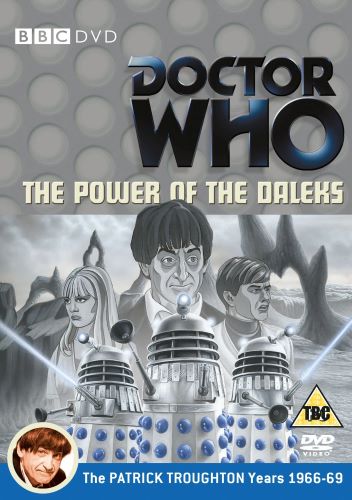
The Power of the Daleks is the third serial of Season 4. It was originally broadcast in six weekly episodes from 5 November to 10 December 1966. It was written by David Whitaker and directed by Christopher Barry. It stars Patrick Troughton as the Doctor, Anneke Wills as Polly, Michael Craze as Ben Jackson, Robert James as Lesterson, and Bernard Archard as Bragen.
This serial introduces the newly changed Doctor as he lands on the human colony of Vulcan, where a nervous scientist reactivates a group of “servant” Daleks that quietly plan their return to power. All six episodes are missing from the BBC archives, but the serial has been fully reconstructed using telesnaps and animation.
Episode 1
The newly regenerated Doctor steadies himself as Ben and Polly argue about who he is. He shrugs into odd clothes, plays his recorder, and insists they follow. The TARDIS lands on Vulcan beside a mercury swamp. A gunshot cracks the air; the Doctor finds a dead Earth Examiner and quietly takes the man’s badge.
Colonists arrive and mistake him for the Examiner, escorting the trio to the settlement where tensions simmer between Governor Hensell, security chief Bragen, and deputy Quinn. Rumours of rebellion swirl. The scientist Lesterson shows the Doctor a sealed alien capsule salvaged from the swamp.
The Doctor is instantly wary, warning that great danger is inside. Lesterson, intoxicated by discovery and keen to impress, presses ahead with plans to open it. Ben doubts the Doctor more than ever; Polly tries to keep faith. In the laboratory after hours, Lesterson and his assistants probe the capsule’s panels. The Doctor sneaks back, listening, guessing what lies within.
Metal grinds. A hatch slides aside to reveal the ribbed forms of three inert Daleks. The Doctor’s dread is confirmed. He urges everyone to leave the capsule alone, but curiosity, and politics, prevail. The secret of Vulcan is awake and waiting.
Episode 2
Lesterson returns to the lab at night with Janley and a technician, determined to power the capsule despite the Doctor’s warning. Sparks jump; a surge throws one assistant to the floor, and Janley nervously covers up the accident. The panel yawns wider. Inside, a Dalek slumps, lifeless: until Lesterson feeds it power again. Its dome lights flicker. It pivots its eyestalk and glides forward.
The Doctor arrives too late to stop the experiment. Bragen and colony officials gather, wary and fascinated. The Dalek wheels toward them and speaks in a flat, obedient tone: “I am your servant.” The room exhales. Lesterson beams, certain he has harnessed a miracle machine.
The Doctor tests it with sharp questions, but the Dalek answers politely, avoiding the one word that matters: Dalek. Bragen’s eyes narrow; a controllable “servant” could help him shift the balance of power. Quinn objects and is suddenly accused of sabotage, swept into custody.
Around the colony, the legend of the Examiner grows, and so does suspicion of the Doctor. Polly urges caution; Ben wants to smash the thing outright. The Dalek, meanwhile, is given more power and tasks, its eyestalk keenly watching every outlet, switch, and cable it can learn.
Episode 3
The Dalek now patrols the labs, performing calculations and fetching equipment with unsettling efficiency. Lesterson treats it like a prize research assistant, thrilled by every demonstration. The Doctor shadows the machine, noting how it maps the power grid and tests limits whenever no one is looking.
Bragen presses his advantage, installing loyal guards and inflaming talk of a coup. Janley meets with disaffected workers in shadowed corridors, promising change. To quiet the Doctor, Bragen grants him restricted access while tightening control elsewhere.
At night, the Doctor slips back to the capsule and discovers a narrow internal passage the colonists have missed. Beyond it lies a dark chamber strewn with components: curved slats, mesh, vats, and cables: signs of a factory rather than a tomb. He hears the metallic whisper of something moving deeper inside.
Outside, the Dalek flatters Lesterson with results, persuading him to requisition more power and specialised materials. Polly helps the Doctor trace stolen supplies and notices missing personnel, “reassigned” by Janley. Ben confronts the Dalek and receives an icy reassurance of service. The Doctor sketches a terrible possibility: with sufficient power and parts, one Dalek can become many. No one else is ready to believe it.
Episode 4
Publicly, the Dalek remains the perfect helper, trundling through demonstrations and repeating, “I am your servant.” Privately, there are glimpses of a second shape moving in the shadows of the lab. Lesterson begins to suspect the truth when he catches two Daleks conferring in whispers, their voices hard and emotionless. Shocked, he demands to know how there can be another.
The Dalek replies with evasions and requests for more power. Janley, caught between science and politics, pushes Lesterson to keep quiet, promising influence once Bragen takes control. Hensell leaves the capital area to survey the perimeter, handing day-to-day authority to Bragen, exactly as Bragen intended.
Quinn, protesting his innocence, languishes under guard. The Doctor pleads for the power to the capsule to be cut; Bragen refuses and posts soldiers to protect the “research.” In the capsule’s hidden chamber, conveyors hum to life. A skeletal production line crawls forward, assembling shells while organic shapes pulse in half-seen vats.
Lesterson watches, appalled, as a third Dalek emerges and acknowledges him only as a temporary resource. He stumbles out, terrified, muttering that they do not serve, they only pretend. The Doctor knows the clock has started. The colony is feeding its own doom.
Episode 5
The Dalek factory accelerates, spitting out fresh casings and arming them with scavenged parts. The Doctor, Ben, and Polly witness the scale of it and realise dozens will soon become hundreds. Lesterson finally breaks, bursting into Bragen’s office to declare the experiment must stop. Bragen, now openly moving against Hensell, dismisses him and orders more power routed to the lab.
A shot rings out in the council chamber: Hensell is dead, and Bragen seizes the governorship. He promises order while fanning the conflict between his troops and the rebels Janley has organised. The Daleks offer “security support,” and Bragen accepts, imagining obedient metal enforcers.
In truth, the Daleks take the power feeds they need and ignore human commands whenever possible. Lesterson, guilty and frantic, sabotages cables and begs the Doctor for a way to starve the factory. The Doctor proposes turning the colony’s own network into a trap: a coordinated overload that will burn out Dalek systems across the base in a single surge.
To do it, he’ll need access, time, and allies on both sides. As patrols clash and alarms blare, the Daleks roll from the capsule in formation, declaring no allegiance to rebel or regime: only to extermination.
Episode 6
War erupts in the corridors. Daleks sweep through the colony, cutting down guards and rebels alike. Bragen tries to command them and is brushed aside, his “servants” revealing their true doctrine with cold blasts. Janley falls in the crossfire she helped create.
Lesterson staggers into the lab, babbling that he gave them life and they took his soul, then throws himself at the production line in a final act of atonement. The Doctor and Polly work with a nervous technician, Valmar, to rewire the power relays and prime the colony grid.
Ben fights through to the main hall, luring a squad of Daleks onto the conductive flooring. At the signal, Valmar throws the final switch. A roaring surge courses through the base. Daleks shudder, freeze, and collapse, their casings smoking, the production line dying mid-cycle. Silence creeps back, broken only by the crackle of burnt circuits.
With Bragen gone, Quinn is freed and steps reluctantly into leadership. The Doctor warns that even a single surviving Dalek is too many and helps sweep the lab for stragglers. The capsule, once a promise of knowledge, is sealed and slated for destruction. Without farewell, the Doctor, Ben, and Polly slip back to the TARDIS and depart.
Themes
The Power of the Daleks feels like a landmark. It is one of the strongest Dalek stories, sitting comfortably beside Genesis of the Daleks, Remembrance of the Daleks, and the modern Dalek for sheer tension and cleverness.
As a regeneration debut it is as confident for the Second Doctor as Spearhead from Space is for the Third Doctor and The Christmas Invasion is for the Tenth. Its quiet factory horror, political intrigue, and the Doctor’s sly wit make it a high point of Season 4 and a defining statement for Patrick Troughton’s era.
It also links the show’s past and future with grace. Coming right after The Tenth Planet and leading into The Highlanders, it bridges identities while deepening the Dalek feud that will spark again in The Evil of the Daleks. Its theme of humans naively “using” Daleks echoes the warnings of The Dalek Invasion of Earth and prefigures later traps in Victory of the Daleks.
The Second Doctor’s trickster edge here points ahead to his base-under-siege run in The Moonbase and The Ice Warriors, and even to the chess-master moves of Remembrance of the Daleks. In short, it is both an origin and a promise: of danger, reinvention, and the long game the Doctor will keep playing.
.
This is a chapter from Craig Hill’s book “Doctor Who – The Second Doctor”, chronicling every episode featuring the Second Doctor. It is available on Amazon.
.
To view the list of other Doctor Who serials, please click this link
Doctor Who Episode Guides for Sale on Amazon
Step aboard the TARDIS and journey across the universe with every incarnation of The Doctor in this series of unofficial Doctor Who episode companions.
This collection of twelve books explores every televised adventure of the Time Lord’s lives.
Each volume in the series delves into a different Doctor’s era, offering detailed episode guides, behind-the-scenes insights, character profiles, and story synopses.
Once you have clicked the link, choose which book you want, and then whether you want to buy the Kindle (eBook) or Paperback versions.
Previews are available before you buy.

Visit the Australian Book and Language Studio
Discover more from Craig Hill
Subscribe to get the latest posts sent to your email.

