

.
Doctor Who was conceived in early 1963 by the BBC as a new science fiction drama intended to fill a gap in Saturday evening programming between sports coverage (Grandstand) and a pop music show (Juke Box Jury). The BBC’s Head of Drama, Sydney Newman, was instrumental in developing the series.
He envisioned a time-travel program that could both educate and entertain, exploring historical events and scientific concepts through adventure stories. Newman’s key contributions included the idea of the mysterious time- traveling character known as “the Doctor,” who would not be the central protagonist in the traditional sense. Rather, he would be a complex figure who helps others, particularly a pair of young, relatable schoolteachers.
The initial production team included producer Verity Lambert, the BBC’s first female drama producer, and director Waris Hussein, one of the corporation’s first directors of Indian heritage. Writer Anthony Coburn developed the first storyline, An Unearthly Child, and refined the concept of the Doctor and his time machine, the TARDIS (Time And Relative Dimension In Space), which would resemble a 1960s police telephone box due to its malfunctioning “chameleon circuit.”
The first pilot episode, produced on September 27, 1963, was rejected by BBC executives for technical issues, tone inconsistencies, and the portrayal of the Doctor as too cold and unlikable. It was reworked and reshot with various changes, leading to the official launch of Doctor Who on November 23, 1963.
Plot Outline
After school in London, 1963, two teachers talk about a strange pupil. Ian Chesterton teaches science. Barbara Wright teaches history. Their brightest student is Susan Foreman. She answers hard questions easily, yet makes odd mistakes with simple things.
She draws unusual patterns, counts in a curious way, and speaks as if she remembers future events. Barbara offers extra lessons. Susan refuses to let anyone visit her home. She writes an address on a slip: 76 Totter’s Lane.
That night, Barbara and Ian go to the address. It is a locked junkyard full of crates, scrap, and old signs. A battered blue police box stands in the shadows, humming softly. They see Susan’s outline near it and hear a radio playing pop music. She vanishes between stacks of junk. The teachers search the yard and call her name.
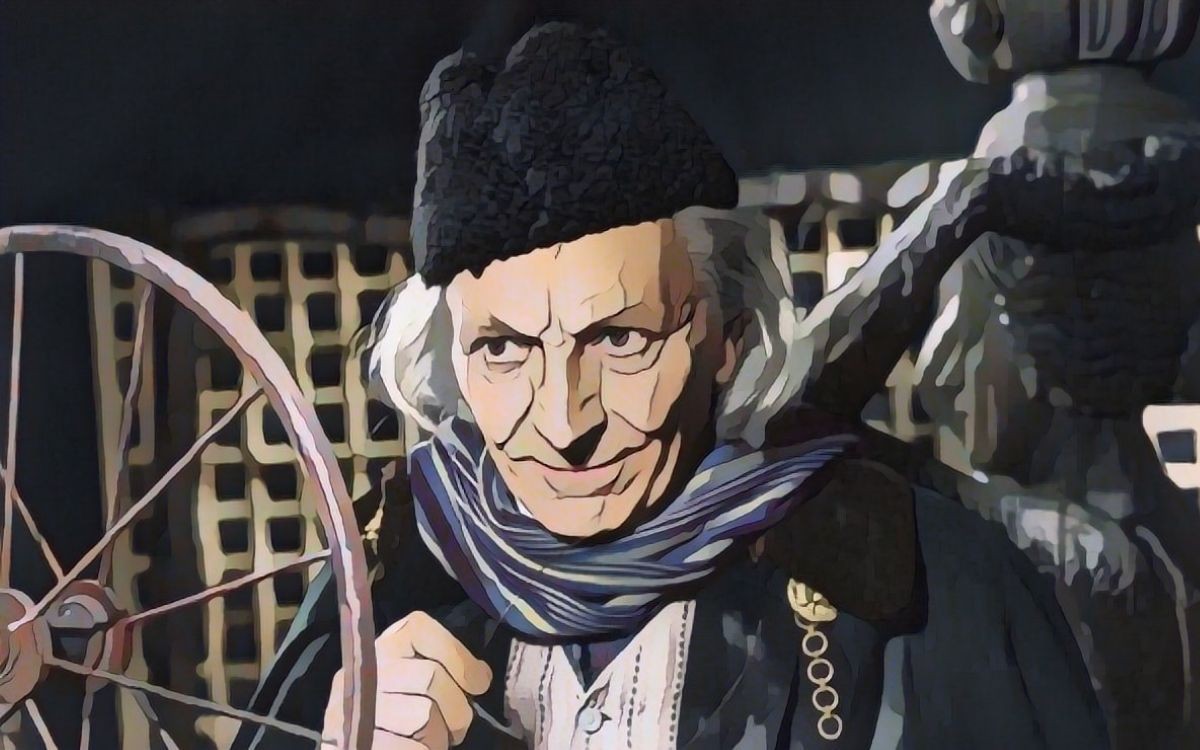
An elderly man in an old coat steps out from behind the police box. He is sharp, defensive, and amused. He asks why two schoolteachers hunt a girl in the dark. He claims no knowledge of Susan, then slips and calls himself her grandfather.
Barbara hears Susan’s voice from inside the box. She pushes at the door. The old man blocks her path. Ian tries to reason with him and hears the odd hum again. The door gives a little.
The teachers force it open and step through, then stop in shock. The inside is vast. A high control room stretches away, bright with panels and roundels. A six-sided console stands in the middle, full of switches and levers. The battered police box outside is only the shell. Inside is a machine.
Susan runs to them and calls the elderly man “Grandfather.” She tells Ian and Barbara the truth as she sees it. The “box” is a ship called the TARDIS (Time And Relative Dimension In Space). It travels through time and space.
She wanted to stay in London to learn. Her grandfather insists it is too dangerous. The teachers argue with him. They demand to leave and call the police. He refuses. He says they will expose them, and their lives will change the world’s history.
Ian laughs at the idea. He touches the console to prove it is a trick. The old man whirls and pulls a lever. The doors swing shut and lock. A deep hum rises. The central column begins to pump up and down.
The room shakes. Lights flicker. Barbara cries out. Ian clutches the rail. Susan sways, torn between delight and fear. The old man. now clearly the Doctor, smiles with fierce pride and a hint of worry. He tells them they are leaving 1963 behind.
The sound grows like wind and engines at once. The floor tilts. The teachers are thrown to the deck. The Doctor circles the console, making fine adjustments with impatient hands. Susan tries to soothe Ian and Barbara, but she is excited too. The machine groans and then settles. The column slows. The hum fades to a soft purr.
They open the doors and look at the scanner. The screen shows a stony plain under a pale sky. No houses. No lights. Just wind and sand. The Doctor says they have landed far from London. He does not say where or when. Ian insists it is an illusion. Barbara shivers and says the air on her face feels real.
The Doctor warns that the place outside may be hostile. He claims he did not intend to kidnap them, then adds that what is done is done. He orders the doors secured and starts to check instruments. Ian and Barbara stare at the impossible room and at Susan, who seems at home amid the controls.
Finally the Doctor opens the doors a crack. Cold air moves across the threshold. Sand lies in small drifts against the step. The Doctor peers out. He decides to wait a moment. He says they must prepare properly before exploring. Behind him, the teachers whisper about escape and about truth. Susan looks between her grandfather and her teachers, torn.
The final shot moves outside. The blue box stands alone in a barren landscape. Wind hisses across the stones. As the camera lingers, a dark, ragged shadow falls over the police box and stops. Someone, or something, stands just out of frame, watching the TARDIS. The adventure has begun.
Themes
Viewed as drama, the unaired 1963 pilot for An Unearthly Child is a rough draft: fascinating, imperfect, and essential. Line fluffs, harsher lighting, and a sharper-edged Susan make Ian and Barbara feel stiffer and the Doctor more abrasive than in the transmitted An Unearthly Child.
Measured against early triumphs like The Daleks and The Aztecs, it sits lower as a story but rates highly as an artifact for showing the moment just before Doctor Who clicks into place.
Its links are foundational. The remount the following week becomes the broadcast An Unearthly Child, leading straight into the first serial’s caveman trio and onward to The Edge of Destruction, which explores the TARDIS the pilot only hints at.
In the long view, the pilot’s recovery and afterlife feed later reflections on the show’s birth in An Adventure in Space and Time, while the series’ habit of re-starting itself echoes decades later in The Pilot and the anniversary weave of The Day of the Doctor. As a story, it earns a strong rating for letting us watch the programme become itself: one retake before history begins.
.
To view the list of other Doctor Who serials, please click this link
Doctor Who Episode Guides for Sale on Amazon
Step aboard the TARDIS and journey across the universe with every incarnation of The Doctor in this series of unofficial Doctor Who episode companions.
This collection of twelve books explores every televised adventure of the Time Lord’s lives.
Each volume in the series delves into a different Doctor’s era, offering detailed episode guides, behind-the-scenes insights, character profiles, and story synopses.
Once you have clicked the link, choose which book you want, and then whether you want to buy the Kindle (eBook) or Paperback versions.
Previews are available before you buy.

Follow Me on Social Media
Discover more from Craig Hill
Subscribe to get the latest posts sent to your email.
 Craig Hill