

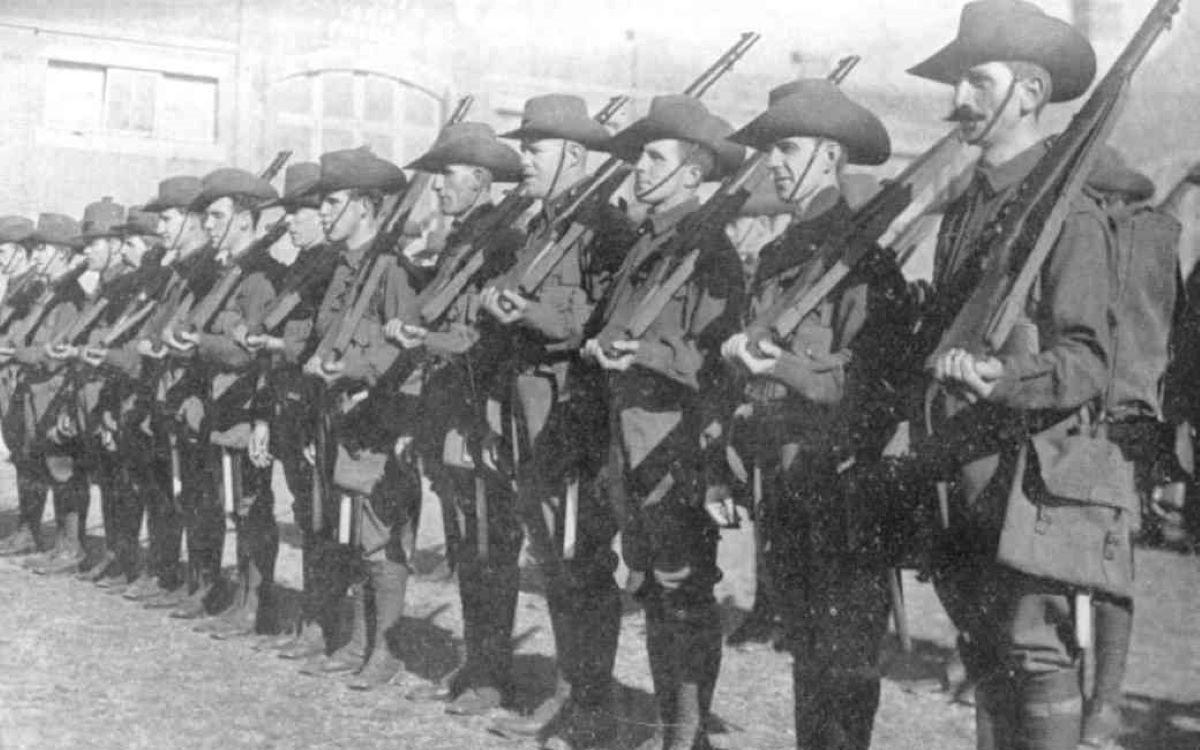
On 11 September 1914, Australian troops land in German New Guinea at Bita Paka (near Rabaul). On 21 September, all German forces in the colony surrendered.
German New Guinea consisted of the northeastern part of the island of New Guinea and several nearby island groups and was the first part of the German colonial empire. The mainland part of the territory, called Kaiser-Wilhelmsland, became a German protectorate in 1884.
Other island groups were added subsequently. The Bismarck Archipelago (New Britain, New Ireland and several smaller islands), and the North Solomon Islands were declared a German protectorate in 1885; in the same year the Marshall Islands were bought from Spain for $4.5 million by the Hispano-German Protocol of Rome; Nauru was annexed to the Marshall Islands protectorate in 1888, and finally the Caroline Islands, Palau, and the Mariana Islands (except for Guam) were bought from Spain in 1899. German Samoa, though part of the German colonial empire, was not part of German New Guinea.
Following the outbreak of World War I, Australian troops captured Kaiser-Wilhelmsland and the nearby islands in 1914, after a short resistance led by Captain Carl von Klewitz and Lt. Robert “Lord Bob” von Blumenthal, while Japan occupied most of the remaining German possessions in the Pacific.
The only significant battle occurred on 11 September 1914 when the Australian Naval and Military Expeditionary Force attacked the low-power wireless station at Bita Paka (near Rabaul) on the island of New Britain, then Neu Pommern.
The Australians suffered six dead and four wounded – the first Australian military casualties of the First World War. The German forces fared much worse, with one German officer and 30 local policemen killed and one German officer and ten local policemen wounded. On 21 September all German forces in the colony surrendered.
However, Lieutenant (later Hauptmann) Hermann Detzner, a German officer, and some 20 local policemen evaded capture in the interior of New Guinea for the entire war. Detzner was on a surveying expedition to map the border with Australian-held Papua at the outbreak of war, and remained outside militarised areas.
Detzner claimed to have penetrated the interior of the German portion (Kaiser Wilhelmsland) in his 1920 book Vier Jahre unter Kannibalen (“Four Years Among Cannibals”). These claims were heavily disputed by various German missionaries, and Detzner recanted most of his claims in 1932.
After the Treaty of Versailles of 1919, Germany lost all its colonial possessions, including German New Guinea. In 1923, the League of Nations gave Australia a trustee mandate over Nauru, with the United Kingdom and New Zealand as co-trustees.
Other lands south of the equator became the Territory of New Guinea, a League of Nations Mandate Territory under Australian administration until 1949 (interrupted by Japanese occupation during the New Guinea campaign) when it was merged with the Australian territory of Papua to become the Territory of Papua and New Guinea, which eventually became modern Papua New Guinea.
The islands north of the equator became the Japanese League of Nations Mandate for the South Seas Islands. After Japan’s defeat in World War II, the former Japanese mandate islands were administered by the United States as the Trust Territory of the Pacific Islands, a United Nations trust territory.
To see other events that happened in Australian history, visit the blog site of Advance Institute of Business by clicking on this link.
Advance Institute of Business has nationally recogised Certificate and Diploma courses available to help you progress in your career.
The Certificate IV in TESOL will allow you to teach English in Australia and many other countries.

The 10773NAT Certificate IV in TESOL is a nationally and internationally recognised qualification that will allow you to teach English to speakers of other languages in Australia and many other countries.
The practical component can be done in your own country (conditions apply), Vietnam or Cambodia. If you choose to do the practical component in Vietnam or Cambodia, we will provide hotel accommodation at no extra cost.
We have the following Certificate and Diploma courses available for your career development:
Teaching Courses
Business
Leadership and Management
Entrepreneurship and New Business
- Certificate III in Entrepreneurship and New Business
- Certificate IV in Entrepreneurship and New Business
Accounting
We will soon also be offering:
- Advanced Diploma of Business
- Diploma of Human Resource Management
- Diploma of Marketing and Communication
And there will be more courses to come in the future.
Our non-accredited speciality courses:
- Career Paths (43 career paths to choose from)
- Corporate Training
- Business English
- English Tutoring
- University and College Tutoring
- Professional and Academic Writing Skills
- Where to Study in Australia
- Education Consultancy
25% discount on all courses for Centrelink and Veteran’s Affairs recipients.
All courses are nationally recognised through our Registered Training Organisation partner Skills Recognition International (RTO 32373). We also have an advisory service on where to study in Australia.
To find out more about these courses, please click this link to arrange a free video or phone call.
Discover more from Craig Hill
Subscribe to get the latest posts sent to your email.
 Craig Hill
2 thoughts on “On this day (Australia): In 1914, Australian troops landed in German New Guinea”