
O 6 December 1956, the Blood in the Water water polo match between Hungary and the USSR was played at the 1956 Melbourne Olympics.
The “Blood in the Water” match (Hungarian: melbourne-i vérfürdő lit. Blood bath of Melbourne; Russian: Кровь в бассейне, romanized: Krov’ v basseyne, lit. ‘Blood in the swimming pool’) was a water polo match between Hungary and the USSR at the 1956 Melbourne Olympics.
The match took place on 6 December 1956 against the background of the 1956 Hungarian Revolution, and saw Hungary defeat the USSR 4–0.
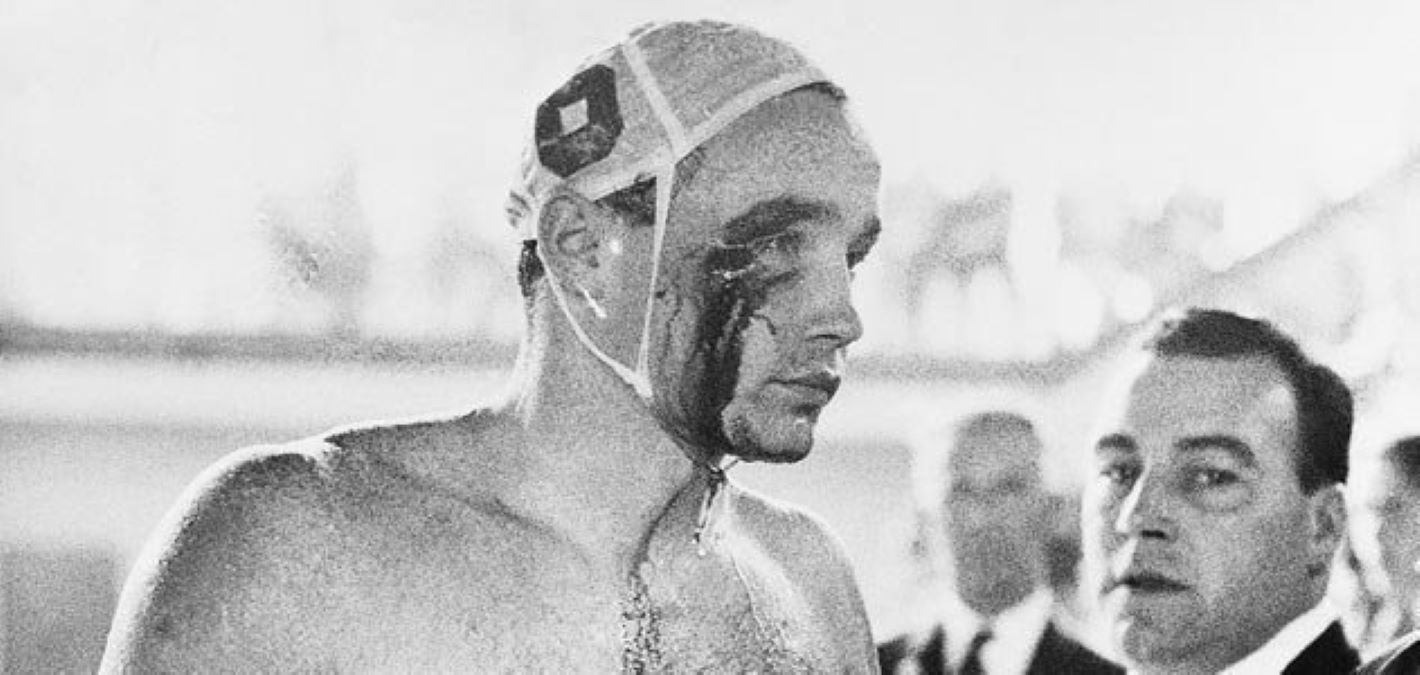
The name was coined after Hungarian player Ervin Zádor emerged during the last two minutes with blood pouring from above his eye after being punched by Soviet player Valentin Prokopov.
Background
Tensions were already high between the Hungarian and Soviet water polo teams, as the Soviets had taken advantage of their political control of Hungary to study and copy the training methods and tactics of the Olympic champion Hungarians.
Then, on 23 October 1956, a demonstration by students of the Budapest University of Technology and Economics escalated into an uprising against the government in Budapest. On 1 November, Soviet tanks began rolling into Hungary and from 4 to 10 November forces began suppressing the uprising with air strikes, artillery bombardments, and tank-infantry actions.
At the time, the Hungarian water polo team was in a mountain training camp above Budapest. They were able to hear the gunfire and see smoke rising. The players were the defending Olympic champions; with the Summer Olympics in Melbourne two months away, they were moved into Czechoslovakia to avoid being caught in the revolution.
The players only learned of the true extent of the uprising and the subsequent crackdown after arriving in Australia and they were all anxious for news of friends and family.
By the start of the Olympics, the uprising had been suppressed and many players saw the Olympics as a way to salvage pride for their country. “We felt we were playing not just for ourselves but for our whole country”, said Zádor after the match.
The match was played in front of a partisan crowd bolstered with expatriate Hungarians (many of whom had been in the boxing arena before to see the Hungarian László Papp) as well as Australians and Americans, two of the Soviet Union’s Cold War opponents.
The match
In the morning before the start, the Hungarians had created a strategy to taunt the Russians, whose language they had studied in school. In the words of Ervin Zádor: “We had decided to try and make the Russians angry to distract them.”
From the beginning, kicks and punches were exchanged. At one point, a punch thrown by Hungarian captain Dezső Gyarmati was caught on film. Meanwhile, Zádor scored two goals to the crowd’s cheers of Hajrá Magyarok! (“Go Hungarians!”).
With one minute remaining in the match, Hungary was leading 4–0. Zádor was marking Valentin Prokopov, with whom he had already exchanged words, and a whistle was blown. In the intermission, Prokopov struck him, causing a bleeding gash.
Zádor left the pool; his bleeding was the final straw for a crowd already in frenzy. Many angry spectators jumped onto the concourse beside the water, shook their fists, shouted abuse and spat at the Russians. To avoid a riot, police entered the arena and shepherded the crowd away.
Pictures of Zádor’s injuries were published around the world, leading to the “Blood in the Water” moniker. Reports that the water in the pool turned red were, however, an exaggeration. Zádor said his only thought was whether he would be able to play the next match.
The referees stopped the match; Hungary was declared the winner since they had been leading. Hungary then beat Yugoslavia 2–1 in the final to win their fourth Olympic gold medal. Zádor’s injury forced him to miss the match. After the event was completed, he and some of his teammates defected to the West.
In film
In 2006, for the 50th anniversary of the attempted Hungarian Revolution, the documentary Freedom’s Fury, produced by Kristine Lacey and Thor Halvorssen, told the story of the match. Quentin Tarantino described it as “the best untold story ever”. The documentary was narrated by the Olympic swimmer Mark Spitz, who, as a teenager had been coached by Ervin Zádor.
Also in 2006, a feature film about the match was released, entitled Children of Glory (Hungarian title: Szabadság, szerelem, meaning “Freedom, love”, after the lines of Sándor Petőfi, the martyred poet of the 1848–49 revolution).
The movie shows the Hungarian Revolution through the eyes of a player on the water polo team and a young woman who is one of the student leaders. It was directed by Krisztina Goda, and produced by Andrew G. Vajna.
The movie appeared in Hungarian cinemas on 23 October 2006, the 50th anniversary of the revolution. On 29 October 2006, it was shown at the White House for President George W. Bush and guests (including Hungarian-American figures such as George Pataki, Governor of New York, and George A. Olah, Nobel Prize winner).
The incident also features in the 1978 Australian film Newsfront.
To see other events that happened in Australian history, visit the blog site of Advance Institute of Business by clicking on this link.
Advance Institute of Business has nationally recogised Certificate and Diploma courses available to help you progress in your career.
The Certificate IV in TESOL will allow you to teach English in Australia and many other countries.

The 10773NAT Certificate IV in TESOL is a nationally and internationally recognised qualification that will allow you to teach English to speakers of other languages in Australia and many other countries.
The practical component can be done in your own country (conditions apply), Vietnam or Cambodia. If you choose to do the practical component in Vietnam or Cambodia, we will provide hotel accommodation at no extra cost.
We have the following Certificate and Diploma courses available for your career development:
Teaching Courses
Business
Leadership and Management
Entrepreneurship and New Business
- Certificate III in Entrepreneurship and New Business
- Certificate IV in Entrepreneurship and New Business
Accounting
We will soon also be offering:
- Advanced Diploma of Business
- Diploma of Human Resource Management
- Diploma of Marketing and Communication
And there will be more courses to come in the future.
Our non-accredited speciality courses:
- Career Paths (43 career paths to choose from)
- Corporate Training
- Business English
- English Tutoring
- University and College Tutoring
- Professional and Academic Writing Skills
- Where to Study in Australia
- Education Consultancy
25% discount on all courses for Centrelink and Veteran’s Affairs recipients.
All courses are nationally recognised through our Registered Training Organisation partner Skills Recognition International (RTO 32373). We also have an advisory service on where to study in Australia.
To find out more about these courses, please click this link to arrange a free video or phone call.
Discover more from Craig Hill
Subscribe to get the latest posts sent to your email.
 Craig Hill
One thought on “On this day (Australia): In 1956, the Blood in the Water water polo match between Hungary and the USSR was played at the 1956 Melbourne Olympics”