

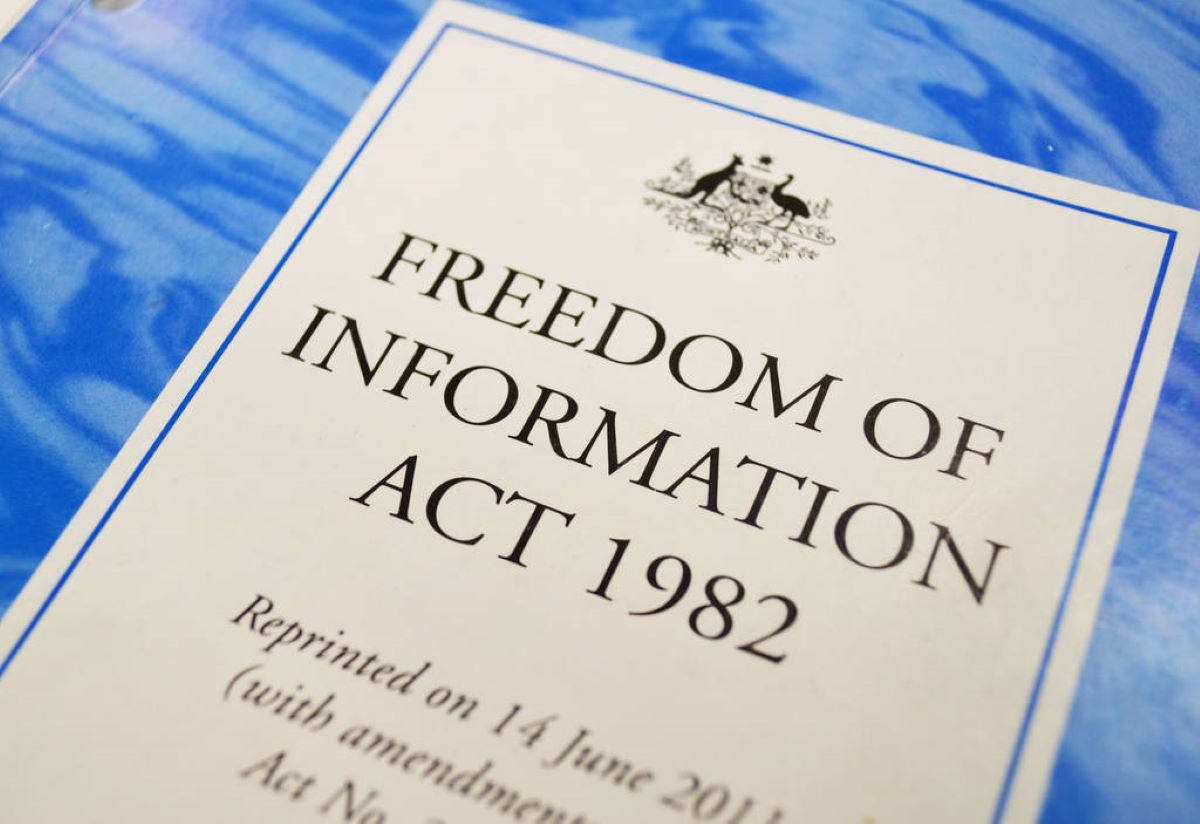
On 1 December 1982, the Commonwealth introduced the Freedom of Information Act.
The Freedom of Information Act 1982 (FOI) is Australian Commonwealth Freedom of Information legislation which gives members of the public rights of access to official documents of the Government of the Commonwealth and of its agencies.
Members of the public have certain rights of access. These include the right to access documents about the operation of government departments and documents that are in the possession of government Ministers or agencies (Freedom of Information Act 1982).
Certain documents are exempt from this, including (but not limited to) documents detailing Cabinet deliberations or decisions; documents disclosing trade secrets; or documents that could damage national security, defence, or international relations, or any document that could damage Commonwealth-State relations.
The Act protects personal privacy by exempting documents the disclosure of which would result in the unreasonable disclosure of personal information about any individual person, including a deceased person.
The request for access to a document must be in writing, and contain a reasonable amount of information about the requested document in order for it to be easier to locate. The application process can also incur charges.
Upon receiving the application, the government agency or Minister who receives the application must take all reasonable steps to inform the applicant that their request has been received within 14 days, and must also notify the applicant of their decision in relation to the request within 30 days of receiving the request.
If access has been refused wholly or in part, reasons must be provided to the applicant. However, not all documents, depend on the contents, that held in a minister’s office will be subject to the Act.
History of the FOI
Before the FOI act of 1982 the various governments of Australia had no obligation to release information to the public, because the traditional Westminster system of governance is fairly closed to public scrutiny.
Between the 1960s and 1980s a number of enquiries were made, looking into the transparency of the Australian government and public services which led to New Industry Law (NAL) reforms. One of the NAL initiatives was Freedom of Information and is considered a “landmark in the development of Australian democracy”.
The Freedom of Information Amendment (Reform) Act 2010 was passed in May 2010, and came into effect in November 2010. The changes were largely targeted at reducing the cost of the FOI applications, which had been criticized by journalists as “prohibitively costly” (Ricketson and Snell, 2002).
Some of the changes to the Freedom of Information Amendment (Reform) Act 2010 for applications received on or after 1 November 2010 include :
- No application fee is payable for an FOI request or application for internal review;
- An applicant who seeks access to their own personal information does not pay any charges;
- For all other applications, the cost of the first five hours of decision-making time is set to be free of charge.
To see other events that happened in Australian history, visit the blog site of Advance Institute of Business by clicking on this link.
Advance Institute of Business has nationally recogised Certificate and Diploma courses available to help you progress in your career.
The Certificate IV in TESOL will allow you to teach English in Australia and many other countries.

The 10773NAT Certificate IV in TESOL is a nationally and internationally recognised qualification that will allow you to teach English to speakers of other languages in Australia and many other countries.
The practical component can be done in your own country (conditions apply), Vietnam or Cambodia. If you choose to do the practical component in Vietnam or Cambodia, we will provide hotel accommodation at no extra cost.
We have the following Certificate and Diploma courses available for your career development:
Teaching Courses
Business
Leadership and Management
Entrepreneurship and New Business
- Certificate III in Entrepreneurship and New Business
- Certificate IV in Entrepreneurship and New Business
Accounting
We will soon also be offering:
- Advanced Diploma of Business
- Diploma of Human Resource Management
- Diploma of Marketing and Communication
And there will be more courses to come in the future.
Our non-accredited speciality courses:
- Career Paths (43 career paths to choose from)
- Corporate Training
- Business English
- English Tutoring
- University and College Tutoring
- Professional and Academic Writing Skills
- Where to Study in Australia
- Education Consultancy
25% discount on all courses for Centrelink and Veteran’s Affairs recipients.
All courses are nationally recognised through our Registered Training Organisation partner Skills Recognition International (RTO 32373). We also have an advisory service on where to study in Australia.
To find out more about these courses, please click this link to arrange a free video or phone call.
Discover more from Craig Hill
Subscribe to get the latest posts sent to your email.
 Craig Hill
One thought on “On this day (Australia): In 1982, the Commonwealth introduced the Freedom of Information Act”