
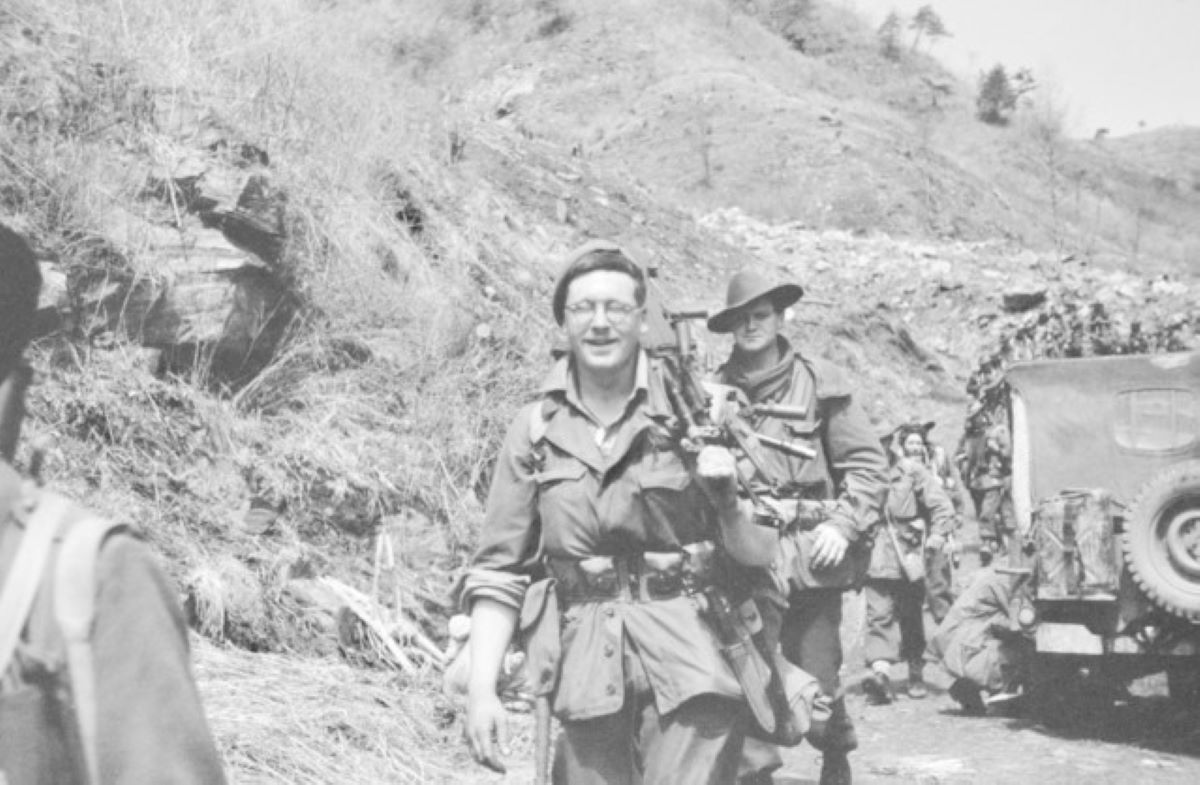
On 5 November 1950, 3RAR successfully assaulted and held crucial hill during the Battle of Pakchon in the Korean War.
The Battle of Pakchon, also known as the Battle of Bochuan, took place ten days after the start of the Chinese First Phase Offensive, following the entry of the Chinese People’s Volunteer Army (PVA) into the Korean War.
The offensive reversed the United Nations Command (UN) advance towards the Yalu River which had occurred after their intervention in the wake of the North Korean invasion of South Korea at the start of the war.
The battle was fought between British and Australian forces from the 27th British Commonwealth Brigade with American armour and artillery in support, and the PVA 117th Division of the 39th Army, around the village of Pakchon on the Taeryong River.
After capturing Chongju on 30 October the British and Australians had been ordered to pull back to Pakchon in an attempt to consolidate the western flank of the US Eighth Army.
Meanwhile, immediately following their success at Unsan against the Americans, the PVA 117th Division had attacked southward, intending to cut off the UN forces as they withdrew in the face of the unexpected PVA assault.
To halt the PVA advance, the 27th British Commonwealth Brigade was ordered to defend the lower crossings of the Taeryong and Chongchon rivers as part of a rearguard, in conjunction with the US 24th Infantry Division further upstream on the right.
During the night of 4/5 November, the PVA and Korean People’s Army (KPA) mounted a full-scale assault on the US 24th Infantry Division, pushing back an American infantry regiment nearly 2 kilometres (1.2 mi).
The PVA/KPA force subsequently turned west, advancing between the Taeryong and Chongchon rivers and threatening the rear of the 27th British Commonwealth Brigade by cutting the Pakchon–Sinanju road.
The following day they attacked an American artillery battery which was guarding a vital concrete bridge near Kujin. The British and Australians then successfully counter-attacked the PVA forces occupying a number of nearby ridgelines during the day but were in turn counter-attacked before being pushed off the high ground during the night.
In their first battle with the PVA, the 3rd Battalion, Royal Australian Regiment (3 RAR) captured a well defended hill with only limited offensive support, and held it in the face of heavy counter-attacks before confused command decisions resulted in a disorganised night withdrawal while still in contact.
The withdrawal threatened to open the 27th British Commonwealth Brigade’s left flank and the Australians were ordered to immediately reposition on the ridge, yet ultimately it was too late to regain the feature in darkness.
However, following heavy fighting the pressure on the Australians unexpectedly ceased after midnight, and parties of PVA were observed beginning to withdraw.
By early morning the PVA attack had been checked and 3 RAR had redeployed to new positions in the paddy fields around the railway crossing north of Maenjung-dong.
The fighting was costly for both sides. Although the Australians halted the advancing PVA 117th Division and inflicted numerous casualties on them, they also suffered heavy losses.
In the aftermath the inexperienced Australian battalion commander—Lieutenant Colonel Floyd Walsh—was relieved of his position by the British brigade commander, having taken over just six days earlier following the death of the previous commanding officer Lieutenant Colonel Charles Green at Chongju.
Nonetheless, the 27th British Commonwealth Brigade succeeded in preventing a PVA break-through at Pakchon, keeping open vital withdrawal routes across the river and securing the UN left flank.
Suffering significant casualties, the PVA offensive was halted the next day due to logistic difficulties. The PVA and KPA were temporarily forced to withdraw north, while the UN successfully reinforced its positions, holding on the Chongchon Line.
Yet by late November the US Eighth Army was again forced to withdraw after the PVA began their Second Phase Offensive, starting a long retreat south. The UN forces withdrew from North Korea to the 38th Parallel where they sought to re-establish defensive positions.
To see other events that happened in Australian history, visit the blog site of Advance Institute of Business by clicking on this link.
Advance Institute of Business has nationally recogised Certificate and Diploma courses available to help you progress in your career.
The Certificate IV in TESOL will allow you to teach English in Australia and many other countries.

The 10773NAT Certificate IV in TESOL is a nationally and internationally recognised qualification that will allow you to teach English to speakers of other languages in Australia and many other countries.
The practical component can be done in your own country (conditions apply), Vietnam or Cambodia. If you choose to do the practical component in Vietnam or Cambodia, we will provide hotel accommodation at no extra cost.
We have the following Certificate and Diploma courses available for your career development:
Teaching Courses
Business
Leadership and Management
Entrepreneurship and New Business
- Certificate III in Entrepreneurship and New Business
- Certificate IV in Entrepreneurship and New Business
Accounting
We will soon also be offering:
- Advanced Diploma of Business
- Diploma of Human Resource Management
- Diploma of Marketing and Communication
And there will be more courses to come in the future.
Our non-accredited speciality courses:
- Career Paths (43 career paths to choose from)
- Corporate Training
- Business English
- English Tutoring
- University and College Tutoring
- Professional and Academic Writing Skills
- Where to Study in Australia
- Education Consultancy
25% discount on all courses for Centrelink and Veteran’s Affairs recipients.
All courses are nationally recognised through our Registered Training Organisation partner Skills Recognition International (RTO 32373). We also have an advisory service on where to study in Australia.
To find out more about these courses, please click this link to arrange a free video or phone call.
Discover more from Craig Hill
Subscribe to get the latest posts sent to your email.
 Craig Hill
One thought on “On this day (Australia): In 1950, 3RAR successfully assaulted and held crucial hill during the Battle of Pakchon in the Korean War”