

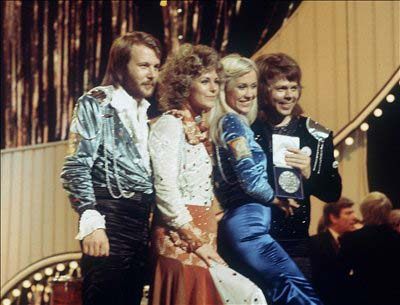
On April 6th 1974, in Brighton, England, at the 19th Eurovision Song Contest, the tiny nation of Luxembourg was devastated when it failed to secure a third consecutive win at the pan-European musical event. The judges did the rest of the world a favour, however, by selecting the Swedish entry as the winner instead. The song was called “Waterloo,” performed by a group called ABBA, which went on to become something of a sensation. ABBA’s win at the annual Eurovision Song Contest launched the group on its monumental international career, marking the first and still only time that the Eurovision Song Contest crowned a previously unknown winner destined for legitimate superstardom.
The Eurovision Song Contest was originally conceived as a way for the member countries of the European Broadcasting Union to participate in a simultaneous live broadcast—a major technical challenge in 1956. From a one-night event involving only seven participating countries in its first year, the contest has grown into a week-long spectacle involving preliminary rounds of competition among representatives of more than 20 countries in Europe, the Middle East, North Africa and the former Soviet Union. But while the annual contest is now one of the most-watched television events in the world, one thing Eurovision has consistently failed at doing is launching new artists to truly international stardom.
The sole, shining exception to this rule is ABBA. The 1988 winner, Celine Dion, was already something of a star prior to her Eurovision victory. The 2006 winner, Lordi, while undoubtedly the finest monster-costumed Finnish metal band of all time, so far enjoys only a cult following outside of northern Europe. ABBA outshines all other hopefuls, both before and after.
ABBA was a Swedish pop/rock group formed in Stockholm in 1972, comprising Agnetha Fältskog, Benny Andersson, Björn Ulvaeus and Anni-Frid Lyngstad. They became one of the most commercially successful acts in the history of pop music, topping the charts worldwide from 1972 to 1982.
ABBA has sold over 375 million records worldwide and still sell millions of records a year, which makes them one of the best-selling music artists, and the second best selling music group in history, behind The Beatles. ABBA was the first pop group to come from a non-English-speaking country that enjoyed consistent success in the charts of English-speaking countries, including the UK, Ireland, the U.S., Canada, Australia, New Zealand, South Africa and the Philippines. The group also enjoyed significant success in Latin American markets, and recorded a collection of their hit songs in Spanish.
The year that ABBA was chosen as Sweden’s Eurovision entry was the second in which contest competitors were allowed to perform in any language they wished. A national-language restriction was reinstated in 1977 before being abolished in 1999. This proved to be critical to ABBA’s international success. While the UK judges awarded ABBA zero points toward their winning total on this night in 1974, their English-language “Waterloo” became an instant hit with the British public; the first of nine UK #1 hits for the biggest group ever launched by the Eurovision Song Contest.
Discover more from Craig Hill
Subscribe to get the latest posts sent to your email.
 Craig Hill
I remember it well!
Craig…OMG I hadn’t thought about them in years….
Love them!
Still a fan of the Group
Thanks for some insight on the Euro contest. I was not aware of it. And how can people not like ABBA? They were great.
euro vision – great fun
ABBA … know we swedes know anything about them when they won. I would stick my neck out here and say that they are the biggest group ever, bigger then Beatles. Still today they are played daily on radio stations the world over. Happy uncomplcated music. See Mama Mia the muscial the most succesful musical in the world. Thanks for going Swedish.