

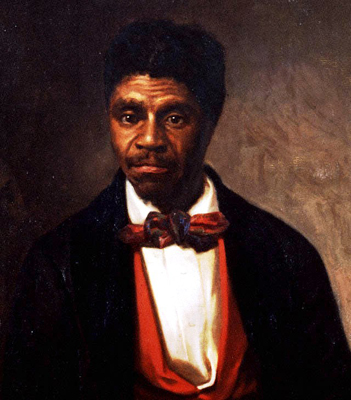
 On March 6th 1857, the US Supreme Court handed down its decision on Sanford v Dred Scott, a case that intensified national divisions over the issue of slavery.
In 1834, Dred Scott, a slave, had been taken to Illinois, a free state, and then Wisconsin territory, where the Missouri Compromise of 1820 prohibited slavery. Scott lived in Wisconsin with his master, Dr John Emerson, for several years before returning to Missouri, a slave state. In 1846, after Emerson died, Scott sued his master’s widow for his freedom on the grounds that he had lived as a resident of a free state and territory.
He won his suit in a lower court, but the Missouri supreme court reversed the decision. Scott appealed the decision, and as his new master, J.F.A. Sanford, was a resident of New York, a federal court decided to hear the case on the basis of the diversity of state citizenship represented. After a federal district court decided against Scott, the case came on appeal to the U.S. Supreme Court, which was divided along slavery and antislavery lines; although the Southern justices had a majority.
During the trial, the antislavery justices used the case to defend the constitutionality of the Missouri Compromise, which had been repealed by the Kansas-Nebraska Act of 1854. The Southern majority responded by ruling on March 6, 1857, that the Missouri Compromise was unconstitutional and that Congress had no power to prohibit slavery in the territories. Three of the Southern justices also held that African Americans who were slaves or whose ancestors were slaves were not entitled to the rights of a federal citizen and therefore had no standing in court.
These rulings all confirmed that, in the view of the nation’s highest court, under no condition did Dred Scott have the legal right to request his freedom. The Supreme Court’s verdict further inflamed the irrepressible differences in America over the issue of slavery, which in 1861 erupted with the outbreak of the American Civil War.
Discover more from Craig Hill
Subscribe to get the latest posts sent to your email.
 Craig Hill
Hi,
They must of been terrible times back then.
A very interesting read.
Nothing like reading and re – learning about HISTORY!
Taney was hoping to settle the matter once and for all. His findings that Clay’s compromises had violated 5th amendment rights are just as suspect as the racial elements of the ruling.
Interesting post. I recently read a story titled something like “The life of a slave girl – told by herself”. It gave me an interesting insight into slavery. It was a free book for my kindle from Amazon.
Lorraine 🙂
I’m not American, so not up to scratch on American law, but it still seems racist and suspect
Very interesting read. Thanks for sharing it!