

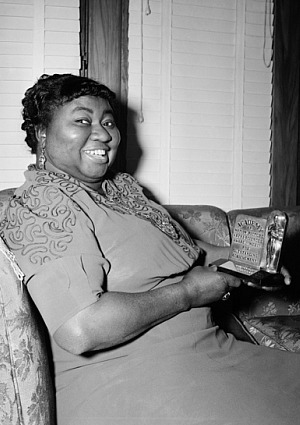
 On February 29th 1940, Gone with the Wind won eight Academy Awards, the most momentous of them being that of Hattie McDaniel, who won Best Supporting Actress for her role as “Mammy,” a housemaid and former slave. She became the first African-American to win an Oscar.
McDaniel was born in Wichita, Kansas, in 1895, and proved herself to be a talented singer and actress as a youth in Denver, Colorado. She left school as a teenager and travelled with several minstrel groups. In 1924, she became one of the first African-American women to sing on U.S. radio. During the Great Depression, she was forced to take work as a ladies’ washroom attendant in a Milwaukee club. The club, which hired only white performers, eventually made an exception and let her sing, and she performed there for a year before leaving for Hollywood.
In Los Angeles, she hada small role on a local radio show called The Optimistic Do-Nuts, quickly becoming the program’s main attraction. In 1932, she made her first film as a Southern house servant in The Golden West. In American movies at the time, African-American actors and actresses were usually only cast as house servants. McDaniel seems to have gone with this stereotype, playing maids and cooks in nearly 40 films in the 1930s. In reply to disapproval expressed by groups such as the National Association for the Advancement of Colored People (NAACP) that she was promoting stereotypes, McDaniel countered that she would rather play a maid on the screen than be one in real life. Additionally, she often challenged the stereotype by turning her maids into lively, independent-minded characters who sometimes made white audiences more than a little uncomfortable.
Her most remembered role was as Mammy in the 1939 film Gone with the Wind. Directed by Victor Fleming from the best-selling Margaret Mitchell novel, the movie remains the highest-grossing movie of all time when inflation is taken into account. Although she was honoured with an Oscar, liberal African Americans attacked McDaniel for her role, in which her character, a former slave, reflected fondly about the Old South.
Her film career declined in the late 1940s, and in 1947 she returned to radio, starring in the nationally broadcast The Beulah Show. In the program, she again portrayed a bubbly Southern maid, but in a very un-stereotypical manner that won approval from the NAACP. In 1951, while filming the first episodes of a television version of the popular show, she had a heart attack. She recovered to do a few more radio programs, but died of breast cancer in 1952, aged 57.
Discover more from Craig Hill
Subscribe to get the latest posts sent to your email.
 Craig Hill
Far too much time passed before the academy recognized Sidney Poitier in 1963. That’s over 20 year’s of all white winners. Thankfully things are changing.. but there are still so much ignorance and inequalities!
The Eye
http://theeyeoffaith.com
A big part of the problem back then was limited oppotunities by production companies for African-American actors
Reblogged this on Leo Donaldson – Motivational Speaker.