

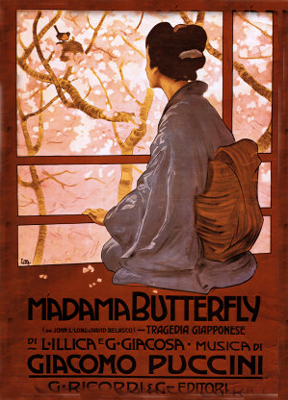
 On February 17th 1904, Giacomo Puccini’s opera Madame Butterfly premiered at the La Scala theatre in Milan, Italy. It was not received well, and lasted only one performance.
The young Puccini had decided to dedicate his life to opera after seeing a performance of Giuseppe Verdi’s Aida in 1876. In his later life, he would write some of the best-loved operas of all time: La Boheme (1896), Tosca (1900), Madame Butterfly (1904) and Turandot (left unfinished when he died in 1906). Not one of these, however, was an immediate success when it opened. La Boheme, the now-classic story of a group of poor artists living in a Paris garret, earned mixed reviews, while Tosca was downright panned by critics.
While supervising a production of Tosca in London, Puccini saw the play Madame Butterfly, written by David Belasco and based on a story by John Luther Long. Taken with the strong female character at its centre, he began working on an operatic version of the play, with an Italian libretto by Giuseppe Giacosa and Luigi Illica. Written over the course of two years, including an eight-month break when Puccini was badly injured in a car accident, the opera made its debut in Milan in February 1904.
Set in Nagasaki, Japan, Madame Butterfly told the story of an American sailor, B.F. Pinkerton, who marries and abandons a young Japanese geisha, Cio-Cio-San, or Madame Butterfly. In addition to the rich, colourful orchestration and powerful arias that Puccini was known for, the opera reflected his common theme of living and dying for love. This theme often played out in the lives of his heroines, women like Cio-Cio-San, who live for the sake of their lovers and are eventually destroyed by the pain inflicted by that love.
Perhaps because of the opera’s foreign setting or perhaps because it was too similar to Puccini’s earlier works, the audience at the premiere reacted badly to Madame Butterfly, hissing and yelling at the stage. Puccini withdrew it after one performance. He worked quickly to revise the work, splitting the 90-minute-long second act into two parts and changing other minor aspects.
Four months later, the revamped Madame Butterfly went onstage at the Teatro Grande in Brescia. This time, the public greeted the opera with tumultuous applause and repeated encores, and Puccini was called before the curtain 10 times. Madame Butterfly went on to huge international success, moving to New York’s Metropolitan Opera in 1907.
Discover more from Craig Hill
Subscribe to get the latest posts sent to your email.
 Craig Hill
Thank you for this. It’s interesting to know the back story of Madame Butterfly. I’ve never heard it except for that famous part…I think where Madame Butterfly is about to kill herself. Why did the soldier abandon her?
People sometimes do live and die for love. Sometimes I think writers, musicians and other artists live and die for their art.
Whether we live or die for art, beauty comes from it. Sometimes tragic beauty.
The soldier, Pinkerton, married the 15 year old Japanese girl for convenience only, always intending to leave her once he found a “proper” American wife. He left her shortly after the wedding, but not before she had been denounced by her family and friends for converting to Christianity, because of her love and commitment to Pinkerton. He never realised the depth of her true love for him.
After Pinkerton left, she gave birth to his child, unknown to Pinkerton, and refused to listen to everybody that Pinkerton would not be coming back. Three years later, however, she is told that Pinkerton is coming back, but is so excited that she doesn’t wait for the end of the message. Pinkerton will arrive with his new wife Kate.
On his return, he finds out about his son, and his new wife agrees to take the child from Cio-cio and raise him in America. However, when Pinkerton finally realises the mistake he has made, he admits he is too cowardly to tell her, and leaves that to his new wife and others. Cio-cio refuses to give up the child unless Pinkerton comes personally, which he does, just in time to see her go behind a screen and cut her own throat with her father’s hari-kari knife.
It is a deeply moving story, and one of the first operas I saw as a youth studying music at school. It is still one of my favourites. Hope you get to watch it entirely one day.