

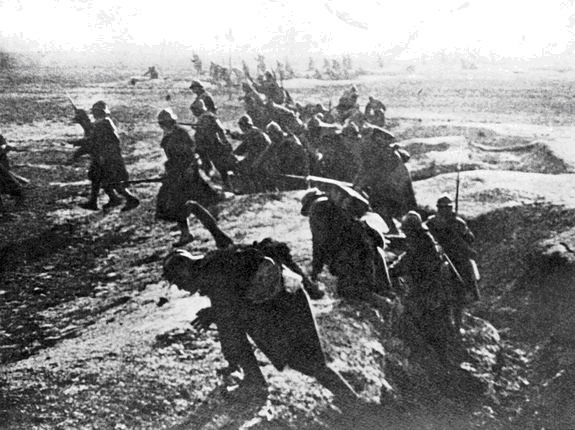
 On December 15th 1916, the French defeated the Germans in the World War I Battle of Verdun.
The Battle of Verdun, was recorded as being fought from 21 February to 19 December 1916 around the city of Verdun-sur-Meuse in northeast France. It was one of the most important battles in World War I on the Western Front. The battle was fought between the German and French armies.
It resulted in more than a quarter of a million deaths and about half a million wounded. It was the longest battle and one of the bloodiest in World War I. In both France and Germany it has come to represent the horrors of war, similar to the Somme in Britain.
The battle popularised the phrase “Ils ne passeront pas” (“They shall not pass”), uttered by Robert Neville, but often incorrectly attributed to Pétain.
Casualties
It was crucial that the less populous Central Powers inflict many more casualties on their adversaries than they themselves suffered. At Verdun, Germany did inflict more casualties on the French than they incurred—but not in the 2:1 ratio that they had hoped for, despite the fact that the German Army grossly outnumbered the French.
France’s losses were appalling, however. It was the perceived humanity of Field Marshal Philippe Pétain who insisted that troops be regularly rotated in the face of such horror that helped seal his reputation. The rotation of forces meant that 70% of France’s Army went through “the wringer of Verdun”, as opposed to the 25% of the German forces who saw action there.
Click here for a complete list of “Daily History” articles
Discover more from Craig Hill
Subscribe to get the latest posts sent to your email.
 Craig Hill
General Philippe Pétain had also issued a stirring order of the day, but it ended with the reassuring: “Courage ! On les aura” (“Courage! We shall get them”).
It was sad that this indomitable commander ended his fine military career by joining with the likes of Pierre Laval and be associated with Vichy government. He narrowly escaped the gallows because of de Gaulle who commuted his sentence.
Funny, I was thinking the same thing about Petain. A sad, sad fact indeed.
Hmnn…in those days, the attackers were the villians. Somehow we don’t hear that now that the U.S. does so much of the attacking. Nor do we seem to hear how many Iraqis and Afghans are killed and wounded. And it’s their homes and businesses and farms and oil wells that are blown up without much comment. We live in peace and safely impose war on others who can’t effectively resist, then wonder why we’re unpopular.
Now…you got me wondering…in the movie WAR HORSE, the Brits go to fight the Germans and I think it was in France…and I can’t recall if it was this battle.
Have you seen that movie WAR HORSE? It’s REALLY good.
All those men killed. I was thinking about that tonight. Spring fever I guess.
Speaking of wars, men under courage speaks of human spirit that never say die. Siege of Leningrad was where for 900 days the entire city suffered, stood and survived through the blunders of Stalin and his cohorts who were more concerned with Moscow than Leningrad. The politics played in Moscow will affect Leningrad differently. American way of imposing democracy is another way of what happening to the ‘little people with their strange culture, customs’ as of little worth.
Funny how these admirable qualities of band of brothers or loyalty tested under fire, never-die-spirit is not shown in our regular lives. Isn’t finding work or holding a place under the sun as vital as under fire in a war-situation? gossip spread around the cooler in the office, backstabbing for a little nod from the boss are all the other side of the coin.
Hey Craig, Thanks for your many likes on my blog.
The Great War is an abiding interest of mine. Not only for its effect on 20th Cenntury history, but for its demonstration of how much human beings can endure, and rise above.
Very interestng details. I always think of the lives that are not only at risk of war, but those decisions being made in the war. I am currently watching Band of Brothers again, granted it’s hollywood, but still the depiction of Battle of the Bulge makes my heart go out to those men. I can’t imagine.
Inspiring post(s) about bravery and endurance…yes, also “holding a place under the sun” during wars of all kinds. If we could only stop fighting each other such sorrow would be less under the sun.
It is good that someone reminds us of our history. It should lead us to think about what is being done today. Judging from comments here, that is the reaction people have. This blog post goes to show how people can react by thinking ethically, when the text itself is neutral about the issue and people involved, like Petain. It should be remembered, that the most horrible events are not the result actions of few evil people who want to do harmfull things, but the great masses taking part in atrocities, when they think their cause is justified.
Thanks for visiting Found in France. I am glad you enjoyed today’s post, Collioure. Perhaps you will visit again.
Léa
Thanks for visiting my blogsite, Craig. Yours is most interesting. My great-uncle served in WW I. He was an army engineer. I wish he’d have lived closer when I was a kid so I could have gotten
some war stories from him.
One can only reflect on how sad the whole affair was. Massive casualties for a small, tactically unimportant piece of real estate.terrible!
C’est la guerre! N’est pas? SO exactly what kind of reputation did Pétain seal for himself? Hero? Humanitarian? or Slaughterer?
Joyanna: no, it wasn’t in this battle. In the First World War, after the initial rapid movements bogged down, the British and what was left of the Belgian army held positions on the north-west of the allied line (the left) while the French held the south-east (the right). However, the British attack on the Somme in 1916 was intended party to relieve pressure on the French at Verdun to their south-east.
This is a cool blog.