

.
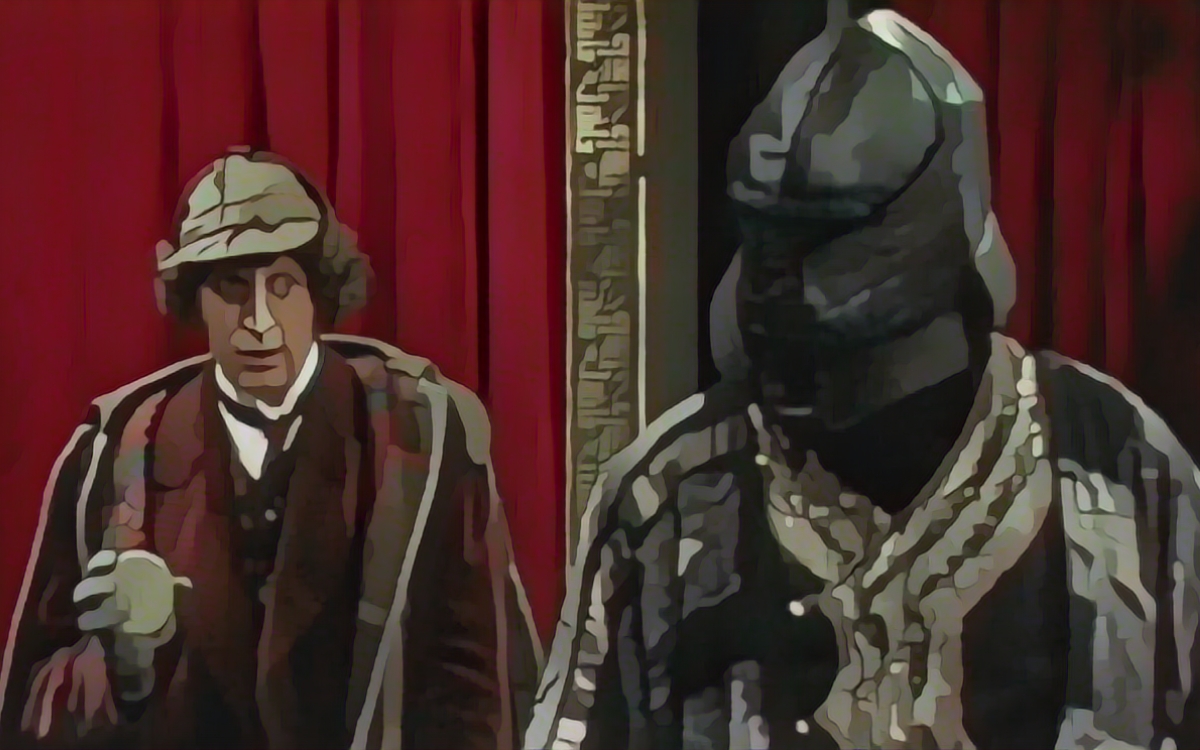
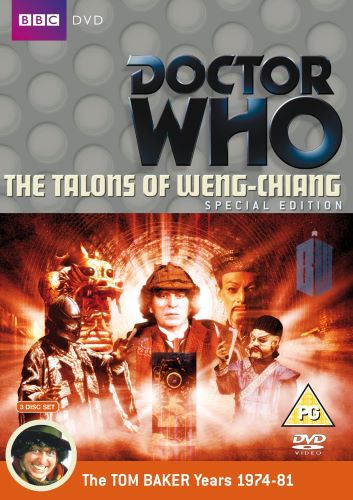
The Talons of Weng-Chiang is the sixth and final serial of Doctor Who Season 14, originally broadcast in six episodes from 26 February to 2 April 1977. It was written by Robert Holmes and directed by David Maloney. It stars Tom Baker as the Fourth Doctor, Louise Jameson as Leela, Trevor Baxter as Professor Litefoot, Christopher Benjamin as Henry Gordon Jago, John Bennett as Li H’sen Chang, and Michael Spice as Magnus Greel.
In foggy Victorian London, the Doctor and Leela investigate strange disappearances linked to a music-hall magician and a hidden master who seeks power through advanced technology. Teaming up with the warm-hearted Jago and the sharp-minded Litefoot, they follow clues from stage to sewers, face a lethal automaton and a giant rat, and uncover the truth behind the name “Weng-Chiang.”
Episode 1
Fog curls off the Thames as the Doctor, dressed like a consulting detective for fun, and Leela step into Victorian London and straight into a string of vanishings. A cabman’s body turns up at Professor Litefoot’s morgue with his lungs strangely collapsed, as if something sucked the life out of him.
At the Palace Theatre, flamboyant impresario Henry Gordon Jago boasts of packed houses for Li H’sen Chang, a Chinese illusionist whose patter charms the crowd while his ventriloquist’s doll, Mr. Sin, stares with glassy malice. Backstage, men with scorpion tattoos whisper about their “god” Weng-Chiang, whose lair lies beneath the city in opium dens and culverts. The Doctor tests residues and finds future-tech traces where no such thing should exist.
Chang smiles too smoothly when asked about missing girls. Leela, hunting in alleys, follows tong members through a trapdoor to sewers patrolled by something vast that leaves clawed tracks slick with slime. Jago and Litefoot cross paths with the Doctor and begin a wary partnership: one all bluster, one dry good sense. In a cellar shrine lit by dragon masks, a veiled figure breathes through a rasping mask and demands more “life-essence.” Leela edges along a ledge above black water. A wake boils, teeth flash, and a giant rat lunges up at her.
Episode 2
Leela scrambles clear, the Doctor driving the rat back with flare and fumes. He and Litefoot trade theories: a cult feeding victims to something below while a sick man above bleeds others for strength. At the theatre, Jago preens for the Doctor then admits he hears footsteps when the house is empty and finds rooms he cannot keep locked.
Chang performs miracles (swords through baskets, hypnotic trances) and the Doctor notes the tells of real mesmerism threaded through stagecraft. Mr. Sin moves when no hand touches it. Following tong couriers through a laundry into tunnels, the Doctor finds a laboratory stitched together from Victorian pipes and alien lenses. A withered shape reclines on a throne-chair, hidden by silk and a dragon screen.
Later, in Litefoot’s gentle kitchen, Leela tears into roast beef with her fingers while they discuss the vanished: girls poor enough that no one asks after them. Chang retaliates. He lures Leela with hypnotic suggestions; she resists at the last second and bolts. The Doctor returns to the theatre’s cellars, discovers a hidden door in a prop idol, and stares at a power conduit humming with energies centuries ahead of its time. Behind him, Mr. Sin’s shadow tilts. A knife glints. The smile never changes.
Episode 3
The attack jolts the Doctor into action; Mr. Sin scuttles away with inhuman speed. Jago and Litefoot finally compare notes and form an unlikely detective duo, one with lanterns and boasting, the other with method and autopsy reports. Chang, feeling pressure, abducts Leela and strings her above the sewer channel as rat-bait; the Doctor arrives in time, cuts her free, and leaves a trail of pepper and fire to drive the beasts back.
In the lair, the veiled commander rages: the life-draining cabinet still fails to restore him. He demands the “time cabinet” that brought him here be found. The Doctor hears a name in whispers (Weng-Chiang) and dredges up a legend from the fifty-first century: Magnus Greel, the Butcher of Brisbane, a war criminal who fled in an experimental time capsule and was rumoured to have died in transit.
His body, warped by zygma energy, would need constant infusions of bio-energy. The pattern fits. Chang’s show falters as police prowl the wings; he tries to shoot the Doctor onstage and flees wounded into the fog, where the great rat repays him for years of cruelty. Litefoot reveals a curiosity in his possession: a lacquered Chinese cabinet dredged from a wreck. The Doctor opens it and feels temporal air on his face.
Episode 4
Greel moves fast. Tong men raid Litefoot’s house and steal the cabinet while Leela, attempting Victorian manners over dinner, proves more efficient with chopsticks than etiquette. The Doctor examines residues inside the box and confirms it: this is a time capsule, crippled by a botched zygma jump.
Jago blunders into the theatre cellar and is seized, trussed like a prop, and left as bait; Litefoot, searching for him, joins the collection. Greel relocates to a mansion with a dragon-headed furnace and installs his stolen cabinet in a new laboratory, ordering Mr. Sin to guard it while he prepares a final harvest of life-essence. The Doctor frees Jago and Litefoot with a grin and a screwdriver, then turns their talents to good use: decoys, lantern signals, and a trap to flush Greel.
They set the Palace for one last performance. Chang, hunted and broken, staggers onstage, tries to reclaim power with one last illusion, and fails. In a back alley, dying, he tells the Doctor of the “god” who arrived from a blazing box and promised him glory. Armed now with the truth and two brave amateurs, the Doctor traces Greel to his dragon lair. The furnace roars. Above it, the cabinet waits, hungry as a mouth.
Episode 5
Greel’s mask slips. He is the wreckage of a man wrapped in silk, skin collapsed, voice hissing through damaged lungs. He straps victims to a crystalline funnel and drinks their life through the zygma condenser, growing strong for minutes before the decay returns. Mr. Sin (the “Peking Homunculus,” a future killing toy with a pig brain) serves him with vindictive glee.
The Doctor crashes the lab and names Greel: Magnus Greel, whose crimes stained a continent and whose escape broke time. Greel shrieks denial, then boasts and throws a lever. Jago and Litefoot distract tong guards with bluster and brandy while Leela, knife-first, frees prisoners. In the struggle, Greel snatches Leela and straps her under the funnel; the machine hums, crystal brightening as it starts to drink.
The Doctor dives for the control rods and reroutes the feed to blow a safety seal. Mr. Sin rakes the room with a stolen gun and drives them back. Outside, police batter gates. Inside, the zygma core whines toward overload. Litefoot takes a staser blast for Jago and glares the pain away with English stoicism. The Doctor chooses: he can save Leela or the cabinet: but not both. He yanks cables free. Sparks leap. The dragon’s mouth glows white.
Episode 6
The lab becomes a battlefield. The Doctor smashes the condenser, freeing Leela, and turns the energy feedback back into the life-drain, making it fatal to touch. Greel lunges for a new victim and the Doctor kicks the lever; the tyrant tumbles into his own beam and collapses into dust with a scream that rattles glass.
Mr. Sin, freed of orders, goes feral: climbing consoles, firing wildly, trying to vent the cabinet to full power. Jago tackles him and is thrown; Litefoot clubs the homunculus with a chair to no effect; Leela’s knife pins a joint and the Doctor pulls the mains: Mr. Sin twitches, sparks, and winds down at last. Police flood the house as the zygma residue ebbs. The time cabinet, damaged beyond use, sits inert.
The Doctor thanks Jago and Litefoot with a bow that makes them both blush, then refuses their offers of a celebratory port: he cannot explain the TARDIS over sherry. Outside, dawn pushes fog into tatters. The Palace Theatre will open that night as if nothing happened, and two unlikely friends will dine together and tell a story no one will believe. In a quiet yard, the blue box fades. Somewhere far ahead in time, history exhales as a paradox closes.
Themes
As a gaslit opera of menace and showmanship, The Talons of Weng-Chiang closes Season 14 with swagger and precision. Its theatrical scale, clockwork plotting, and Tom Baker–Leela chemistry place it on the era’s top shelf: standing beside Pyramids of Mars and The Robots of Death, and only a shade under the moral thunder of Genesis of the Daleks.
If The Seeds of Doom roars and The Brain of Morbius broods, this one luxuriates: confident, witty, and indelible. It also carries a complicated legacy in its period portrayals, a reminder that even great Doctor Who can be brilliant and dated at once. Many of the portrayals are now considered as racist.
The serial threads continuity with poise. It builds directly on the partnership forged in The Face of Evil and honed in The Robots of Death, then caps the Hinchcliffe–Holmes run before the colder, tighter minimalism of Horror of Fang Rock. Its “science in ritual robes” idiom echoes Pyramids of Mars and The Masque of Mandragora, while its Victoriana casts a long shadow over later excursions like The Unquiet Dead, The Crimson Horror, and Thin Ice.
From here, the season-turn carries the pair toward Image of the Fendahl and The Sun Makers, but by its final bow The Talons of Weng-Chiang has already done the heavy lifting: binding past strengths to future directions and leaving the programme striding into the dark with supreme confidence.
.
This is a chapter from Craig Hill’s book “Doctor Who – The Fourth Doctor”, chronicling every episode featuring the Fourth Doctor. It is available on Amazon.
.
To view the list of other Doctor Who serials, please click this link
Doctor Who Episode Guides for Sale on Amazon
Step aboard the TARDIS and journey across the universe with every incarnation of The Doctor in this series of unofficial Doctor Who episode companions.
This collection of twelve books explores every televised adventure of the Time Lord’s lives.
Each volume in the series delves into a different Doctor’s era, offering detailed episode guides, behind-the-scenes insights, character profiles, and story synopses.
Once you have clicked the link, choose which book you want, and then whether you want to buy the Kindle (eBook) or Paperback versions.
Previews are available before you buy.
Visit the Australian Book and Language Studio
Discover more from Craig Hill
Subscribe to get the latest posts sent to your email.
 Craig Hill