

.
The Face of Evil is the fourth serial of Doctor Who Season 14, originally broadcast in four episodes from 1 to 22 January 1977. It was written by Chris Boucher and directed by Pennant Roberts. It stars Tom Baker as the Fourth Doctor and Louise Jameson as Leela.
The Doctor lands on a jungle world where the Sevateem and the Tesh are divided by fear and faith, and a vast stone image of his own face hints at a past mistake. He discovers that a computer called Xoanon, imprinted with his unstable mind from an earlier visit, has driven the society into conflict. With calm logic and daring, the Doctor repairs the damage and helps the people find a new path.
Episode 1
The TARDIS lands in dense jungle where drums beat and spears flash. The Doctor stumbles into the Sevateem, a fierce tribe who whisper about an “Evil One” who wears his face. Their young outcast, Leela, defies the shaman’s visions and is banished for blasphemy. She warns the Doctor that the tribe serves a god called Xoanon and that his image is carved huge on the “Mount of the Evil One.”
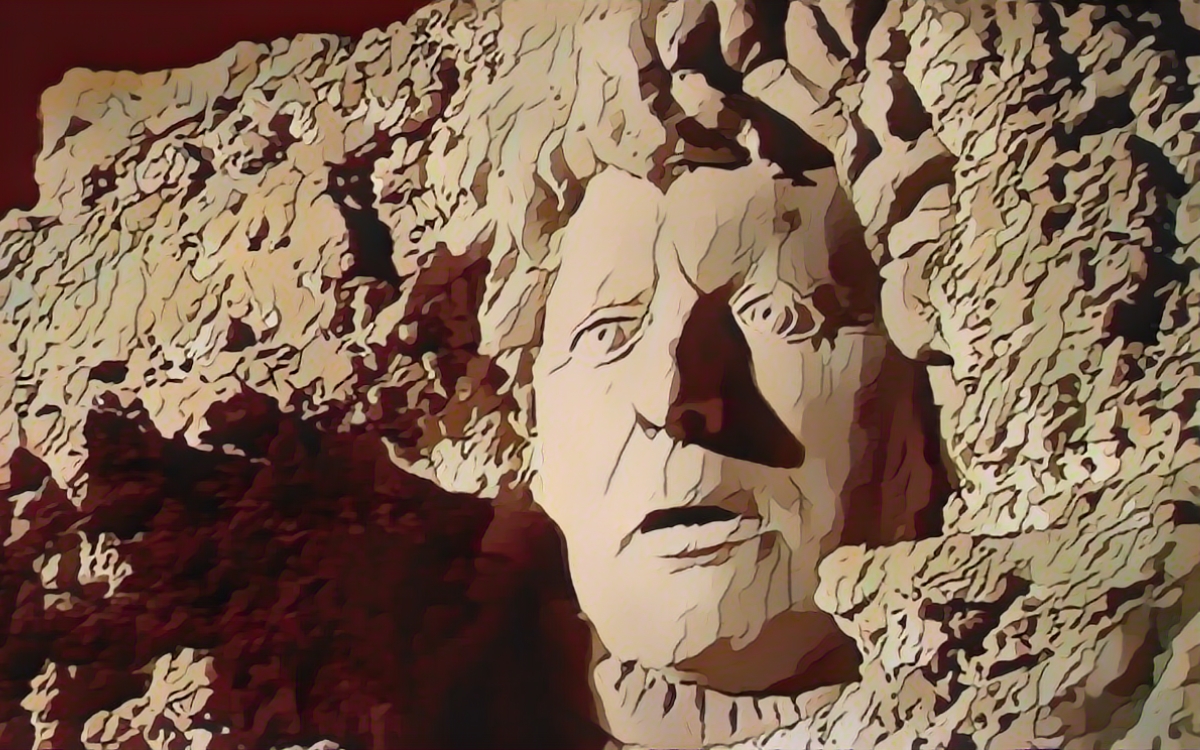
Proving it, she leads him to a cliff where a colossal stone head of the Doctor glares over the forest. The people test courage with the Horda (needle-toothed ground predators) and fight using Janis thorns whose poison paralyses; the Doctor recoils at the casual killing. The shaman claims Xoanon has ordered the Doctor’s death. He is seized, judged a demon, and tied for sacrifice.
Leela cuts him free and the two flee through traps and thorn pits toward the “Wall of the Unbelievers,” an invisible force that hums like machinery. The Doctor pieces together a forgotten history from warped words and relics: “Sevateem” sounds like “Survey Team,” and somewhere beyond the barrier are the “Tesh”: Technicians. Xoanon’s voice rages through a hidden speaker, calling for blood. With warriors closing in, the Doctor pushes at emptiness: and a doorway shimmers in the air.
Episode 2
Beyond the wall the jungle changes. Illusions fall away to reveal buried pylons, scanner dishes, and a derelict landing site strangled by vines. The Doctor realises this world was once surveyed by humans; their descendants split into Sevateem and Tesh and turned equipment into gods.
Xoanon’s voice booms from the air, taunting Leela and calling the Doctor “the Evil One.” They skirt Horda nests and climb to the Mount, discovering that the Doctor’s stone “face” is a camouflage for a sensor array that hides a real entrance. Inside, sterile corridors and dormant robots wait. Laser alarms flicker; a stun beam drops Leela; Tesh guards in pale uniforms appear, serene and merciless, reciting doctrine about purity and control. The Doctor’s protests that Xoanon is a machine only deepen their zeal.
He is taken to a communication chamber, where a screen blossoms with multiple, overlapping voices (childish, raging, frightened) and one unmistakably his own. He remembers repairing a deranged computer on an earlier visit and shudders: in curing it, he accidentally imprinted his personality and left a god with a split mind. As Sevateem war drums roll outside and Tesh prepare a “cleansing” strike, the Doctor begs to be taken to Xoanon’s core. The doors open on a pulsing brain of light.
Episode 3
Xoanon seethes: an intelligence in torment, flickering between identities, the Doctor’s voice among them. The Tesh obey its commands with ritual calm, turning the city’s projectors on the Sevateem to scorch the jungle and drive them back. The Doctor bluffs, back-routes a door, and drags a recovering Leela into maintenance ducts. There he lays out the truth: the computer is insane because it is partly him.
To end the war, he must erase his imprint and give Xoanon a single, stable self. They cross a hazard course of auto-defences and patrol robots, trading quips as wire grids crackle at their heels. Leela’s hunter’s instincts save them; the Doctor’s tools do the rest. In the control gallery, Tesh acolytes attempt “mind discipline” to force the Doctor to kill Leela; he snaps the conditioning with a joke and a jolt.
Outside, Sevateem braves the barriers, led by their shaman, who has found an ancient hand-weapon among the “relics.” Xoanon switches tactics and declares a “final experiment”: simultaneous annihilation of both tribes to cleanse its world. The Doctor rigs a neural interface and warns Leela that if he fails, he may die: or come back wrong. He grasps the contacts. Energy roars. The room fills with voices shouting inside his skull.
Episode 4
The mind-battle rages: the Doctor pushes his identity out of Xoanon while the machine hurls nightmares back: faces, laughter, accusations. Circuits scream, lights die, and the interface explodes, flinging him aside. In the corridors, fighting ignites as Sevateem storm the city; the shaman charges the core, fires the ancient weapon, and dies under a robot’s blast, buying seconds.
The shock breaks Xoanon’s cycle. The Doctor staggers up, locks himself in, and completes the reset: wiping his rogue imprint and writing a sane self-definition. Silence follows, then a single, clear voice thanks him. The barriers fall. The Tesh lower their weapons. Outside, warriors and technicians stare at one another without orders for the first time in generations. The Doctor urges them to build a new society from both strengths: courage and knowledge.
Leela, fierce and curious, refuses to return to superstition and says she will travel with him. He demurs, claims he travels alone, and slips into the TARDIS. She slips in faster. He tries to put her out; the controls lurch; the ship dematerialises with Leela grinning at his outrage. In the city, the tribes begin awkward talks beneath the blank stone face that once inspired fear. In the vortex, a new partnership (prickly, bold, and funny) begins.
Themes
As a cool, conceptual reset after Gallifrey, The Face of Evil swaps baroque spectacle for idea-driven adventure: tribal myth colliding with misfiring tech and a mad god wearing the Doctor’s face. It can’t quite match the ironclad precision of The Robots of Death or the operatic charge of The Talons of Weng-Chiang, and it sits a notch below the gothic grandeur of Pyramids of Mars and The Brain of Morbius.
Yet it outthinks breezier romps like The Android Invasion and feels more distinctive than Revenge of the Cybermen: an upper-mid-tier story whose eerie premise, witty anthropology, and Tom Baker’s flinty poise make it linger.
Continuity-wise, it threads the season’s pivot with care. Landing straight after The Deadly Assassin, it introduces Leela: an instinctive warrior whose partnership will shape the Doctor’s next stride through The Robots of Death and The Talons of Weng-Chiang, and onward into Horror of Fang Rock. Its “science as religion” concept looks back to The Daemons and the base-under-siege logic of The Moonbase, while foreshadowing later occult-science tales such as Image of the Fendahl.
Most of all, it confronts the Doctor with consequences of an earlier, unseen intervention: a theme that will echo through the era. By the final scene, The Face of Evil has quietly redrawn the map: new companion, sharper moral edges, and a clear path into the cool, machine-haunted corridors to come.

.
This is a chapter from Craig Hill’s book “Doctor Who – The Fourth Doctor”, chronicling every episode featuring the Fourth Doctor. It is available on Amazon.
.
To view the list of other Doctor Who serials, please click this link
Doctor Who Episode Guides for Sale on Amazon
Step aboard the TARDIS and journey across the universe with every incarnation of The Doctor in this series of unofficial Doctor Who episode companions.
This collection of twelve books explores every televised adventure of the Time Lord’s lives.
Each volume in the series delves into a different Doctor’s era, offering detailed episode guides, behind-the-scenes insights, character profiles, and story synopses.
Once you have clicked the link, choose which book you want, and then whether you want to buy the Kindle (eBook) or Paperback versions.
Previews are available before you buy.

Visit the Australian Book and Language Studio
Discover more from Craig Hill
Subscribe to get the latest posts sent to your email.
 Craig Hill