

.
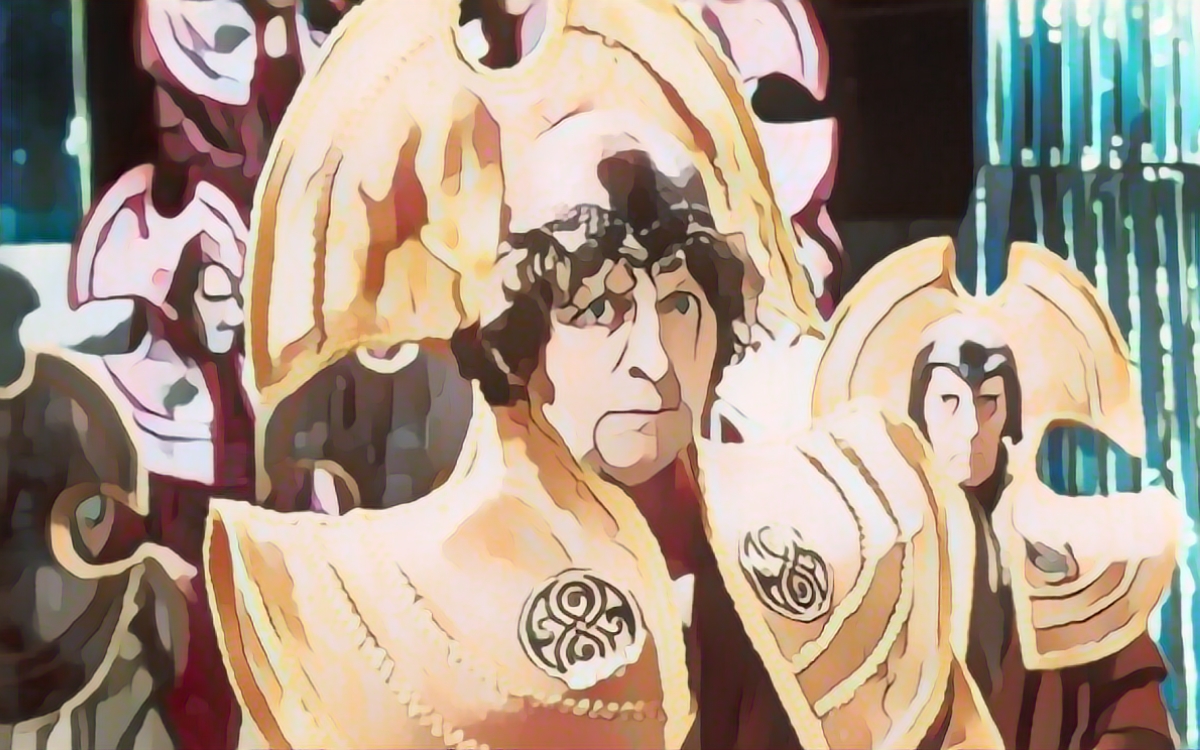
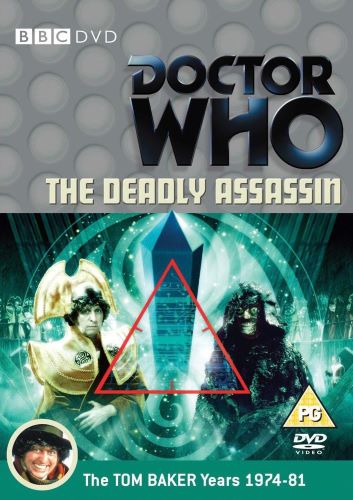
The Deadly Assassin is the third serial of Doctor Who Season 14, originally broadcast in four episodes from 30 October to 20 November 1976. It was written by Robert Holmes and directed by David Maloney. It stars Tom Baker as the Fourth Doctor, Peter Pratt as the Master, Bernard Horsfall as Chancellor Goth, and Angus MacKay as Cardinal Borusa.
Returning alone to Gallifrey, the Doctor is caught in a political storm and framed for the assassination of the Time Lord President. To clear his name he enters the Matrix—a dangerous dream world—where he battles Goth and uncovers the truth. Behind the plot stands the decayed Master, seeking to tap the Eye of Harmony to restore himself at any cost. With quick thinking and fierce moral courage, the Doctor exposes the conspiracy and saves his home world, showing the darker intrigue of Time Lord society.
Episode 1
The Doctor receives a shocking premonition: on Gallifrey, the Time Lord President will be assassinated during the Resignation ceremony. He pilots the TARDIS home and is nearly refused entry to the Citadel, slipping past chancellery guards to warn anyone who will listen.
Castellan Spandrell arrests him as a trespasser; Coordinator Engin coolly notes his story for the record. In the Panopticon, the masked President proceeds toward the dais while trumpets echo beneath the great dome. The Doctor spots a staser rifle hidden in the galleries, realises he’s been herded toward it, and understands the trap: someone wants the blame to land on him. He grabs the weapon to search for the real shooter and, in that instant, the President unmasks. A shot tears the air. The President falls dead.
Guards tackle the Doctor and drag him away as the Panopticon erupts in panic. Evidence piles up obscenely fast: his prints on the rifle, his unauthorised arrival, his pre-knowledge of the crime. In the quiet after the uproar, Spandrell sees too many coincidences, but the law is the law. Behind the pomp, a hooded figure pads through forgotten catacombs, whispering to a rotting TARDIS and a scorched, skull-faced shadow. The Doctor is framed. The game has only begun.
Episode 2
Condemned in hours, the Doctor invokes ancient privilege: he declares himself a candidate for the vacant Presidency, halting proceedings and winning access to information that might clear his name. With Spandrell’s wary help and Engin’s technical curiosity, he follows a thread into the APC net (the Time Lords’ living computer, the Matrix) where every mind-leaf of Gallifrey is recorded.
Somewhere inside its psychic wasteland, the assassin’s trace remains. Meanwhile, in the ossuary tunnels, Chancellor Goth kneels before a burned, desiccated survivor: the Master, reduced to a skeletal husk yet still brilliant and venomous. The Master needs the ceremonial regalia and the secrets under the Panopticon to steal power enough to cheat death; Goth wants absolute office. On the surface, public fear curdles into political opportunism.
The Doctor jacks into the Matrix and wakes in a hunting ground stitched from memory and nightmare: jungles that turn to deserts, abandoned railways that loop into canyons, storm skies humming with unseen wires. A faceless pursuer snipes, sets snares, and toys with him, using the terrain like a weapon. In the real world, Engin reads the Doctor’s life signs spiking and falling as if he’s running and bleeding for real. In the unreal, a rifle cracks; sand erupts beside the Doctor’s head. The hunter laughs and closes in.
Episode 3
The Matrix becomes a killing maze. The Doctor crawls through thorn scrub that becomes razor wire, sprints across a blasted salt pan, dodges a steam train that screams from nowhere, and staggers into a swamp where reeds tug at his boots. The hunter is merciless (gas traps, tripwires, a camouflaged minefield) and always one step ahead, reading the Doctor’s moves through stolen knowledge.
Outside, Spandrell pushes Engin to intervene; inside, that is impossible without frying the mind they’re trying to save. The Doctor turns and fights in bursts: feints with a flare, a bluff with a cliff edge, a snatched knife that buys him seconds. At last he springs his own ambush and rips away the hunter’s mask: Chancellor Goth, not merely complicit but the assassin himself. Goth grins and doubles down, driving the Doctor into the black water where roots knot like snakes.
Fingers close on the Doctor’s throat. He sinks. Bubbles trail upward and burst in the stifling heat. On Gallifrey, alarms shriek; Engin shouts that the Doctor’s brain activity is crashing. In the swamp, the surface folds over him, a dull green lid. The hunter’s shadow watches, patient and sure, as the last pockets of air boil from the Doctor’s lips and the mud swallows his face.
Episode 4
With his life signs flatlining, the Doctor claws one last breath from muck, turns the struggle, and forces Goth to surface. Technicians cut the Matrix link. Both men collapse in the Panopticon chamber: Goth dying from injuries sustained in the mindscape, the Doctor barely conscious. Before he slips away, Goth gasps the truth: he conspired with the Master, who even now works in the bowels of the Citadel.
The Master seizes the chaos, steals the Sash and Rod of Rassilon, and breaks into the Eye of Harmony beneath the Panopticon: a captured stellar singularity that powers Gallifrey. He will tap its energies to renew himself, even if the planet tears apart. Earthquakes ripple through the city as protective fields fail. The Doctor dives into the underworks with Spandrell, threading ancient service galleries to the Eye’s control cradle. There, the Master (black-robed, skull-faced) clamps a converter into place and drinks the first spill of power.
The Doctor wrenches the linkage, reroutes feedback, and slams the containment back online. The Citadel steadies; the Eye seals. The Master, thwarted, pitches into darkness and vanishes into a hidden exit, alive to scheme again. Later, with the Presidency still vacant and his name cleared, the Doctor declines power and slips back to his TARDIS. Gallifrey endures; so does danger.
Themes
As a cold, barbed pivot into Gallifreyan politics, The Deadly Assassin is both audacious and assured: half conspiracy thriller, half surreal nightmare in the Matrix. Measured against its neighbours, it stands shoulder to shoulder with Pyramids of Mars and The Robots of Death, and only a whisper beneath the grand theatricality of The Talons of Weng-Chiang, while feeling more cerebral than the feral charge of The Seeds of Doom.
Tom Baker’s solo turn has flinty focus, Robert Holmes’s world-building is razor-clean, and the imagery (steam, scaffolds, and that drowning sun) lodges deep. In the grand tally of the era, it is top-tier classic Doctor Who: brisk, bold, and unafraid to redraw the map.
Continuity-wise, it stitches past and future with uncommon precision. The Time Lords introduced in The War Games and tempered in The Three Doctors are recast here as fallible politicians; the Gallifreyan summons from The Hand of Fear lands the Doctor in the Panopticon, and the Matrix itself becomes a myth-engine that will power The Invasion of Time, The Five Doctors, and The Trial of a Time Lord.
The decayed Master’s bid for survival lights a fuse that runs through The Keeper of Traken, Logopolis, and Castrovalva, shaping his later incarnations. And as the Doctor departs, the series pivots straight into the reconfiguration of The Face of Evil, carrying the sharper, stranger tone forward. By its closing bell, The Deadly Assassin hasn’t only solved an assassination: it has rewritten how the programme imagines its own gods.
.
This is a chapter from Craig Hill’s book “Doctor Who – The Fourth Doctor”, chronicling every episode featuring the Fourth Doctor. It is available on Amazon.
.
To view the list of other Doctor Who serials, please click this link
Doctor Who Episode Guides for Sale on Amazon
Step aboard the TARDIS and journey across the universe with every incarnation of The Doctor in this series of unofficial Doctor Who episode companions.
This collection of twelve books explores every televised adventure of the Time Lord’s lives.
Each volume in the series delves into a different Doctor’s era, offering detailed episode guides, behind-the-scenes insights, character profiles, and story synopses.
Once you have clicked the link, choose which book you want, and then whether you want to buy the Kindle (eBook) or Paperback versions.
Previews are available before you buy.
Visit the Australian Book and Language Studio
Discover more from Craig Hill
Subscribe to get the latest posts sent to your email.
 Craig Hill