

.
The Hand of Fear is the second serial of Doctor Who Season 14, originally broadcast in four episodes from 2 to 23 October 1976. It was written by Bob Baker and Dave Martin and directed by Lennie Mayne. It stars Tom Baker as the Fourth Doctor, Elisabeth Sladen as Sarah Jane Smith, and Judith Paris and Stephen Thorne as Eldrad.
After a quarry explosion, Sarah finds a fossilised hand that comes to life and draws power from a nearby nuclear complex, allowing Eldrad to regenerate and claim a right to return home. The Doctor and Sarah follow to the ruined world of Kastria, where they uncover the truth about Eldrad’s past and the danger of his plans.
Episode 1
A quarry blast buries Sarah; when the dust clears she staggers out clutching a stone hand sealed in a fossil sheath and a ring that will not come off. In hospital she stares at the hand, dazed, murmuring a phrase that seems to bloom in her mind: “Eldrad must live.” The Doctor, sniffing at the gritty residue, decides the hand is silicon-based, not bone, and still faintly alive.
Monitors fail as the ring heats on Sarah’s finger; she slips away with the specimen box, walking like a sleepwalker toward a destination she does not know. The hand twitches. Dr. Carter, infected by a brush with the relic, smashes after the Doctor and Sarah with murderous strength, then plummets from a gantry as if the possession itself severs.
Tracks and timing lead the Doctor to the Nunton Nuclear Power Complex, where alarms blare about an impossible power drain. Sarah arrives ahead of him, badgeless yet unchecked, drawn straight to the heart of the station. In a lab, the fossil splits; new crystal tissue knits along the wrist, hungrily drinking heat. The Doctor bursts through security and sees the danger: the hand is rebuilding itself from raw energy, and the reactor is the richest feast on Earth.
Episode 2
Nunton locks down. Professor Watson orders the core scrammed, but energy still bleeds away along a path the instruments cannot see. The Doctor pries the ring from Sarah’s hand with a cryogenic blast and breaks the compulsion; together they track the living hand into the reactor conduit.
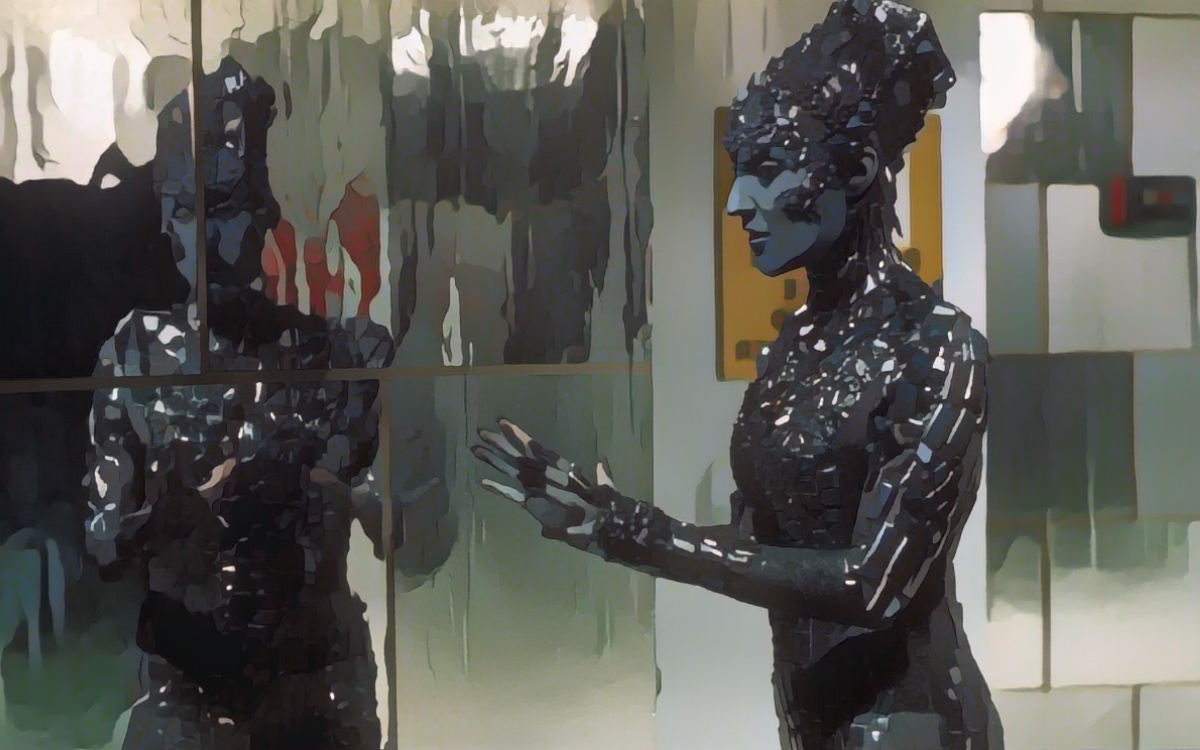
It clamps to a feed, swells, and grows a torso and head: a crystalline figure who stands, breathless and triumphant. “I am Eldrad,” she says, voice like glass, and claims she was a Kastrian scientist shot from the sky by traitors. The station quakes under the power draw. Security rushes the chamber; Eldrad flicks them aside, then listens as the Doctor pleads that a meltdown will kill millions. With cool disdain she reroutes the flow herself and stabilises the core, proving both her genius and her threat.
In the control room Watson thanks the travellers, but Eldrad demands a price: the Doctor must take her to Kastria so she can confront her betrayers and reclaim her world. Sarah, wary, whispers that every lie has a kernel of truth: and every truth a hook. Eldrad smiles, promising gratitude. The Doctor, calculating risks and responsibilities, agrees. The TARDIS groans open. A last look at the scorched reactor, and they are gone.
Episode 3
Kastria is a tomb. The TARDIS lands in wind-gnawed caverns where dust skirls over dead machinery and a faint voice beckons from deeper halls. Eldrad strides ahead, anger brightening her facets. Doors test them with heat and pressure; defence nodes spit spears of force. The Doctor deciphers a control column to spare Sarah a roasting and sees the pattern: the traps are tuned to Eldrad.
In a vaulted gallery, a recording kindles in a crystal throne. High Lord Rokon speaks across ages, calling Eldrad a tyrant who planned to enslave Kastria and hollow the planet to feed his schemes. There will be no subjects for him to rule. The spore banks have been destroyed. The last Kastrians chose extinction over returning to Eldrad’s yoke. Eldrad lashes out; a concealed blast smashes her body against the steps.
The shell, grown from Sarah’s imprint, fails. In a convulsion of light, Eldrad’s “true” form reasserts itself: taller, heavier, masculine, a jagged king in armour of stone. He laughs at the message and swears he will breed a new race from the spore vaults anyway. The Doctor leads the way to the breeding chambers to show him. Doors grind open onto bare, ruined racks. Silence answers Eldrad’s roar.
Episode 4
Eldrad rages, demanding the Doctor take him to Earth to begin a new empire. The Doctor refuses and retreats through a gauntlet of collapsing bridges while Sarah flings taunts to keep the tyrant charging. At the core pit, heat gusts from a bottomless shaft. Eldrad advances, promising slow death; the Doctor winds his scarf across a strut and at the last instant whips it tight around Eldrad’s ankles.
The stone giant pitches forward, scrabbles at the lip, and plunges into the abyss, his howl spinning away into furnace dark. The caverns settle. Back in the TARDIS, relief softens to something else as a Time Lord recall signal claws across the console. The Doctor’s face closes; Gallifrey calls him home, and humans are not permitted.
Sarah jokes to hide the sting, then squares her shoulders. They choose kindness over speeches. He promises it is only for a while; she packs her shoulder bag with a grin that wobbles. The TARDIS dematerialises and rematerialises on a quiet street the Doctor thinks is South Croydon. They exchange a last look, and she steps out. The TARDIS fades. Sarah takes in the wrong lampposts, the wrong cat, and laughs through tears, turning toward whatever comes next.
Themes
As a chamber piece with a beating heart, The Hand of Fear swaps grand gothic thunder for intimate, modern unease: quarries and corridors, sirens and whispers, “Eldrad must live” turning from mantra to menace. It doesn’t scale the operatic heights of Pyramids of Mars or the feral certainty of The Seeds of Doom, and it’s less baroque than The Brain of Morbius, but it’s more focused and affecting than breezier outings like The Android Invasion and Revenge of the Cybermen.
In the season’s ledger, it lands as an upper-mid-tier serial elevated by its emotional core: a crystalline nightmare framed around the most human of goodbyes.
Continuity-wise, it ties the knot on a whole era while setting the next in motion. Sarah Jane’s journey (from The Time Warrior through Invasion of the Dinosaurs, The Ark in Space, and Genesis of the Daleks) culminates in a farewell that feels both earned and aching, the Time Lords’ summons pivoting the TARDIS straight into The Deadly Assassin. From there, the series will reconfigure itself (into The Face of Evil, The Robots of Death, and ultimately The Talons of Weng-Chiang) but The Hand of Fear keeps a thread to the past.
Eldrad’s “science as sorcery” sits alongside the occult physics of The Masque of Mandragora and foreshadows later stone-bound hauntings like The Stones of Blood. Decades on, Sarah’s legacy echoes in School Reunion, The Stolen Earth, and Journey’s End. By its final beat, the serial has done more than defeat a god of glass: it has closed one of Doctor Who’s warmest partnerships and opened the door to a colder, bolder Gallifreyan reckoning.

.
This is a chapter from Craig Hill’s book “Doctor Who – The Fourth Doctor”, chronicling every episode featuring the Fourth Doctor. It is available on Amazon.
.
To view the list of other Doctor Who serials, please click this link
Doctor Who Episode Guides for Sale on Amazon
Step aboard the TARDIS and journey across the universe with every incarnation of The Doctor in this series of unofficial Doctor Who episode companions.
This collection of twelve books explores every televised adventure of the Time Lord’s lives.
Each volume in the series delves into a different Doctor’s era, offering detailed episode guides, behind-the-scenes insights, character profiles, and story synopses.
Once you have clicked the link, choose which book you want, and then whether you want to buy the Kindle (eBook) or Paperback versions.
Previews are available before you buy.

Visit the Australian Book and Language Studio
Discover more from Craig Hill
Subscribe to get the latest posts sent to your email.
 Craig Hill