

.
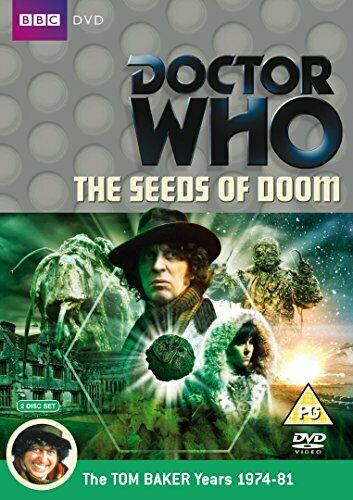
The Seeds of Doom is the sixth and final serial of Doctor Who Season 13, originally broadcast in six episodes from 31 January to 6 March 1976. It written by Robert Banks Stewart and directed by Douglas Camfield, stars Tom Baker as the Fourth Doctor, Elisabeth Sladen as Sarah Jane Smith, Tony Beckley as Harrison Chase, and John Challis as Scorby.
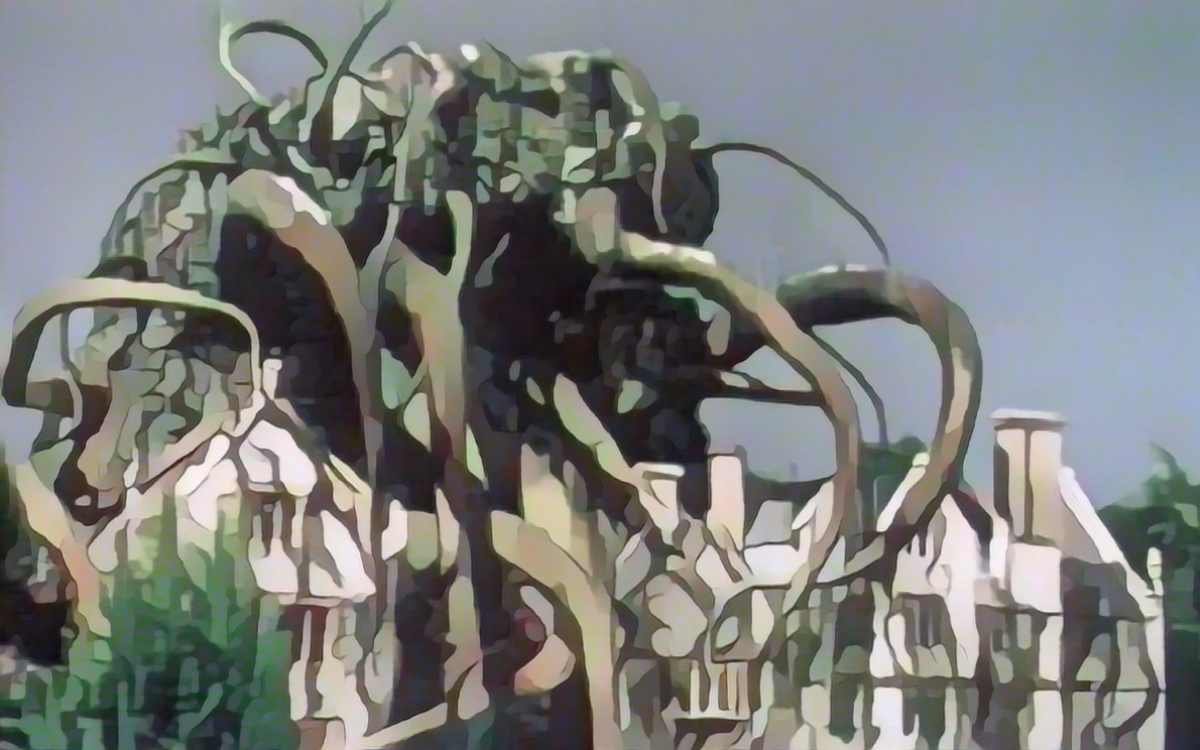
In Antarctica, a buried seed pod awakens and infects a scientist, beginning a terrifying transformation into a Krynoid—an alien plant that feeds on animal life. The Doctor and Sarah race from the ice to London’s World Ecology Bureau and then to Chase’s grand estate, where the ruthless plant collector plans to nurture the creature and let nature “take back” the world. As the Krynoid grows into a towering menace and vines choke the house and grounds, the Doctor uses quick wit, brave allies, and a dash of explosives to stop the spread. This fast, grounded thriller shows the Fourth Doctor at his most urgent and Sarah at her bravest against a green enemy that feels chillingly real.
Episode 1
A message from the World Ecology Bureau pulls the Doctor and Sarah to Antarctica, where a small research camp has dug a leathery pod from ancient ice. The base is tense and under-resourced; equipment freezes, the radio crackles, and one scientist jokes about “space cabbages” to hide his nerves.
The Doctor’s jokes stop the moment he probes the pod’s surface and feels warmth pulsing under frost. He warns them not to expose it to heat. Too late: the generator hum lifts, the temperature rises, and the pod swells with life. At the Bureau in London, a smooth official funnels information to an eccentric millionaire, Harrison Chase, whose devotion to rare plants borders on worship. He dispatches his thug Scorby and botanist Keeler to “assist.”
On the ice, a man is stung by a darting tendril; green veins spread under his skin and his arm goes numb. The Doctor argues for isolation and even amputation to stop whatever is germinating inside him. Wind screams over the huts, metal groans, and the pod splits, ejecting a second, dormant seed while the first infection incubates within human tissue. As night falls, something bulky moves between the snow tractors. A figure stumbles from the medical hut, eyes wild, skin mottled: and the shadows answer.
Episode 2
The infected man changes by the hour: strength surges, voice sinks, and skin blooms with leaf-like tissue. The Doctor names it: Krynoid, a parasitic plant intelligence that seeds itself in animal hosts, then consumes the ecosystem. Scorby and Keeler arrive, armed and smiling, with orders from Harrison Chase to secure any pods.
They search the huts with practised menace, cable-tie the scientists, and ignore the Doctor’s plea to burn the seed before it hatches. The host bolts into the whiteout, leaving husks where he touches men in the drift. The Doctor tries a brutal remedy; the infection has already crossed into every cell. Snow claws at the windows. Scorby coldly sets demolition charges, planning to erase witnesses and the growing creature while he escapes with the remaining pod.
The Doctor and Sarah fight free, dragging survivors toward the aerodrome as the wind strips visibility to nothing. In the storm’s heart the Krynoid reaches its first full form, a rearing, tendrilled beast that tears at the huts. Engines cough to life. Scorby’s plane lifts with Keeler and the precious second pod aboard. The Doctor shoves Sarah up the ramp of a waiting aircraft and dives after her as the entire camp erupts behind them in a roaring sheet of fire.
Episode 3
Back in London, the Doctor storms the World Ecology Bureau and follows the trail straight to Harrison Chase: reclusive magnate, botanical collector, and self-declared saviour of plant life. Chase welcomes the travellers to his mansion’s glass palaces with languid charm, plays to his cameras, and lets his men do the hurting.
Scorby prowls the paths; Keeler takes the remaining pod into a laboratory and studies its vascular sacs with awed dread. Chase speaks of humanity as a blight and plants as “the true inheritors,” his fingers lingering over carnivorous blooms. Meanwhile, a guilty Bureau insider tries to atone and tips the Doctor off about Chase’s earlier bribes. The TARDIS crew slip back after dark to destroy the pod. Lights flare. Sarah is seized; the Doctor is beaten and dumped outside the gates.
In the lab, Keeler’s curiosity strays a second too long; the pod blossoms and lashes out, spitting a seed into his wrist. Keeler stares at the tiny wound as green creeps under his skin. Chase is transfixed, filming the first stages of transformation like an artist at work. The Doctor breaks in again, too late to stop it, and watches the veins of the infection feather through Keeler’s arm while, in the hothouse, the orchids seem to listen.
Episode 4
Keeler’s condition deteriorates into a shambling hunger; the Krynoid mind begins to speak through him in cracked whispers about propagation and conquest. Chase dismisses human squeamishness and nurtures his “guest,” turning heat and humidity up, feeding it protein, documenting every change.
Scorby keeps Sarah under guard and tries, briefly, to imagine a payoff without murder. At the Bureau, the traitor makes a clean breast of it and leads the Doctor back with police support; the rescue goes instantly wrong. The Krynoid bursts from Keeler’s clothes, smashes glass, and flees into the grounds, rooting into soil already rich with Chase’s fertilizers. Tendrils probe foundations. Vines coil around statues and cameras. The Doctor confronts Chase, who calmly orders them all composted and has the greenhouse doors locked.
A would-be penitent from the Bureau forces his way onto the estate and dies screaming as creepers drag him into the shrubbery. Within hours the creature swells beyond human scale, feeding on the collection and seeding the lawns with alien growth. Chase, rapt, orders sprinklers on and calls it “magnificent.” The Doctor warns that once the Krynoid flowers, its spores will ride the wind across continents. In the night garden, the ground itself heaves: and the mansion becomes a siege.
Episode 5
Dawn reveals a fortress of thorns. The Krynoid looms over the mansion like a moving grove, its tendrils plugging into masonry and power lines. The Doctor radios for military help while Sarah sneaks through service corridors to free captives. Scorby, rattled at last, cuts a deal to guide them out; the garden answers with strangling creepers at every turn.
Harrison Chase gives himself entirely to the green cause, rhapsodising about a world without “animal infestation.” He straps Sarah to the conveyor of a giant composting crusher and starts the belts rolling, intent on making her “useful to nature.” The Doctor crashes through catwalks and slams the stop lever inches from the blades, hauling her clear as gears shriek. Outside, Scorby wades a flooded terrace and is dragged under by weed that knots around his throat.
The Doctor and Sarah fight free to the gatehouse and coordinate an assault with soldiers: explosives here, firebreaks there, buying time for a bigger solution. It is not enough. The Krynoid hurls boughs through windows and over walls, spawning new growths that crawl along pipes toward the city. The Doctor makes one last call for an air strike. Overhead, jets vector in; on the lawn, the creature rears to meet them.
Episode 6
UNIT and the RAF commit. While troops carve burning lanes through the outer growth, the Doctor and Sarah dash back inside to stop Chase disabling the beacon that guides the strike. The house is a living maze now; stairs buckle under roots. Chase confronts them in the laboratory, douses the Doctor with plant distillate, and tries to force a “transformation,” raving that he will be the first of a new human-plant breed.
The struggle spills into the processing room. Sarah knocks the controls; belts thunder; Chase tumbles into the roaring macerator and is gone. The Krynoid senses the loss and lashes out blindly, smashing stone and sending shockwaves through the garden. The Doctor rigs detonators along key supports to slow its spread and bursts onto the terrace with Sarah as sirens rise. They dive for cover as missiles streak in, blossom into fire, and roll across the grounds.
The mansion disintegrates under the bombardment; the giant plant convulses, collapses, and burns. Smoke pillars into a clearing sky. Later, at the Bureau, the surviving staff count the cost and seal files. The Doctor wipes compost from his coat, trades one dry quip with Sarah, and slips away. In the ruins where a collector worshipped green, only ash and ordinary ivy remain.
Themes
As the feral crescendo of Season 13, The Seeds of Doom roars where its neighbours brood: urgent, muscular, and utterly sure of itself. Measured against the era’s giants, it sits shoulder to shoulder with Pyramids of Mars and only a shade behind the moral thunder of Genesis of the Daleks, outpacing the polished paranoia of The Android Invasion and the dreamlike dread of Planet of Evil.
Tom Baker’s flinty resolve and Sarah Jane’s tenacity, welded to the story’s ruthless pace, make it one of the Hinchcliffe–Holmes run’s definitive statements. If The Brain of Morbius is the refined gothic, The Seeds of Doom is the savage counterpart: top-tier classic Who where menace blossoms into spectacle.
Its roots and branches thread the programme’s past and future with ease. The plant-horror and possession beats echo Fury from the Deep and the eco-anxieties of The Green Death, while the body-terror lineage from The Ark in Space flowers here into something grand and grotesque. As a capstone, it closes the post-Terror of the Zygons stretch with a final, breathless Earthbound battle before the TARDIS swings into The Masque of Mandragora and the transitions of The Hand of Fear and The Deadly Assassin.
Decades on, its template (science sharpened to a scream) resonates in later hauntings like Image of the Fendahl and even modern chamber horrors such as The Impossible Planet/The Satan Pit. By its last conflagration, The Seeds of Doom has done more than defeat a monster; it has proved that the show’s gothic nerve can be both brutal and brilliant.
.
This is a chapter from Craig Hill’s book “Doctor Who – The Fourth Doctor”, chronicling every episode featuring the Fourth Doctor. It is available on Amazon.
.
To view the list of other Doctor Who serials, please click this link
Doctor Who Episode Guides for Sale on Amazon
Step aboard the TARDIS and journey across the universe with every incarnation of The Doctor in this series of unofficial Doctor Who episode companions.
This collection of twelve books explores every televised adventure of the Time Lord’s lives.
Each volume in the series delves into a different Doctor’s era, offering detailed episode guides, behind-the-scenes insights, character profiles, and story synopses.
Once you have clicked the link, choose which book you want, and then whether you want to buy the Kindle (eBook) or Paperback versions.
Previews are available before you buy.

Visit the Australian Book and Language Studio
Discover more from Craig Hill
Subscribe to get the latest posts sent to your email.
 Craig Hill