

.
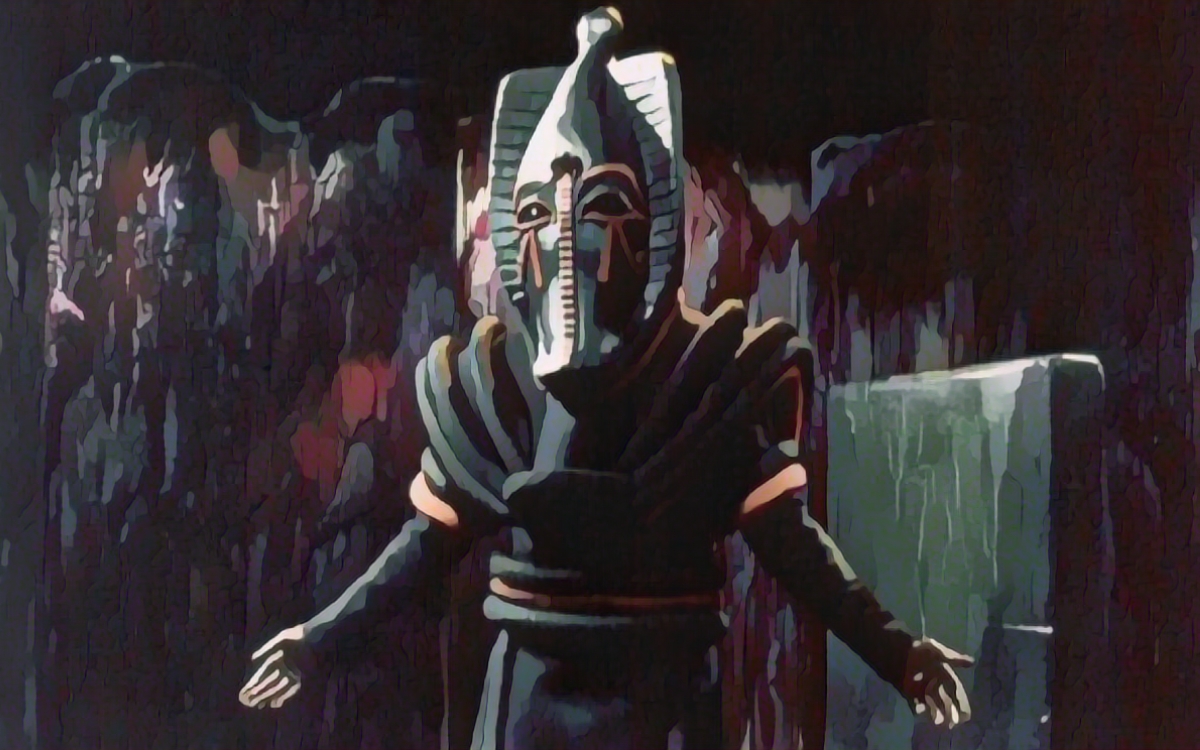
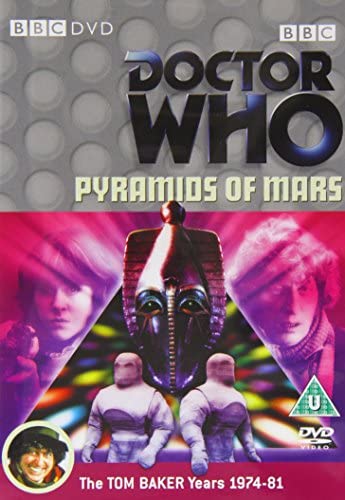
Pyramids of Mars is the third serial of Season 13 of Doctor Who, first broadcast in four weekly parts on BBC1 from 25 October to 15 November 1975. It was written by Stephen Harris and directed by Paddy Russell. It stars Tom Baker as the Fourth Doctor, Elisabeth Sladen as Sarah Jane Smith, Gabriel Woolf as Sutekh, and Bernard Archard as Marcus Scarman.
The TARDIS lands in a quiet English priory in 1911, where Egyptian relics stir and eerie “mummies” patrol the grounds. The Doctor and Sarah discover that Sutekh, an ancient Osirian tyrant, is controlling Professor Scarman to break his prison on Mars. Following clues from crypts to laboratories, they race to stop the destruction of the Eye of Horus and prevent Sutekh’s release.
Episode 1
A violent time distortion forces the TARDIS to land in 1911 at the Priory, a country house stuffed with Egyptian relics from Professor Marcus Scarman’s expedition. The Doctor and Sarah slip past locked rooms and find Laurence Scarman, Marcus’s gentle, inventive brother, and Dr Warlock, who fears something is wrong.
Ibrahim Namin, an Egyptian servant fanatically loyal to a shadowy “Sutekh,” has taken charge of the estate and dismisses them with threats. In the woods, a poacher sees a towering, bandage-wrapped figure crush a man like straw. The Doctor analyses a humming sarcophagus wired to strange coils and realises it is a spacetime tunnel aimed at Mars. He warns that a signal is bleeding through history; if it breaks free, Earth’s future burns.
Sarah’s disbelief lasts until the Doctor shows her a glimpse of a devastated 1980. Back in the Priory, Namin performs a rite; bass notes throb through the house as robot “mummies” march at his command. Warlock bursts in and is driven off by the bandaged giants. Laurence hides the travellers in his workroom, hands shaking over crystal radio parts. Doors slam by themselves. The air grows icy. A tall figure in black steps from the night: Marcus Scarman, returned from Egypt with dead eyes and Sutekh’s voice.
Episode 2
Marcus, animated by Sutekh’s will, executes Namin with a casual gesture and assumes control. The mummies (Osiran servitors) begin hauling canopic canisters and explosive gelignite to build a transmitter that will reach Mars and shatter the Eye of Horus, the force that imprisons Sutekh. The Doctor allies with Laurence, who clings to the hope that his brother can be saved. Sarah scouts the grounds and sees the robots strangle Warlock; the “plague of accidents” is murder.
The Doctor lays an electrical snare to stun a mummy and proves it is a machine, not a corpse, but his sabotage only slows the work. To break Sarah’s doubt, he takes her in the TARDIS to 1980 again: if Sutekh escapes, Earth is a charred wasteland. They return determined to stop the transmission. Marcus visits Laurence and, for a heartbeat, love cracks the mask. Then Sutekh tightens his grip.
The Doctor and Sarah plant charges at the mast base, but the mummies are impervious, and the detonator fails. In the cellar, the spacetime sarcophagus flickers like a heartbeat; a control ring gleams on Marcus’s finger. The transmitter thrums toward full power. On the lawn, the robots raise the final strut. The Doctor realises, sickly, that the answer now lies at the far end: on Mars.
Episode 3
Using the Osiran time tunnel, the Doctor and Sarah ride the sarcophagus to the Pyramid of Mars, a sterile labyrinth guarding the Eye of Horus. Each chamber tests mind and nerve: riddles, mirrored illusions, crushing walls, and a void bridged only by logic. The Doctor deciphers symbols of the gods while Sarah steadies him and keeps the path lit.
Back at the Priory, Laurence begs Marcus to remember their childhood; Sutekh allows a moment of tenderness, then forces Marcus to crush his brother’s heart. The servitors complete the Earth transmitter and lock onto the Martian target. In the pyramid, a guardian materialises, red-eyed and implacable; the Doctor turns its strength against it and presses on, only to find the control room already primed.
The Eye focuses a beam that keeps Sutekh chained for eternity; the transmitter will break that link. The Doctor tries to jam the circuit but the system reroutes. On Earth, Marcus throws the final switch. A spear of energy leaps space. Stone trembles. The Eye flickers. The Doctor races a sequence of glyphs as sarcophagus echoes scream through the passageways. Sarah reaches for a lever and a hidden blade cuts her sleeve. The chamber hum rises to a shriek. If the Eye fails, Sutekh will be free.
Episode 4
The Eye’s containment falters, but the Doctor restores a failsafe long enough to force a stalemate: Sutekh cannot yet walk free, but the prison is weakening. They dive back through the tunnel to stop Marcus at the source and find the Priory a charnel house. Sutekh speaks directly through the sarcophagus, a jackal-headed tyrant bound to a chair since antiquity, his will flooding the room.
He seizes the Doctor’s mind and drags him to his feet, forcing him to guide Marcus to the last control. The Doctor feigns compliance, then snaps a connector into the time tunnel circuitry, secretly extending the corridor’s duration by thousands of years. Marcus opens the path. Sutekh rises from his throne and steps into the transit. Time claws at him. Millennia pour over his body. On Earth the mummies grind to a halt; Marcus collapses to dust.
Deep in the tunnel, Sutekh withers and dies, never reaching the exit. Feedback tears through the Priory; fire races along cables, timbers catch, and the great house burns: the future site of UNIT headquarters born from ash. The Doctor shepherds Sarah into the TARDIS as flames climb the walls. Outside, dawn finds the lawn strewn with broken bandages and scorched stone. History breathes again; the TARDIS fades.
Themes
As the jewel of Season 13’s gothic crown, Pyramids of Mars feels both sumptuous and severe: mummies stalking candlelit corridors while the Doctor stares down a god. Against the era’s giants, it more than holds its ground: it has the mythic charge of Genesis of the Daleks, the meticulous craft later seen in The Talons of Weng-Chiang, and a cooler, more ritual dread than Terror of the Zygons or Planet of Evil.
If The Seeds of Doom roars with ferocity and Robot crackles with debut charm, Pyramids of Mars sings: measured, tragic, and inexorable. In the grand reckoning, it sits firmly on the top shelf of classic Doctor Who, where atmosphere and idea fuse into something both elegant and unnerving.
It also threads continuity with uncommon elegance. Looking back, its “science dressed as sorcery” idiom echoes The Daemons and the base-under-siege grammar honed in The Moonbase, while its Egyptian–Martian lore foreshadows later ancient-cosmic tales like The Brain of Morbius, The Seeds of Doom, and Image of the Fendahl. In-season, it follows cleanly from Planet of Evil and points the TARDIS toward The Android Invasion, sharpening the Baker–Sladen dynamic that will carry into The Hand of Fear.
Decades on, its template reverberates through The Stones of Blood and modern hauntings like The Impossible Planet/The Satan Pit. Even Sutekh’s shadow stretches into The Legend of Ruby Sunday/Empire of Death. By its final fade, Pyramids of Mars has done more than defeat a god; it has set the standard for how Doctor Who marries folklore, futurism, and fate.
.
This is a chapter from Craig Hill’s book “Doctor Who – The Fourth Doctor”, chronicling every episode featuring the Fourth Doctor. It is available on Amazon.
Visit the Australian Book and Language Studio
Discover more from Craig Hill
Subscribe to get the latest posts sent to your email.
 Craig Hill