


.
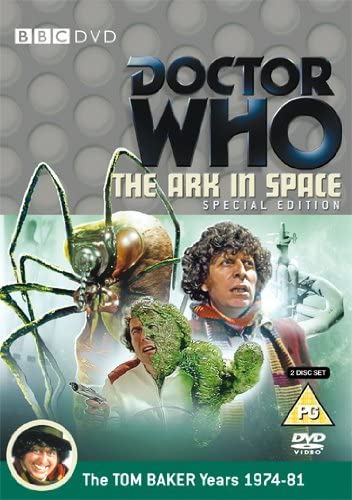
The Ark in Space is the second serial of Doctor Who Season 12, originally broadcast in four episodes from 25 January to 15 February 1975. It was written by Robert Holmes and directed by Rodney Bennett. It stars Tom Baker as the Fourth Doctor, Elisabeth Sladen as Sarah Jane Smith, and Ian Marter as Harry Sullivan.
The Doctor, Sarah, and Harry land on a silent space station called Nerva, which holds the last humans asleep in cryogenic chambers after a disaster on Earth. As strange green trails mark the walls, the team discover an alien species, the Wirrn, is trying to use the Ark’s people to survive. The Doctor rallies the waking crew, while Sarah shows courage under pressure and Harry learns fast as a new companion. This story celebrates the strength and hope of humanity in the far future, and shows the Fourth Doctor’s quick wit and inspiring words as he fights to keep the Ark alive.
Episode 1
The TARDIS lands inside a silent space station orbiting far-future Earth. The Doctor, Sarah, and Harry step into sterile corridors, finding low oxygen, dead lights, and rows of sleeping humans sealed inside transparent capsules. This is Nerva, an ark where Earth’s survivors wait out a solar catastrophe.
Automatic defences still work; Harry blunders into a laser trap, and the Doctor cheerfully dismantles it while praising humanity’s “indomitable” streak. Searching for a control core, Sarah is carried by a conveyor into a conditioning chamber and locked inside a cryo pod, her breath frosting the glass. The Doctor crawls through cramped ducts to reroute power and revive life support, noticing greasy green slime and a thick, leathery chrysalis wedged in the metalwork: proof that something alien has been breeding in the dark.
He forces a dangerous manual reset and frees Sarah, then restores the med systems to begin reviving the first crew member. Lights flicker up over the sleeping ranks. In the hush, the trio piece together the ark’s mission and a distress call that was never answered. As the first capsule stirs and instruments tick back to life, the chrysalis splits behind them with a wet crack, and something insectoid pulls itself free.
Episode 2
Vira, a capable med-tech, wakes to find strangers in her sterile world and coolly asserts procedure. She revives Noah, the elected commander, whose suspicion hardens at once. The Doctor examines a desiccated corpse found near the ducts (Dune, a technician) its tissues leeched and ringed with green residue.
He sketches a chilling theory: an insect creature that consumes hosts and inherits their knowledge. Meanwhile the empty chrysalis proves him right. In the cryo hall, a larva lashes out and stings Noah. He kills it, but hides the wound as a slick of bubbling green creeps over his hand. Vira wants to wake more crew; Noah forbids it, voice tight, eyes unfocused. Sarah befriends Vira and insists the ark needs leadership, not rules.
Alarms flare as doors jam and power dips: the intruder is in the conduits, learning the station from within. The Doctor and Harry rig a trap using live cable, but the larva has grown into a sleek, chitinous hunter and slips away. Noah’s speech falters, words sliding into a hiss. He snaps orders to drive the “intruders” out of Nerva, then recoils from Vira’s touch and flees. Over the tannoy, a distorted voice announces a new priority: the Wirrn will claim the Ark.
Episode 3
Noah’s infection advances; he becomes the mouthpiece of the Wirrn, a hive that feeds on intelligence and remembers what it eats. Lights die across sections as the creatures sabotage power. Sarah steels Vira to act, waking Libri and Rogin to build a small, stubborn crew. The Doctor proposes a brutal solution: lure the Wirrn aboard the station’s shuttle, jettison it into space, and destroy it before the hive multiplies.
To bait the swarm, they need Wirrn scent inside the craft. Harry and Rogin help the Doctor stun a prowling adult with electrified cable, then heaves its bulk across the docking bay while chittering shapes skitter in the shadows. Noah, body warping under green bubbles and hardening plates, wavers between human memory and hive logic. Through a communicator, he warns Vira to get the sleepers safe, then, with a shudder, orders the brood to the shuttle.
The plan nearly collapses as doors jam and controls fail; the Wirrn are learning faster than the crew can improvise. In the crush, Libri is cornered and rescued at the last second. The bay fills with clicking, wing-shearing bodies. The Doctor, breathless and grim, slams the last seal and signals the launch: only to find the release burned out.
Episode 4
With the release fused, the shuttle will not detach, and the Wirrn are moments from overrunning the bay. The Doctor and Rogin crawl into a service nest to bypass the lock with raw power, sweating as arcs spit around them. A Wirrn drops from the ceiling; Rogin shoves the Doctor clear and takes the blast of heat himself, dying with a wry apology for calling him “idiot” earlier.
The manual couplings blow. In the bay, Noah staggers forward, a towering insect silhouette with human sorrow behind the mandibles. For a heartbeat he is Noah again. He orders Vira to protect the Ark, steps aboard the packed shuttle, and triggers the launch. The craft blasts free, spins into the void, and detonates: Wirrn minds snuffed in a distant flash. Systems steady.
Vira, grieving, turns to her duty as the revival program resumes. The Doctor resets the transmat to send teams down to a cleansed Earth, then tells Sarah and Harry they must fix the receiver planetside or the colonists will be stranded. They take their places on the pad. Sarah squeezes Vira’s hand. The Doctor glances once at the sleeping thousands and, softly, at humanity’s courage. Light flares. The trio dissolve toward the waiting world.
Themes
As a statement of intent for the Hinchcliffe–Holmes years, The Ark in Space is lean, eerie, and assured: proof that Doctor Who can be both poetic and petrifying when it wants to be. Its stripped-back “people versus parasite” tale, the luminous Nerva sets, and Tom Baker’s gleeful alien confidence make it one of the era’s touchstones.
It doesn’t carry the moral thunder of Genesis of the Daleks or the operatic sweep of Pyramids of Mars, but its clarity of theme and atmosphere place it comfortably among the show’s top tier. Compared with the genial handover of Robot, this is bolder and stranger, a chamber piece that expands the series’ horizons by trapping us in one haunted corridor at a time.
Linking past and future with quiet elegance, the story revives the Troughton-era “base under siege” grammar from The Moonbase and The Ice Warriors while pointing forward to the gothic science tales to come. It lifts directly from Robot into deep space, cements Harry as the Doctor and Sarah Jane’s foil, and launches the Nerva mini-arc: the transmat to Earth in The Sontaran Experiment, the time-diverted mission to Skaro in Genesis of the Daleks, and the eventual return for Revenge of the Cybermen.
By the closing fade, The Ark in Space has done more than survive the Wirrn: it has reborn the programme’s sense of scale, setting the tone for adventures that feel grand, unsettling, and unmistakably new.
.
This is a chapter from Craig Hill’s book “Doctor Who – The Fourth Doctor”, chronicling every episode featuring the Fourth Doctor. It is available on Amazon.
Visit the Australian Book and Language Studio
Discover more from Craig Hill
Subscribe to get the latest posts sent to your email.
 Craig Hill