

.
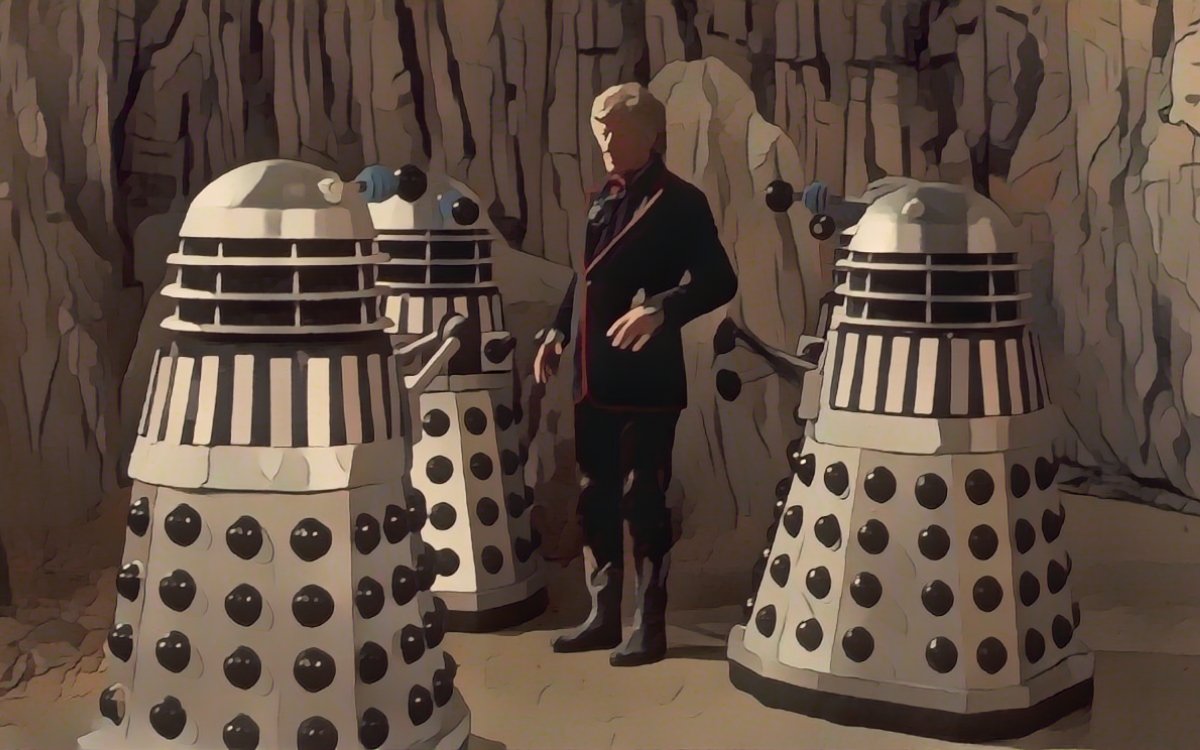
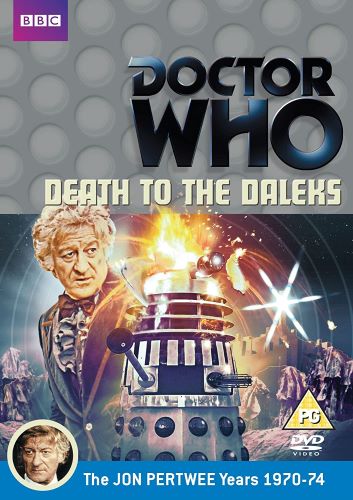
Death to the Daleks is the third serial of Doctor Who Season 11, originally broadcast in four episodes from 23 February to 16 March 1974. It was written by Terry Nation and directed by Michael E. Briant. It stars Jon Pertwee as the Third Doctor and Elisabeth Sladen as Sarah Jane Smith.
The TARDIS loses power and lands on the bleak planet Exxilon, where an ancient city drains all energy. A human expedition is stranded while searching for a life-saving mineral called parrinium, and the Daleks arrive with their guns useless, forcing uneasy deals and new tricks. The Doctor explores the city’s living machinery with courage and wit, Sarah faces traps and fearful rituals, and together they try to outsmart both Daleks and superstition to protect the cure and free the planet.
This is the first Doctor Who story where Daleks are not equipped with their traditional energy weapons, and it explores themes of technological dependence, survival, and cooperation between enemies. The serial features a creepy alien city, a savage native race, and a rare example of the Doctor and the Daleks being forced to work together temporarily.
Episode 1
The TARDIS dies mid-flight, every light going black, and crash-lands on a bleak, misty world. The Doctor and Sarah step into a landscape of bleached rocks and whispering winds. A distant tower pulses with a cold, rhythmic glow; Sarah climbs a ridge to look: and vanishes among standing stones as robed figures close in.
The Doctor is cornered by armed humans from an Earth expedition hunting a rare mineral, parrinium, urgently needed to cure a space plague. Their leader was killed by the planet’s natives, Exxilons, who worship the glowing “City” and attack any intruders. All machines fail here, they say; even their ship is a dead husk. As night falls, a second craft tears the sky and crashes nearby. Daleks roll out, sputter, and stop. The power drain has humbled them too.
Prisoners and captors alike share a wary standoff in the torchlight. Sarah, dragged to a stone altar deep in Exxilon catacombs, hears prayers to the City and the promise of sacrifice at dawn. In the dawn murk a Dalek gun clicks, empty, and its dome swivels toward the humans with a new plan forming. The Doctor stares past them at the pulsing tower. Whatever lives in that City is drinking the universe dry.
Episode 2
Sarah fights her way off the altar with quick wits and a loose stone and escapes into tunnels scored with ancient symbols. The Doctor learns from the humans (Jill Tarrant among them) that their ship’s stores hold the parrinium but nothing can lift off while the power drain holds. The Daleks adapt first: stripped of energy weapons, they bolt crude machine-guns to their casings.
They take command of everyone at gunpoint, marching humans and Doctor to quarry out more mineral while they plot to destroy the City. Underground, Sarah meets Bellal, a gentle, curious Exxilon who rejects the priesthood’s fear. He speaks of the City as a living machine that drains power and lures worshippers with false miracles. He asks the Doctor to help reach its heart and shut it down. Above ground, a sinuous, root-like creature bursts from slime and devours a Dalek scout; even metal isn’t safe.
The Daleks force the humans to haul explosives toward the City’s base and send a squad to find a way in. Sarah and Bellal slip through forgotten passages toward a sigil-marked entrance. In the quarry, Galloway, a hard man hungry for control, pockets a detonator “just in case.” The City’s tower throbs, and for a second every torch burns blue.
Episode 3
The City opens like a puzzle box. Bellal guides the Doctor through a gallery where walls shimmer with patterns that must be solved to proceed. Touch the wrong symbol and the floor spits lightning. The Doctor grins despite himself: someone built tests to keep fools out and thinkers honest.
Behind them pads another pair of Exxilons: and a Dalek patrol that has learned to respect these walls. Outside, Jill and Sarah coordinate the humans’ quiet rebellion, switching labelled sacks so the parrinium can leave the planet even if the Daleks think they’ve seized it. In the tunnels, the Exxilon high priest rallies zealots to stop the “blasphemers”; Bellal’s companion falls to a spear as the old faith fights to defend its hungry god.
Deeper in, the tests turn cruel: a logic grid that changes while you solve it, a corridor that reads fear and grows thorns, a room that tries to copy the Doctor’s mind and replace him with a compliant double. He beats it by being gloriously contrary. The Daleks crash through the puzzle rooms using expendable slaves and sheer brutality, losing casings to traps but inching closer. Outside, on a barren rise, a Dalek rocket is assembled piece by piece, nose pointed straight at the City’s crown.
Episode 4
At the core, a vast brain pulses under a glassy dome, veins of light feeding the beacon that smothers power across the world. The City shows the Doctor a history in images: a proud, ancient Exxilon civilisation building perfection: and then serving it. He slips a sabotage loop into the control lattice, telling the machine a new truth: entropy.
The pulse stutters; the beacon falters. Above, engines cough; lamps flare. The Dalek rocket launches toward the limping tower. Sarah and Jill drag the last sacks aboard the Earth ship while Galloway shoves a crate of “parrinium” into the Dalek hold and insists on seeing the deal through. The City begins to die, sections dimming like a creature finally allowed to sleep. Daleks roll to their ship, triumphant: until the Doctor signals Jill. The real parrinium is already on the human vessel; the Daleks have loaded rocks.
They lift off anyway, vowing a plague-world as revenge. Galloway, grim and oddly peaceful, reveals the detonator he kept and triggers the charges in the Dalek hold, sacrificing himself to destroy the ship. In the ruins, Bellal watches the City collapse and weeps for what his people were and might be again. Power returns. The cure will reach the frontier. The Doctor and Sarah step into a TARDIS that finally hums, leaving a sky newly free of its parasite.
Themes
As a change of pace between urban paranoia and palace intrigue, Death to the Daleks lands as solid mid-tier Pertwee: tighter than The Time Monster, moodier than The Monster of Peladon, if less operatic than Planet of the Daleks or as searing as The Green Death. The power-drain conceit disarming both TARDIS and Daleks is a cracking hook, the jungle atmosphere is thick, and the image of Daleks resorting to projectile guns gives this outing a mischievous twist.
It may not reach the philosophical heights of Day of the Daleks or the later benchmark of Genesis of the Daleks, but as a tough, resourceful adventure for the Doctor and Sarah Jane, it more than holds its ground.
In the tapestry of the era, it threads neatly from Invasion of the Dinosaurs into the broader galactic canvas, with Sarah Jane’s courage and curiosity now fully in stride. The Dalek through-line stretches back to The Daleks and The Dalek Invasion of Earth, through Day of the Daleks and Planet of the Daleks, and points forward to the crucible of Genesis of the Daleks.
Its “living city” trials echo forward to later tales of hostile architecture and trapped minds, while the closing promise of new horizons leads directly into The Monster of Peladon and, beyond, the era-closing reckonings of Planet of the Spiders. By surviving Exxilon’s dark puzzle, the Doctor and Sarah step out tougher: ready for the political and personal tests to come.
.
This is a chapter from Craig Hill’s book “Doctor Who – The Third Doctor”, chronicling every episode featuring the Third Doctor. It is available on Amazon.
.
To view the list of other Doctor Who serials, please click this link
Doctor Who Episode Guides for Sale on Amazon
Step aboard the TARDIS and journey across the universe with every incarnation of The Doctor in this series of unofficial Doctor Who episode companions.
This collection of twelve books explores every televised adventure of the Time Lord’s lives.
Each volume in the series delves into a different Doctor’s era, offering detailed episode guides, behind-the-scenes insights, character profiles, and story synopses.
Once you have clicked the link, choose which book you want, and then whether you want to buy the Kindle (eBook) or Paperback versions.
Previews are available before you buy.

Visit the Australian Book and Language Studio
Discover more from Craig Hill
Subscribe to get the latest posts sent to your email.
 Craig Hill