

.
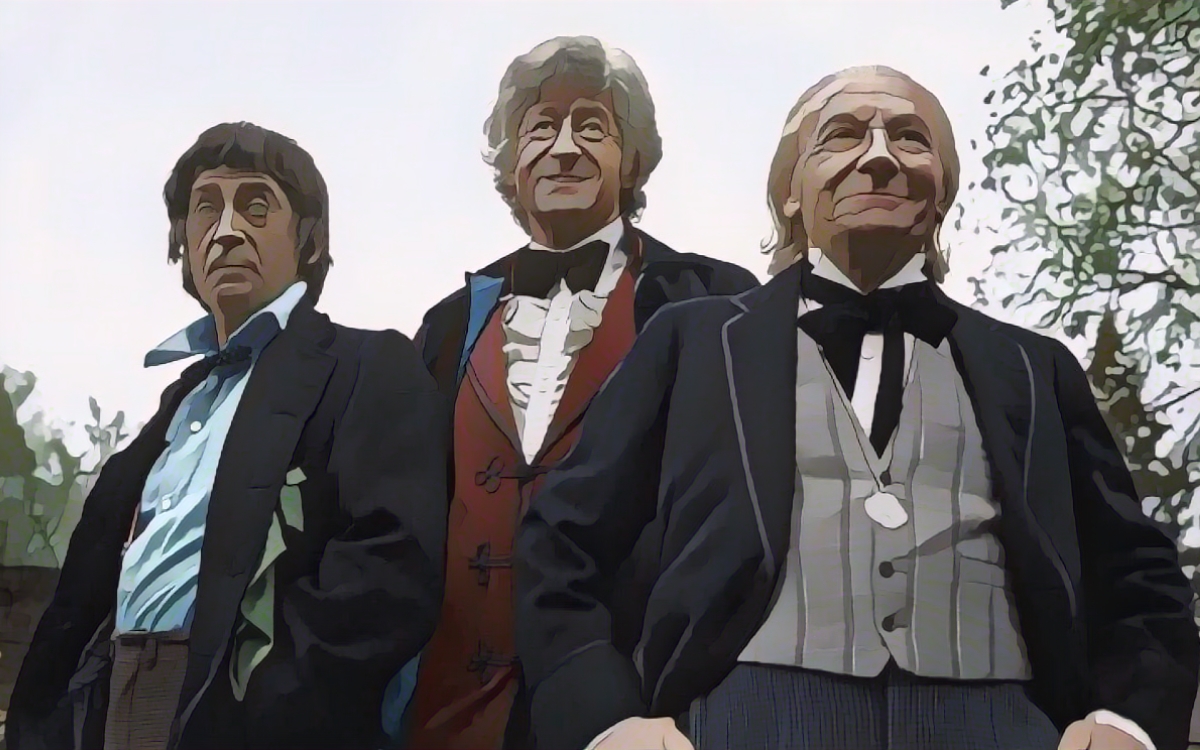
The Three Doctors is the first serial of Season 10 of the classic Doctor Who series. Originally broadcast in four episodes from 30 December 1972 to 20 January 1973. It was written by Bob Baker and Dave Martin, and directed by Lennie Mayne. It stars Jon Pertwee as the Third Doctor, Patrick Troughton as the Second Doctor, William Hartnell as the First Doctor, Katy Manning as Jo Grant, Nicholas Courtney as Brigadier Lethbridge-Stewart, John Levene as Sergeant Benton, and Stephen Thorne as Omega.
Time distortions strike Earth and the Time Lords call on the Doctor’s earlier selves to help, bringing three Doctors together at UNIT as a mysterious force pulls people and objects into a strange realm. With Jo’s loyalty and the Brigadier’s stubborn common sense, the Doctors follow the trail to an anti-matter universe ruled by the exiled Omega, a brilliant but bitter Time Lord.
The story celebrates the 10th anniversary of the show and was the first to feature multiple incarnations of the Doctor in a single story. It also introduced fans to deeper lore about the Time Lords and their home world, Gallifrey.
Episode 1
In deep space, the Time Lords’ power drains away as a strange, intelligent energy hunts for a path into our universe. It finds the Doctor on Earth. At UNIT, cosmic-ray expert Dr Tyler arrives with spiky photographs of something impossible; his experiment vanishes, and so does a grouchy gamekeeper, Mr Ollis.
The energy appears as a shimmering gel creature that oozes into the lab, swallows equipment, and tastes for the Doctor. The TARDIS seals itself, generating a protective field the Doctor can’t switch off. Jo tries to help as the thing batters UNIT HQ and bends locks like tin. On Gallifrey, the High Council decides the Doctor cannot face this alone; they will break their own rules and bring his earlier selves.
The First Doctor appears in the scanner like a man caught in a wind of time, offering tart advice before being trapped in a time eddy. Then the TARDIS door opens and the Second Doctor bounces in with a grin and a recorder, poking fun at his future self and prodding the consoles. Together, they follow the energy’s signature to a black-hole bridge: a link to an anti-matter realm. Outside, the gel creature blooms across the car park. Inside, two Doctors argue their way into a plan.
Episode 2
Two Doctors, one TARDIS, and a very unimpressed Brigadier. The Second Doctor needles, the Third bristles, and Jo plays referee while UNIT braces for another assault. The gel creature returns, bigger and bolder, shrugging off small-arms fire and pushing through reinforced doors. The TARDIS, still under Time Lord control, refuses to move: until the energy suddenly surrounds it and drags ship and occupants through the black hole.
Benton, Jo, and Dr Tyler tumble with them; Mr Ollis reappears, baffled and cross, on alien gravel under a purple sky. The landscape seems built, not grown: quarries of anti-matter shaped by will. Armoured “gell guards” herd the group toward a distant palace. Back at UNIT, the Brigadier stares at a TARDIS that has vanished and a building webbed in gelatinous residue, then orders a perimeter as if any of this were normal.
Inside the dragged TARDIS, the First Doctor flickers back on the screen, stuck in the eddy but calm, pointing them toward the source of control at the heart of this place. The Second Doctor discovers his recorder lodged in the force-field niche (untouched by the journey) and pockets it, thoughtful. Ahead, a throne room waits, and the owner of the trap finally speaks: a sonorous voice that calls itself Omega.
Episode 3
The travellers are escorted into a vast hall of pillars and light where Omega receives them like a king. He tells his legend: once the Time Lords’ stellar engineer, he created the power source that made their civilisation: then was cast into the singularity and left to “die.” He did not die. Trapped in an anti-matter universe, Omega has learned to shape reality by thought alone, but the effort keeps him chained.
Now he wants freedom—and the Doctors’ minds to take his place. He flaunts his power, conjuring storms and prisons, then softens to coax Jo, only to rage when she won’t yield. The First Doctor, still caught in the time eddy, advises via the monitor, sketching the one advantage they have: the TARDIS force field preserves ordinary matter.
The Second Doctor’s recorder, absent-mindedly left in that field, is now the only true matter object in a world of anti-matter. The Third Doctor plays for time, testing Omega’s temper and limits, while Benton, Tyler, and Ollis muddle through escapes and recaptures. Omega removes his mask in fury to show what remains beneath: nothing at all, only force of will. He demands the Doctors submit to a mental transfer. They nod, stall, and trade a glance that says: one chance.
Episode 4
Omega straps the Doctors into a control rig to fuse their minds to his realm. At the last second they twist the settings, triggering a backlash that shatters the apparatus and drives him howling from the chamber. The anti-matter world convulses; gell guards freeze and crumble. The Third Doctor explains the desperate gambit: introduce a fragment of real matter into Omega’s control.
Matter and anti-matter will annihilate, collapsing the bridge and throwing everyone else back home. The Second Doctor produces the recorder, the only surviving bit of matter here, and together they wedge it into the central column. Omega returns, vows eternal imprisonment, and strikes. The column flares. A silent white flash erases the hall. UNIT HQ snaps back to normal space; the TARDIS stands in the lab as if it never moved; Benton spits dust and grins.
Mr Ollis trudges off to tell no one anything. On Gallifrey, power surges back. The First Doctor salutes from the scanner and fades to his own time; the Second tweaks the Brigadier’s nose and vanishes too. The Time Lords thank the Doctor for saving their civilisation and lift his exile, restoring his knowledge of the TARDIS. Jo whoops; the Brigadier mutters about paperwork. The Doctor smiles, pockets the new dematerialisation circuit, and sets a fresh course.
Themes
As an anniversary romp, The Three Doctors is joyous and era-defining. It is less taut than Inferno or The Daemons, but every bit as iconic as a statement piece for the UNIT years. Its playful clash of personas, sparkling Patrick Troughton energy, and grandstanding cosmic stakes place it just a notch below the later polish of The Five Doctors and the spectacle of The Day of the Doctor, yet comfortably above lighter neighbours like Carnival of Monsters.
Measured within the Pertwee run, it’s not the most disciplined thriller, but as celebration and myth-building it’s a crowd-pleasing high point.
In the tapestry of the show, it launches Season 10, pays off the exile set in The War Games, and (crucially) wins back the Doctor’s freedom, opening the door to wander again from Carnival of Monsters through Frontier in Space and Planet of the Daleks. It forges the multi-Doctor tradition continued by The Five Doctors, The Two Doctors, and The Day of the Doctor, and introduces Omega, whose shadow returns in Arc of Infinity.
With the Brigadier and UNIT linking back to The Invasion and forward to Spearhead from Space’s Earthbound legacy, The Three Doctors ties strands past and future: a festive hinge between grounded 1970s intrigue and boundless cosmic adventure.

.
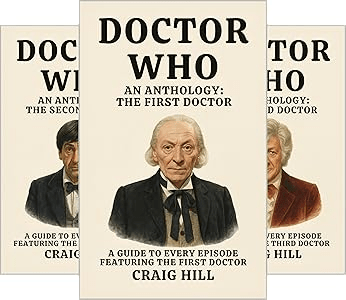
This is a chapter from Craig Hill’s book “Doctor Who – The Third Doctor”, chronicling every episode featuring the Third Doctor. It is available on Amazon.
.
To view the list of other Doctor Who serials, please click this link
Doctor Who Episode Guides for Sale on Amazon
Step aboard the TARDIS and journey across the universe with every incarnation of The Doctor in this series of unofficial Doctor Who episode companions.
This collection of twelve books explores every televised adventure of the Time Lord’s lives.
Each volume in the series delves into a different Doctor’s era, offering detailed episode guides, behind-the-scenes insights, character profiles, and story synopses.
Once you have clicked the link, choose which book you want, and then whether you want to buy the Kindle (eBook) or Paperback versions.
Previews are available before you buy.
Visit the Australian Book and Language Studio
Discover more from Craig Hill
Subscribe to get the latest posts sent to your email.
 Craig Hill