

.
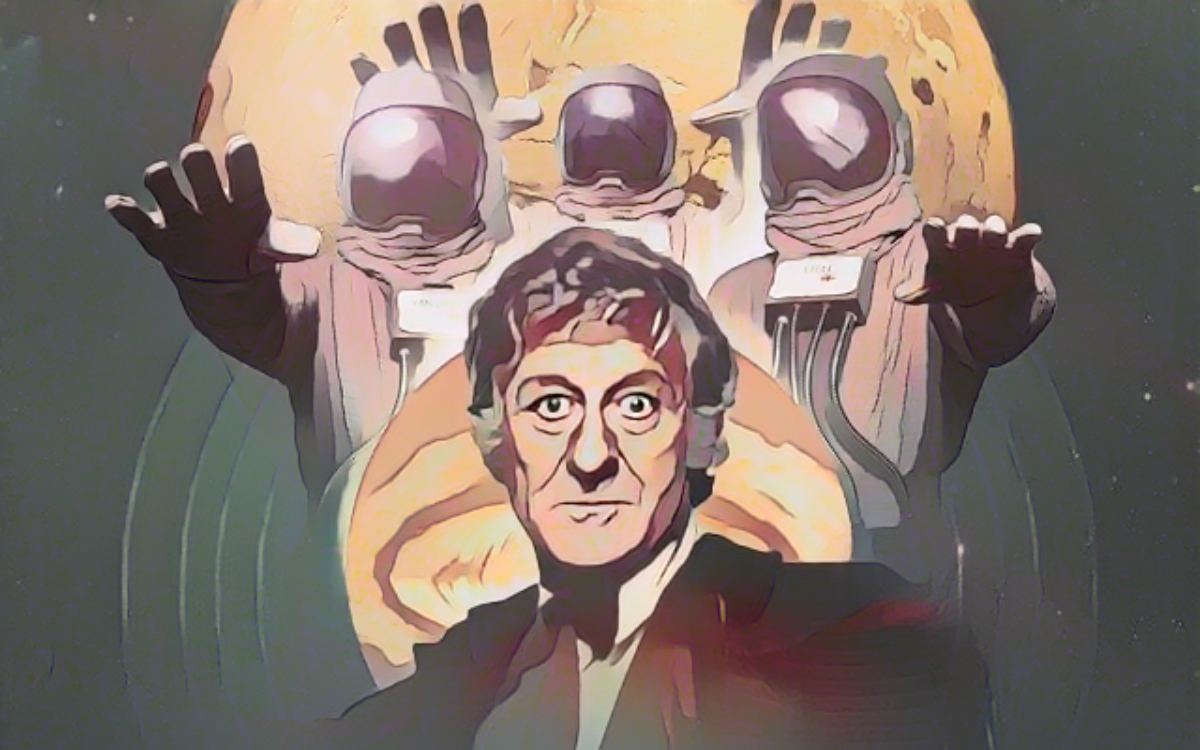
The Ambassadors of Death is a seven-part serial from Doctor Who Season 7, which was first broadcast in seven weekly parts on BBC1 from 21 March to 2 May 1970. It was written by David Whitaker and directed by Michael Ferguson. It stars Jon Pertwee as the Third Doctor, Caroline John as Liz Shaw, and Nicholas Courtney as Brigadier Lethbridge-Stewart.
A missing space mission and a strange signal from Mars draw UNIT to the British Space Centre, where the Doctor uncovers a plot mixing espionage, sabotage, and fear of the unknown. When the returned “astronauts” bring deadly radiation with a touch, the Doctor suspects they are alien envoys and tries to make peaceful contact, while Liz races to decode the science behind their condition.
Episode 1
At the British Space Centre, Professor Ralph Cornish fights to re-establish contact with Mars Probe 7 as the public grows anxious. UNIT takes over security. The Brigadier arrives with the Doctor and Liz Shaw, who both lean into the consoles, listening to an irregular buzz threading through the astronauts’ last transmission. The Doctor hears structure in the noise: call and response, like a coded phrase.
Cornish prepares a rescue craft, Recovery 7, to intercept the returning capsule. A saboteur slips through security with a stolen pass; Dr Taltalian, a prickly visiting expert, behaves oddly and bristles when the Doctor questions his figures. The irregular signal repeats, stronger, as if urging a reply. The Doctor rigs a simple tone encoder and taps back a mathematically neat answer. For a heartbeat, the line clears: and something not human answers in perfect rhythm.
Cornish authorises launch. Recovery 7 blazes into orbit, the control room a tense study in clipped voices and ticking clocks. When telemetry locks on, the room exhales. Then the buzz floods the speakers again, drowning the human voice. The Doctor’s eyes narrow: whoever is talking to Earth, it may not be the crew. He warns Liz softly. If this is contact, it is contact under duress.
Episode 2
Recovery 7 shepherds the returning capsule through re-entry while UNIT secures the landing zone. A helicopter marked with UNIT flashes in, winches the capsule, and peels away before the Brigadier’s men can challenge it. The Doctor stares up, irritated and impressed; someone has rehearsed this theft. A tracking scramble begins: cars, radio vans, a convoy threading motorways.
Liz sifts the mystery signal and finds a repeating key buried in the harmonics. Taltalian reappears with a briefcase of “corrected” data and, panicking, pulls a gun; he is clearly being leaned on. A device inside the case whines: too high to hear, just enough to crack glass. The Doctor shoves it into a fume cupboard and slams the blast shield as it detonates. The false UNIT helicopter vanishes toward an abandoned warehouse complex by the river.
Inside, masked men work with brisk care as a boss named Reegan directs them to flood the capsule with radiation damping. The Brigadier’s troops arrive a minute late to bare foundations and warm tyres. The Doctor taps a pencil: thieves who need isotopes, a signal that expects an answer, a capsule stolen rather than opened in public. He tells Cornish the astronauts may be alive, but not where anyone expects.
Episode 3
Evidence piles up in untidy stacks. A courier is found with burns no fireman can explain. Geiger counters chatter near tyre tracks. A witness swears the “astronauts” never removed their helmets. Reegan keeps his prize in a sealed room and brings in Dr Lennox, a nervous physicist, to stabilise the mysterious trio with carefully dosed radiation.
Their gloved touch kills in seconds. The suits move only when signalled, heads cocked like listeners. The Doctor notices the signal peaks whenever the suits stir and maps relay points across the city. Liz is ambushed on a quiet road while collecting isotope samples and bundled into a van: leverage against UNIT and brains for Reegan’s workshop. She fights, escapes across a canal footbridge in a rain of bullets, is recaptured, and keeps watching.
Back at Space Control, Cornish’s patience frays as officials demand a tidy press story. The Doctor, glumly practical, admits the possibility that the men inside the suits are not human at all. He overlays the alien rhythm on the capsule’s log and hears a simple bargain hiding in the noise: an exchange. The missing crew for the “ambassadors” now walking Earth. The Brigadier orders raids. The Doctor asks for a radio powerful enough to reach orbit.
Episode 4
UNIT storms the riverside warehouses and finds only decoys: empty isotope canisters, scorched floors, and cut cables where transmitters once sat. Reegan shifts his base to a disused laboratory and tightens his hold on the captives. Lennox, appalled, slips away to UNIT for protection and whispers a new name: General Carrington.
Once an astronaut himself, now a respected security chief, Carrington has been orchestrating the whole affair from behind official doors. The Doctor proves the “bargain” by piggybacking a reply on Space Control’s deep-space antenna. The signal comes back at once: calm, alien, and insistent. Cornish wants to formalise contact; the Brigadier wants his people back; Carrington, smiling thinly in meetings, counsels restraint while his men hunt Liz and the suits raid another isotope store.
The Doctor follows a trail of carrier bursts and stumbles into the laboratory just as one suited figure reaches for Liz. He throws a lead blanket over her and yanks the mains, buying seconds. Through the visor glass, he glimpses a face like burnished bone and shimmering skin. Not an enemy, he thinks, an envoy. Carrington arrives with troops and arrests everyone on pretexts, then privately begs the Doctor to help “expose” a menace. The Doctor’s face hardens. He’s seen this before: fear wearing a uniform.
Episode 5
The only way to cut through lies is to go up. The Doctor insists on flying the Recovery capsule himself to the source of the signal, with Cornish gritting his teeth and Liz calculating burn schedules. UNIT protests; Carrington signs the clearance with unreadable courtesy. Launch clamps fall away, sky becomes black, and the Doctor drifts toward a waiting shape that is not a ship so much as a held idea of one.
Inside, weightless and lightheaded with the strange time-lag of the place, he meets the truth: the human astronauts are here, alive but altered, in suspension against a lethal mismatch of environments. The beings on board (calm, ceremonial) explain that three envoys were sent toward Earth, equipped to endure human radiation levels, and were seized on arrival. They have no concept of theft or politics; they want their ambassadors returned and the mistake acknowledged.
If not, they will defend themselves by measures Earth will read as war. The Doctor promises to untie the knots below and asks for time. On re-entry his mind floods with out-of-sequence images: Liz’s prison, Reegan’s smirk, Carrington’s immaculate gloves. He lands with an ultimatum and a plan: recover the envoys, prove peaceful intent, and trade life for life.
Episode 6
Carrington’s mask slips. He believes absolutely that any non-human presence on Earth is an invasion and that his duty is to reveal it before it reveals itself. Reegan, freer with his violence, uses the ambassadors for robberies and tests, letting their fatal touch do his dirty work. Lennox, terrified, begs UNIT for protection and is murdered with a pinch of radioactive crystals thrown into his cell.
Taltalian tries to quit and dies in a rigged car. The Doctor triangulates the control bursts and, with the Brigadier’s help, raids Reegan’s new base. Liz holds her nerve inside, earning the envoys’ trust by not flinching when the air prickles with their radiation. The Doctor jerry-rigs a translator that rides on the same control signal and persuades the tall figures to stop killing when attacked.
They stand very still, almost relieved. Carrington retaliates, seizing Space Control and drafting a live broadcast that will unveil the “invasion” and demand pre-emptive global action. Cornish, under guard, stalls for time. The Doctor outlines an exchange protocol: return the envoys to the capsule, signal the ship, and take the human crew home. The Brigadier lines up troops outside the studio lights. All that remains is to keep Carrington off the air.
Episode 7
Cameras warm, cue lights blink, and Carrington steps into his sermon, prepared to show the world three lethal “astronauts” and call it righteousness. Reegan has positioned snipers and wired doors. The Doctor and Liz guide the envoys through service corridors, speaking softly through the translator, asking for trust a second longer.
UNIT moves. Power fails in one wing; a siren blares; the Brigadier’s men peel Carrington from his podium as he shouts about moral duty. Reegan bolts and is cornered among dummy sets, still brash until the envoys themselves loom in the doorway. He surrenders to their terrible calm. The Doctor returns to Space Control and, with Cornish, restores the deep-space link. The envoys step into the capsule like divers coming home. A shimmering reply answers at once.
In orbit, the alien craft accepts its ambassadors; in exchange, the suspended human astronauts are released for carefully managed retrieval. Carrington, unresisting now, explains to the Doctor that fear compelled him. The Doctor nods, sad rather than triumphant; fear often does. Dawn washes the dishes of the control room. Liz smiles wearily. Another catastrophe has been defused not by bigger guns but by a conversation finally heard. The Doctor pockets a spanner and asks who’s for breakfast.
Themes
As a seven-part thriller, The Ambassadors of Death proves how versatile the new UNIT era can be. It is equal parts espionage, space drama, and moral puzzle. It lacks the raw existential bite of Doctor Who and the Silurians and the apocalyptic drive of Inferno, yet it matches Spearhead from Space for confidence and scope, and often surpasses The Invasion for sheer momentum and stunt-work.
If it runs a touch long, its ambition and nervy atmosphere make it one of Season 7’s most distinctive achievements: an underrated gem that rewards attention. Placed between Doctor Who and the Silurians and Inferno, it deepens the Third Doctor’s Earth-bound brief: politicians, soldiers, and private agendas collide while the Doctor argues for patience and contact.
Its themes echo forward into The Claws of Axos and The Green Death, where government, greed, and science mix uneasily, and they resonate later in the revived series with diplomatic brinkmanship in The Zygon Invasion/The Zygon Inversion.
By ending with truth exposed and catastrophe averted (just) the story affirms the UNIT years’ central question: can humanity meet the unknown without starting a war? The answer here prepares the ground for the harsher lessons still to come in Inferno.

.
This is a chapter from Craig Hill’s book “Doctor Who – The Third Doctor”, chronicling every episode featuring the Third Doctor. It is available on Amazon.
.
To view the list of other Doctor Who serials, please click this link
Doctor Who Episode Guides for Sale on Amazon
Step aboard the TARDIS and journey across the universe with every incarnation of The Doctor in this series of unofficial Doctor Who episode companions.
This collection of twelve books explores every televised adventure of the Time Lord’s lives.
Each volume in the series delves into a different Doctor’s era, offering detailed episode guides, behind-the-scenes insights, character profiles, and story synopses.
Once you have clicked the link, choose which book you want, and then whether you want to buy the Kindle (eBook) or Paperback versions.
Previews are available before you buy.

Visit the Australian Book and Language Studio
Discover more from Craig Hill
Subscribe to get the latest posts sent to your email.
 Craig Hill