

.
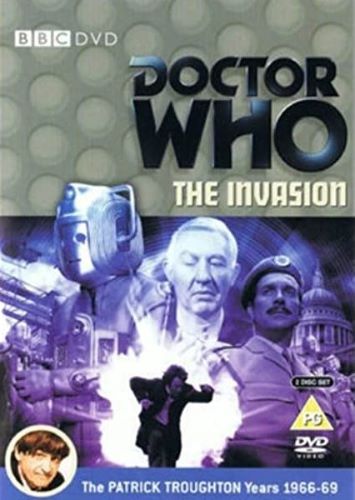
The Invasion is the third serial of Season 6 of the classic Doctor Who series, consisting of eight episodes. It was originally broadcast from 2 November to 21 December 1968. It was written by Derrick Sherwin from a story by Kit Pedler, and directed by Douglas Camfield The serial stars Patrick Troughton as the Doctor, Frazer Hines as Jamie McCrimmon, Wendy Padbury as Zoe Heriot, Nicholas Courtney as Brigadier Lethbridge-Stewart, Kevin Stoney as Tobias Vaughn, and Peter Halliday as Packer.
The TARDIS arrives in late-1960s London, where a powerful company called International Electromatics hides strange secrets and people go missing. The Doctor and his friends link up with the newly formed UNIT under the Brigadier and follow clues from a young photographer to factories, computers, and guarded warehouses. Behind it all is Vaughn, who plans to use the Cybermen to take control of Earth, while the Cybermen prepare a mass invasion through the city’s sewers.
Episodes 1 and 4 were missing for a long time, but animated reconstructions were released in 2006, allowing the complete story to be viewed.
Episode 1
The TARDIS lands in late-1960s London with a fault the Doctor can’t fix without modern parts. He heads to Professor Travers’s old address, hoping for help, but finds a fashion shoot in progress. The flat now belongs to Isobel Watkins, niece of electronics genius Professor Watkins. Travers is abroad; Watkins works for a vast conglomerate called International Electromatics.
Isobel hasn’t seen her uncle for days. The Doctor, Jamie, and Zoe try IE’s fortress-like HQ and meet the velvet-voiced managing director, Tobias Vaughn, and his thuggish security chief, Packer. Vaughn smiles too much and offers to repair the Doctor’s circuit, if they’ll come back tomorrow. The Doctor refuses to leave it and prowls the building; Packer’s men close in. A car screeches up. Army plainclothes agents appear and whisk the travellers to a hidden HQ.
Colonel (now Brigadier) Lethbridge-Stewart of UNIT steps out, older, cooler, and in charge of an investigation into IE’s secretive operations. People who question the company vanish. Vaughn’s private trucks run at odd hours. Somewhere inside IE, Professor Watkins is being “looked after.” The Brigadier wants proof; the Doctor wants his circuit back; Isobel wants her uncle. Outside, IE vans roll through the night like silent chess pieces taking squares.
Episode 2
UNIT sets surveillance on IE while the Doctor tests odd components pulled from IE products: tiny integrated circuits that don’t match any catalogue. Vaughn gives a televised tour, reassuring and omnipresent, while privately ordering Packer to “discourage” snoops. Zoe and Isobel refuse to be sidelined; they march to IE with a story about an interview and end up diverted to a medical wing with smiling staff and locked doors.
The Doctor and Jamie slip into the loading bays and ride a freight lift up into a maze of corridors, dodging Packer’s patrols. In a glassed lab the Doctor glimpses Watkins building a machine that induces intense mental feedback. Watkins calls it a teaching aid; the fear in his eyes says coercion. Vaughn glides in, all charm and pressure. He hints at a “partnership” with forces that will reorder the world and tells Packer to deal with the intruders.
An alarm howls. Jamie yanks the Doctor into a ventilation shaft; boots thunder past. In the safe flat, a shaken Isobel doesn’t return. UNIT triangulates her last location to the IE block. The Brigadier authorises a covert snatch. Across town, a sealed storeroom hums. Vaughn stands before tall crates and listens to something reply from inside his skull.
Episode 3
A UNIT team raids the medical wing; Zoe and Isobel are hustled out under gunfire and indignation. The Brigadier wants hard evidence, so the Doctor proposes a proof-by-numbers: push IE’s central computer with questions it can’t plausibly answer. Zoe, grinning, writes a program that forces the machine to reveal hidden data paths. IE’s system buckles and auto-alerts security.
In the confusion the Doctor and Jamie tail a “high-priority consignment” to a riverside depot. Inside, crates throb with a faint signal. Jamie cracks one: and stares at a steel, expressionless face packed upright in straw. A Cyberman. The lid slams; Packer’s men swarm. They fight clear and sprint through back alleys to a waiting UNIT van. In his penthouse, Vaughn takes a call on a black, organic-looking box.
A flat, pitiless voice answers. He is hosting their forces: temporarily. Professor Watkins finishes a prototype of his machine; Vaughn demonstrates it on him, a surge of agony that drops Watkins to his knees, then smiles and switches it off. With the device, he can hurt what feels nothing. The Doctor briefs UNIT: IE is an entry point for a Cyberman invasion. The Brigadier starts moving troops, quietly. In the sewers beneath London, metal feet wake and turn.
Episode 4
UNIT probes the sewers to confirm the threat. The Brigadier leads from a map; Captain Turner takes squads into the tunnels with Jamie and a camera. The air tastes of oil. A soldier vanishes around a bend: then a blast, a scream, and a shape fills the passage: a Cyberman, larger than memory in the torchlight. The patrol retreats under covering fire. On the surface, Vaughn receives his “allies” in a hidden control room.
He is part machine himself now, with alien circuitry grafted into his body to damp emotion. He thinks he can play both sides. He orders Packer to keep Watkins alive; the professor’s machine will be his lever against the Cybermen when the time comes. Isobel, furious at being told to “leave it to the men,” proposes proof the press can’t ignore: a photograph of a Cyberman.
She, Zoe, and a UNIT corporal bait one up from a sewer grille and nearly pay with their lives; the shot is shaky but undeniable. The Doctor studies micro-circuits seeded through IE devices worldwide, each a node for a control signal. The plan clicks into place: at a chosen hour, a carrier wave will stupefy humanity while Cybermen deploy. Vaughn thinks he’ll seize command afterward. The Doctor thinks London has days at best.
Episode 5
Dawn. Radios hiss and then fall silent. A pulsing tone bleeds through telephones, televisions, and every IE circuit. Across London people slump where they stand. In the streets, manhole covers lift; ranks of Cybermen climb out and march between buses and black cabs, unstoppable and indifferent. UNIT is ready in pockets: ear-defenders, jammers, and orders to avoid direct firefights. But the scale is daunting.
The Doctor and Zoe finish a portable “anti-signal” unit; Turner’s teams deploy them to keep defensive islands awake. Vaughn beams as his gambit begins, then receives new orders: Earth will be processed; human leadership is irrelevant. For the first time, anger cracks his veneer. The Brigadier needs two blows: destroy the transmitter in IE’s London hub and knock out the orbiting Cyber-ship that is amplifying the signal.
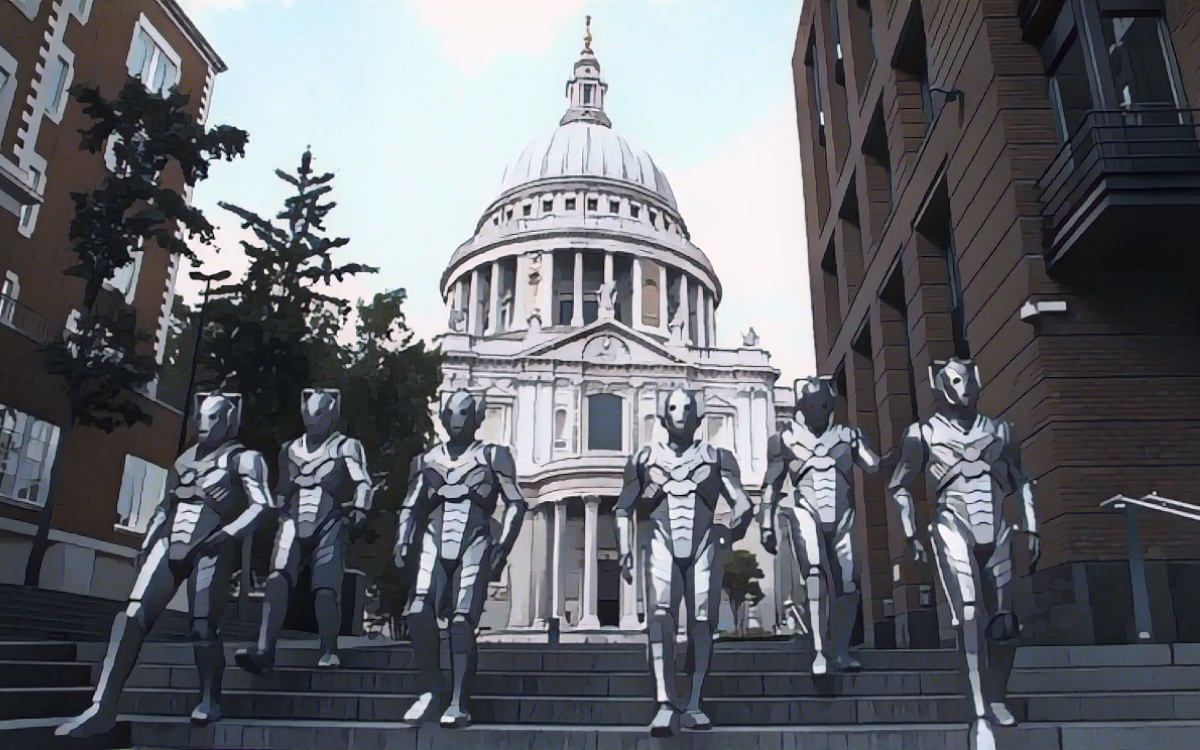
A missile base can do the latter if someone can talk them through jamming and target locks. Zoe sits at the radio and, voice steady, walks the operators through calculations. The first rocket lifts. The Doctor, Jamie, and Turner head for IE’s tower with Watkins’s machine in a crate: pain for creatures that claim to feel none. In the city, a stubborn photograph splashes front pages: a Cyberman on St Paul’s steps.
Episode 6
Airstrikes hammer IE depots while ground teams skirmish with Cyber patrols. Packer turns the HQ into a bunker; Vaughn paces like a general betrayed by his mercenaries. The Doctor and Jamie fight up floor by floor, ducking through offices as Packer’s men trade fire with UNIT. They find Watkins, bruised but fierce, and calibrate his machine against a captured Cyberman. The blast makes it stagger and scream, proof that something like pain can reach them.
Zoe directs a second salvo to catch the Cyber-ship as it slews to avoid debris; vapour trails stitch the sky. Isobel and Sergeant Benton improvise a mobile lab in Travers’s flat, wiring extra jammers to keep civilian clusters awake. In the sewers, Cybermen regroup for a push toward the river bridges. Vaughn calls the Doctor and offers a bargain: help him break the Cyber control and he will, in turn, help stop the invasion.
The Brigadier snarls no deals; the Doctor says yes, because the transmitter won’t fall without someone inside. Packer bursts in on Vaughn mid-call; Vaughn’s patience snaps and he fires Watkins’s device at his own chief enforcer. Packer collapses. Vaughn looks at his shaking hand and decides he’d rather not rule a world than lose it to steel.
Episode 7
The Cyber-ship dips to deploy a “megaton bomb” if resistance continues. Zoe’s math, tight as wire, gives the missile base one last intercept solution. The Doctor and Vaughn, an uneasy pair, penetrate IE’s core. Cybermen stride the corridors; Vaughn turns the machine on them with savage delight, buying inches as they close. Watkins slips out with Turner to rally UNIT troops.
At the transmitter room a Cyber-Controller confronts them, promising assimilation; Vaughn rages that there was to be partnership. He fires point-blank, shredding the unit, and a dozen blasts answer. Vaughn falls, human again in the instant before he dies, having chosen his enemy. The Doctor dives for the control rack and yanks cables; the carrier stutters. On the radio, Zoe counts down a firing window. Rockets streak and blossom; the orbiting amplifier goes to ash.
Across the city, the hypnotic tone dies. People wake in confusion as Cybermen falter and lose coordination. The Brigadier orders a push through IE’s works to the main transmitter. Jamie and Turner bulldoze a path with grenades and grit. In the wrecked hub, the Doctor cracks the last casing and pulls the plug. The network goes dark. For the first time all day, the city breathes.
Episode 8
Mop-up turns ugly in pockets. Cornered Cybermen fight to the end, but the invasion breaks. UNIT clears the sewers and demolishes IE’s remaining nodes. Survivors stumble into sunlight as sirens wind down. Watkins embraces Isobel and promises never again to build something he can’t control. The Brigadier offers the Doctor formal thanks and a quiet invitation to be “on call” if trouble like this returns.
Zoe receives shy salutes from hardened operators who watched her save a continent by arithmetic. In a final spasm, a damaged Cyber platoon tries to retake the transmitter; Benton’s squad pins them while the Doctor uses Watkins’s device one last time, a brutal pulse that drops the metal ranks where they stand. IE’s tower, hollowed by fire, collapses in a curtain of glass. News bulletins call it “The Invasion”: capital letters earned.
In Travers’s flat, Isobel develops her film and laughs at a shot of Jamie gawping at a mannequin; Jamie insists it moved. The Doctor slips his repaired circuit into place and listens to the TARDIS purr. Goodbyes are brisk and warm; there will be other crises. As the police box fades from a quiet mews, the Brigadier looks up at the sky, as if already expecting the next impossible thing.
Themes
As a sleek Earthbound epic, The Invasion sits near the summit of the Troughton years. It is less mythic than The War Games but every bit as gripping as The Web of Fear, and arguably the most “modern” Cybermen story of the 1960s.
Its scale, urban paranoia, and the Doctor–Jamie–Zoe trio at full charge put it shoulder-to-shoulder with The Tomb of the Cybermen and just a notch below later heavy hitters like Earthshock. If The Mind Robber proves the era can dream, The Invasion proves it can stride: confident, cinematic, and influential.
Linking past and future, it follows directly from The Mind Robber and hands off to The Krotons, but its real legacy is the consolidation of UNIT and the elevation of Lethbridge-Stewart to Brigadier: threads that run through Spearhead from Space, Doctor Who and the Silurians, The Ambassadors of Death, and Inferno. Jamie’s claim to have seen a mannequin move echoes ahead to The Terror of the Autons.
Its covert-Cybermen playbook refines the menace first seen in The Tenth Planet and The Moonbase and echoes ahead to Revenge of the Cybermen, Rise of the Cybermen/The Age of Steel, and Army of Ghosts/Doomsday. In that sense, The Invasion is both culmination and launchpad: it closes the wandering 1960s with purpose and sketches the grounded, UNIT-era rhythm the series will ride into the 1970s.
.
This is a chapter from Craig Hill’s book “Doctor Who – The Second Doctor”, chronicling every episode featuring the Second Doctor. It is available on Amazon.
.
To view the list of other Doctor Who serials, please click this link
Doctor Who Episode Guides for Sale on Amazon
Step aboard the TARDIS and journey across the universe with every incarnation of The Doctor in this series of unofficial Doctor Who episode companions.
This collection of twelve books explores every televised adventure of the Time Lord’s lives.
Each volume in the series delves into a different Doctor’s era, offering detailed episode guides, behind-the-scenes insights, character profiles, and story synopses.
Once you have clicked the link, choose which book you want, and then whether you want to buy the Kindle (eBook) or Paperback versions.
Previews are available before you buy.

Visit the Australian Book and Language Studio
Discover more from Craig Hill
Subscribe to get the latest posts sent to your email.
 Craig Hill