

.
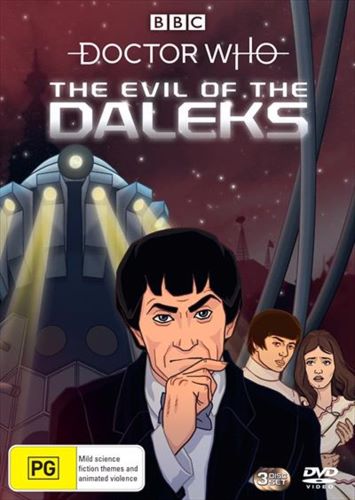
The Evil of the Daleks is the ninth and final serial of Season 4 of the classic Doctor Who series. Originally broadcast in seven weekly parts from 20 May to 1 July 1967. It was written by David Whitaker and directed by Derek Martinus It stars Patrick Troughton as the Doctor, Frazer Hines as Jamie McCrimmon, Deborah Watling as Victoria Waterfield, Marius Goring as Theodore Maxtible, and John Bailey as Edward Waterfield.
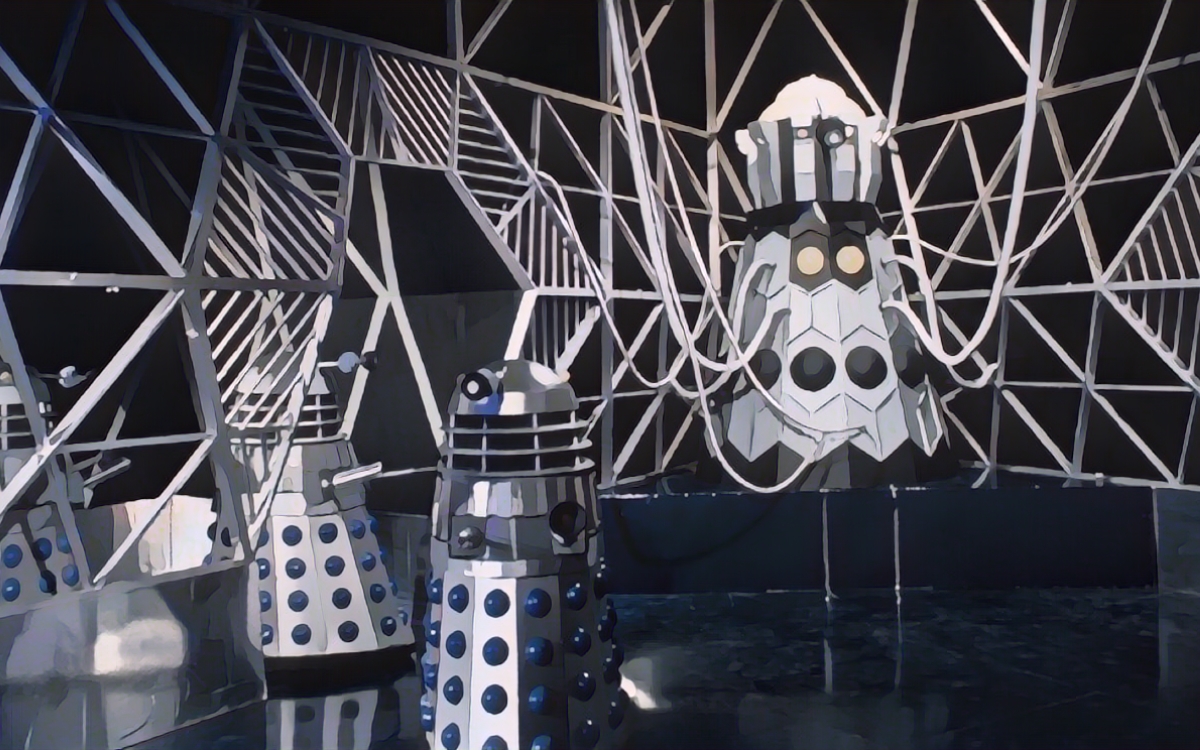
The adventure begins in a London antique shop with brand-new Victorian curios, leading the Doctor and Jamie into a trap and back to 1866, where a terrified scientist and his ambitious partner serve the Daleks. Forced to help extract the “Human Factor,” the Doctor plays a quiet game against the Daleks while Jamie braves secret passages and forms an unlikely alliance to rescue Victoria. The trail ends on Skaro, in the shadow of the Dalek Emperor, where experiments spark a Dalek civil war and the Doctor faces the price of victory. All episodes except Episode 2 are missing from the BBC archives, but the entire serial has been reconstructed using animation and audio recordings.
Episode 1
The TARDIS has been stolen, and the trail draws the Doctor and Jamie to a London antiques shop filled with immaculate “Victorian” pieces that look too new to be old. The owner, Edward Waterfield, is nervous and evasive; a burglar named Kennedy breaks in after hours and is killed by a squat shape that glides from the shadows.
The Doctor recognises the smell of oil and the scorched pattern on the floor. He and Jamie are lured back to the shop, drugged, and wake in another time. They find themselves in a great house in 1866, its cellars humming with modern machinery and its corridors patrolled by servants who flinch at unseen masters. Waterfield admits he is out of his depth. He has a daughter, Victoria, held somewhere in the house; he is forced to obey or she dies.
The Doctor follows a metallic clatter to a hidden laboratory and sees the truth: Daleks have taken control of Waterfield’s experiments in time travel. They demand the Doctor’s help with a project only he can complete: an investigation into the “Human Factor.” If he refuses, Victoria will be exterminated. The Doctor studies their setup, notes their impatience, and agrees: while quietly starting a plan of his own.
Episode 2
Waterfield brings the Doctor to his partner, the wealthy experimenter Theodore Maxtible, who dreams of alchemy and reputation. In the cellars, a Dalek barks orders: the Doctor must identify the qualities that make humans unpredictable and victorious (courage, mercy, loyalty) and distil them into a code the Daleks can analyse. To generate the data, the Doctor must manipulate Jamie into a genuine rescue attempt without telling him the truth.
Bitterly, he sets the board. Victoria is moved through the house like bait; traps are primed; allies are placed where they will test Jamie’s instincts. Jamie is furious when the Doctor refuses to help openly, then goes anyway. He fights and outwits guards, and clashes with Kemel, Maxtible’s hired strongman. In a brutal struggle on a narrow gallery Jamie spares Kemel’s life, and the two shake a wary truce that becomes fast friendship.
Above stairs, Maxtible entertains guests while the house groans with hidden devices. Waterfield wavers, ashamed of his part. The Doctor feeds the Daleks exactly what they want (observations, recordings, measurements) while quietly editing the results. He is looking for a way to turn their experiment back on them. The first pattern forms on his slate, a human heartbeat hidden amid cold, mechanical lines.
Episode 3
Jamie and Kemel move together through the house’s deadly gauntlet: a corridor that electrifies with a hum, a pit masked by carpet, a rope bridge that snaps under the slightest strain. Jamie chooses again and again to protect, not destroy, and Kemel shields him with easy strength. The Doctor watches from the lab, sick at heart yet determined, as instruments trace Jamie’s decisions.
In the drawing room, Arthur Terrall, engaged to Maxtible’s daughter Ruth, behaves like a man pulled by invisible strings. The servants whisper of voices in the walls. A rough local, hired to snoop, vanishes screaming into the dark: another casualty of the Daleks’ patience. Jamie finally reaches Victoria’s cell; the reunion is brief, tender, and immediately interrupted as a Dalek glides between them. Kemel hurls his weight into it; the three flee into a high gallery where another trap waits.
Below, Waterfield pleads with the Doctor to stop. The Doctor cannot: yet. His figures are nearly complete. He marks three traits in bold: curiosity, pity, and the spark that makes a friend. In the cellar, the Daleks demand the formula. The Doctor says he will need test subjects. They bring casings to heel and accept the impossible premise: Daleks will receive the Human Factor.
Episode 4
The Doctor encodes the Human Factor into three Daleks. When they emerge from the process, something is different. They circle him, chant his name with delighted certainty: (“Doctor! Doctor!”) and spin like children trying out a new game. They laugh, ask “Why?”, and announce that Jamie is their friend. The rigid command hierarchy shudders.
One Dalek bumps another and apologises. The watching Daleks recoil at this heresy; the Doctor sees a crack opening. Maxtible recoils as well, then leans in with greed. The Daleks promise him the secret of transmuting metal to gold if he helps deliver the Doctor to their world. In a scramble through the house, the rebels play chase while guards panic, and Victoria is snatched back by a loyal Dalek unit.
The Doctor, Waterfield, and Maxtible are herded into the time apparatus; Jamie pounds on the locked laboratory door too late. In a giddily awful moment, Maxtible chooses ambition over honour and steps forward smiling as the Daleks prepare the journey. The chamber fills with light. The house groans. When the glare clears, the Doctor is gone, borne with his captors to the heart of the enemy Meanwhile Jamie and Victoria are left separated and desperate in the wreckage above.
Episode 5
Skaro: a city of metal domes and whispering corridors. The Doctor is marched beneath a vast, pulsing shape: the Dalek Emperor, a living brain like a fortress. It declares the true purpose of the experiment. The Human Factor was a feint. The Daleks have developed a “Dalek Factor,” an imprint of absolute obedience they will spread through time to remake humanity in their image.
The Doctor is ordered through an arch that will infuse him; he staggers, and remains himself. He is not human in the way they calculated. He bows, feigns submission, and bargains time to “calibrate” the arch for Earth subjects. Meanwhile, he seeks out the three human-factor Daleks (Alpha, Beta, and Omega) now curious, playful, and quietly loyal to him. He seeds questions among other patrols: Why obey? What is a friend?
Waterfield watches in horror as Maxtible allows the Emperor to burn the Dalek Factor into his mind. The once-grand experimenter returns glass-eyed, chanting the creed of conquest. Victoria is brought to the arch to force the Doctor’s hand. He nods as if defeated and, unseen, adjusts the settings. If his plan holds, the arch will become the Daleks’ undoing. If it fails, Earth will kneel under iron voices forever.
Episode 6
The city tightens around the Doctor’s deception. Maxtible, now a Dalek disciple, stalks the corridors and lures humans toward the arch; those who pass emerge with flattened voices and deadened will. The Doctor widens his circle of corruption (in the best sense) teaching the humanised Daleks to make choices. They take names, form tiny alliances, and begin to resist orders.
One hesitates at the word “exterminate” and lowers its gunstick. Another asks what a “game” is and wants to play. Patrol leaders report anomalies; the Emperor booms commands. In a laboratory lined with coils, the Doctor rigs relays to twist the arch’s influence, leaking questions into loyal circuits and shielding the few humans he can. Jamie arrives on Skaro with Kemel’s help and blusters through guards to find Victoria. Waterfield risks everything to shelter them. Alarms rise.
A Dalek sees its reflection and pauses as if startled by itself. The Doctor knows the moment has come. He throws the final switch. The arch floods the network with conflict: human curiosity spliced into Dalek certainty. Loyalists and the human-factor Daleks square off in the main hall. The first shot is fired by a unit that refuses to obey an order. The city erupts into civil war.
Episode 7
Battle rages from dome to sub-basement. Daleks wheel and fire at their own kind, voices rising from monotone to shriek. The Emperor bellows commands to restore order; its guard forms a ring and is torn apart by rebels who shout the word they have learned: “Why?” Maxtible, raving about gold and glory, attacks Jamie and is hurled aside by a blast not meant for him.
The Doctor races to the Emperor’s chamber with Waterfield at his side and plants charges among the consoles. A loyal Dalek swings its gunstick toward the Doctor; Waterfield leaps and takes the shot, dying with a single plea: take care of Victoria. The Emperor’s casing splits and burns. Fire climbs the walls; the city begins to die. The Doctor pulls Jamie and Victoria clear as a tide of flame rolls down the corridors and Dalek voices gutter out.
Outside, amid the ash of Skaro’s skyline, he says what he believes in that moment: this is the end of the Daleks. Victoria weeps for her father; the Doctor, stricken, offers her a place with them. She accepts, hand in Jamie’s, grief and bravery mixed. The TARDIS doors swing open. Behind them, Skaro burns; ahead, the sound of time begins again.
Themes
As a finale for Season 4, The Evil of the Daleks feels like a summit: grand, eerie, and emotionally sharp. It stands just a rung below the all-timer Genesis of the Daleks and shoulder-to-shoulder with The Power of the Daleks and Remembrance of the Daleks for scope and ingenuity. The “Human Factor” vs “Dalek Factor,” the vastness of Skaro, and the chill presence of the Dalek Emperor give it an operatic heft rare in the 1960s.
It’s more disciplined than The Underwater Menace and more expansive than The Moonbase or The Macra Terror, while still keeping Patrick Troughton’s mercurial Doctor at the centre. As capstones go, it’s a classic: ambitious, strange, and satisfying.
Linking past and future, it pays off seeds from The Daleks and The Dalek Invasion of Earth, while continuing the moral chess game begun in The Power of the Daleks. Its “final end” sparks the civil war that later echoes through Resurrection of the Daleks and is refracted anew in Remembrance of the Daleks.
The Dalek Emperor’s myth lingers into The Parting of the Ways, while the rescue of Victoria Waterfield sets the tone for the very next adventure, The Tomb of the Cybermen. In this way, The Evil of the Daleks closes one era with authority and opens another with promise: a hinge between the classic Dalek saga and the restless reinventions still to come.
.
This is a chapter from Craig Hill’s book “Doctor Who – The Second Doctor”, chronicling every episode featuring the Second Doctor. It is available on Amazon.
.
To view the list of other Doctor Who serials, please click this link
Doctor Who Episode Guides for Sale on Amazon
Step aboard the TARDIS and journey across the universe with every incarnation of The Doctor in this series of unofficial Doctor Who episode companions.
This collection of twelve books explores every televised adventure of the Time Lord’s lives.
Each volume in the series delves into a different Doctor’s era, offering detailed episode guides, behind-the-scenes insights, character profiles, and story synopses.
Once you have clicked the link, choose which book you want, and then whether you want to buy the Kindle (eBook) or Paperback versions.
Previews are available before you buy.

Visit the Australian Book and Language Studio
Discover more from Craig Hill
Subscribe to get the latest posts sent to your email.
 Craig Hill