


As a white man who has lived and worked closely with the Aboriginal people over many years, in management positions, I will be voting Yes for the Voice to Parliament. I have seen first-hand that Indigenous people have been let down by “advisory groups” run by non-Indigenous people and, where we have failed, I strongly believe they will succeed.
My first professional dealings with Aboriginal people was as a prison officer in NSW back in 1987. I became concerned that 17% of the prison population were Indigenous people, whereas they only made up 3% of the Australian population. It seemed that many Indigenous people were incarcerated for “crimes” that solicited only a slap on the wrist for non-Indigenous people.
After leaving the prisons, I formed and chaired an Aboriginal Reconciliation Group in Goulburn, NSW, in 1997. At the initial meeting, over 90 local citizens turned up, mostly in support. However, at this meeting I was approached by a sergeant from the local police, who I knew quite well, who “suggested” to me that such a group might not be a good idea.
This sergeant was later involved in arresting me 14 times before getting a conviction in 1999. I was held in custody for six weeks before receiving a $30 fine and a two-year good behaviour bond. The sergeant made it known that certain members of the local police force wanted the group shut down. The magistrate at my final trial imposed the condition in the good behaviour bond that I not enter NSW for a period of two years. This effectively removed me from my position as chairman of the group, and sent a warning to others in the group.
A couple of months later, in the year 2000, I started work as Director of Studies (TAFE) on a large Aboriginal community in remote Central Queensland. I was based inside the local high school, where we set up a system whereby high school students could study TAFE qualifications as part of their high school studies. This system, devised by Murris, was later adopted Australia-wide as VET in Schools.
Another system we started was to appoint Indigenous Justices of the Peace to hear minor offences that were previously heard by white judges in the courts. This was later adopted and legislated by the Queensland Government in 2002 as the Murri Courts.
Instead of sentencing minor offenders to such humiliation as picking up papers on the side of the road, the offenders had the choice to spend their community service hours studying at TAFE. The local police estimated this cut recidivism by about 50%. The Murris designed this system, and it proved that the Murris knew what was best for their own people.
In this position, I also saw first-hand how non-Indigenous people exploit the system to enrich themselves at the expense of the Indigenous people they are supposed to be helping. Millions of dollars was allocated to education and other services on this community, but most of it never reached the community itself. The vast majority went to white administrators and “consultants” in the cities. It seemed to me that the Aboriginal people should be the ones administering the money, and the administration should be done from the community.
In 2001 I went to Rockhampton, where I worked for the Federal Education Department tutoring Aboriginal students after school hours. I saw again how the white administrators of this system, and the consultants, profited most from it.
In 2002, I took up the position of manager of an Aboriginal Corporation in rural NSW, run through ATSIC, with an annual budget of over $10 million. Most of this $10 million never reached the people it was supposed to help. Again, the white administrators and consultants in the cities took a very large percentage of it. While it was true a small number of people in ATSIC profited to some extent, my personal experience was that the white people in charge profited more.
Between 2005-2007 I worked for Big Issue Magazine and Senator Andrew Bartlett in Brisbane, housing the homeless, and found that a high percentage of homeless people were Indigenous. I wrote several articles about this for various newspapers, and I was recognised by Vodafone and the Queensland Government for my work in this field.
I spoke at many seminars organised by the Queensland Government, Brisbane City Council, private corporations and community groups. I also again found that most of the money being allocated to housing for Aboriginal people was actually going to the white people administering the system.
It now amazes me that the people opposed to a Voice to Parliament want this system to continue – white people administering the services and profiting handsomely from it. ATSIC, for all its faults, was the closest we have ever come to having unified organisation that benefitted Aboriginal people to any real effect. Indeed, former Senator Amanda Vanstone this year admitted she was wrong to shut it down when she was in government.
And this is the exact reason we need a Voice to Parliament embedded in the Constitution – so it can’t be shut down. There have been many organisations similar to ATSIC over the last five decades. Most of them were run by white men who profited handsomely from them, and most of them were shut down for political reasons when the government changed from one party to the other. This leaves the Aboriginal people without representation.
It makes sense, therefore, that the laws pertaining to these organisations be advised upon by the Aboriginal people – the advice on such laws from non-Indigenous people has proved to be a failure. And that is why, on 14 October, I will be voting Yes for a Voice to Parliament.
Craig Hill is a Brisbane-based Social Justice Campaigner, Writer, Teacher and Business Consultant. He has campaigned for social justice in Australia, promoted human rights in China and worked with the homeless in Honolulu. He holds a Graduate Certificate in Business, a Graduate Certificate in Education and a degree in Management. He is also the General Manager of The Australian Business and Leadership School.
If you liked this article, please click “Subscribe To My Blog” in the sidebar to receive an email each time a new article is published.
First Published in Independent Australia
ADVERTISEMENT
Advance Institute of Business has nationally recognised Certificate and Diploma courses available to help you progress in your career, as well as corporate training courses for organisations.
Join Advance Institute of Business’ free online open day on Saturday 14 October at 10:00 am AEDT
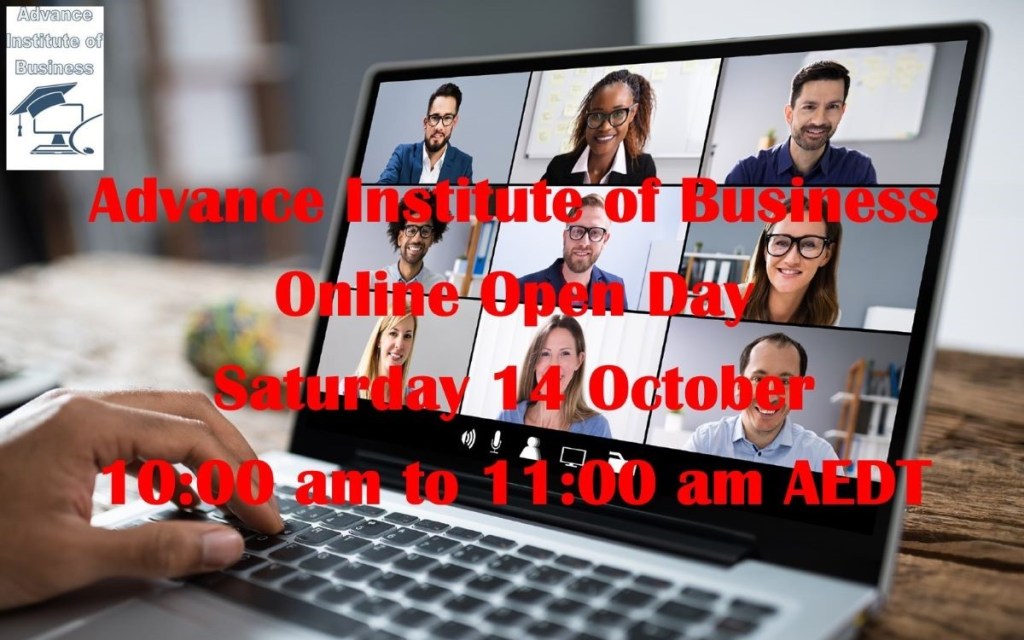
We have the following Certificate and Diploma courses available for your career development:
Leadership and Management
Business
- BSB30120 Certificate III in Business
- BSB40120 Certificate IV in Business
- BSB50120 Diploma of Business
Entrepreneurship and New Business
- BSB30220 Certificate III in Entrepreneurship and New Business
- BSB40320 Certificate IV in Entrepreneurship and New Business
Project Management
Accounting and Bookkeeping
Other Courses
25% discount on all courses for Centrelink and Veteran’s Affairs recipients.
All courses are nationally recognised through our Registered Training Organisation partner IPS Institute (RTO # 32186). We also have an advisory service on where to study in Australia.
Discover more from Craig Hill
Subscribe to get the latest posts sent to your email.
 Craig Hill